“It Was Sam’s First View of a Battle of Men Against Men and He Did Not Like It Much.” Tolkien Brings His Memories of War to His Great Tale.

The Two Towers by J.R.R Tolkien (Harper Collins 1991, 2007) pp.858-865

Sam is already battle hardened standing by Frodo at the attack of the Nazgûl at Weathertop, at the attack of wargs near the doors of Moria and again within Moria at the Chamber of Mazarbul when orcs and trolls assailed the Fellowship. It is not battle itself that affects him so deeply, that realisation that someone is your enemy and wishes you harm, wishes even to kill you, it is, as the English poet Wilfred Owen put it, “the pity of war” that touches his heart when the Rangers of Ithilien ambush the Men of Harad as they march northwards to the Black Gate of Mordor.
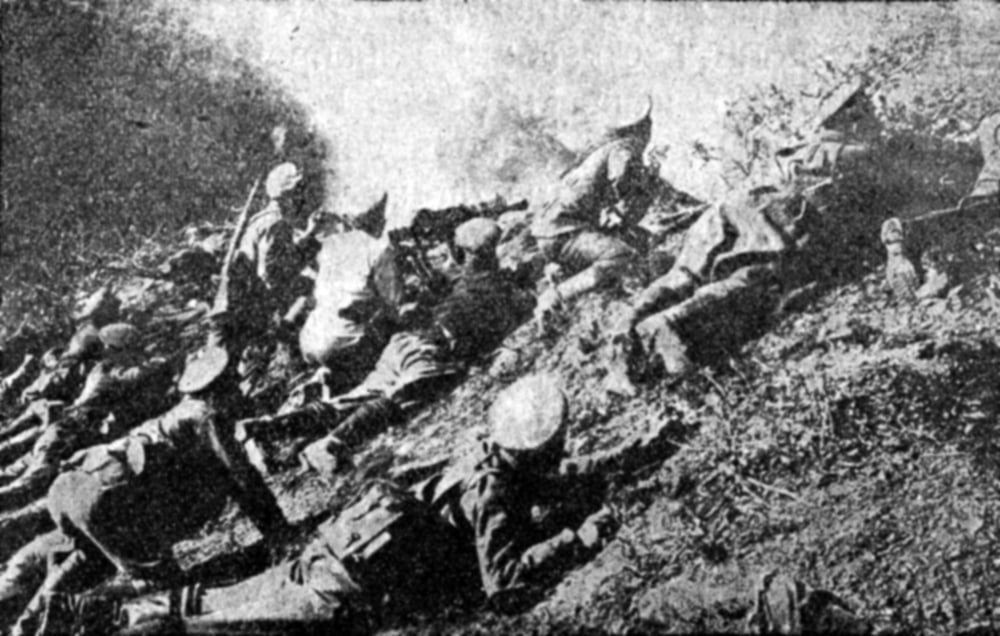
War in the trenches of the First World War of 1914-18

There are few passages within The Lord of the Rings that have the feel of the war literature of the 20th century as this one. Here we are reminded, if we need it, that Tolkien was writing a novel of his century and not a mere pastiche of medieval heroic literature. Tolkien was himself a veteran of the war in the trenches in France and took part in the Battle of the Somme that began on the 1st of July 1916 in northern France and during which a million men were either killed or wounded. The memory of that battle still casts a shadow over western Europe over a hundred years after it took place. My father gave us very little education in any deliberate sense; most of what I learned from him I did by observation rather than because he told it to me, but he was anxious to tell us of the horror of war and how a war in Europe should never be repeated. He himself was a veteran of the Normandy landings of June 1944 and his father of the naval Battle of Jutland of May 1916 and the memory of war played an important part in my education.

The capture of Frodo and Sam by Faramir and his men takes place just before the ambush begins and it is a measure of Faramir, the captain of war, that he does not treat his captives as mere irrelevances in the face of the serious matters of killing and being killed. In the few moments available to him he allows Frodo to tell his story before assigning two of his men to guard them. As they wait for battle to begin Mablung and Damrod speak of their leader and the respect in which they hold him. “He leads now in all perilous ventures,” they tell Frodo and Sam, and they are proud to follow him.

See ‘Faramir the Captain’ by Anke Eissman. Note how relaxed most of his men are. He is in charge and they don’t need to worry about what they have to do.

Tolkien gives us no overview of the battle that follows. We see it through Sam’s eyes, listening to the sound of steel against steel or metal cap, like the sound of “a hundred blacksmiths all smithying together”. We feel the terror as an oliphant charges straight towards them, veering away from them at the very last moment and we see a young warrior of Harad fall dead at their feet. Through all this their main ambition is to survive. Doubtless if battle had overtaken them they would have fought bravely but heroic deeds are not their first concern. This too is true to Tolkien’s memories of the trenches and of modern warfare.

The moment when Sam looks at the dead warrior is deeply moving. We are not shown war from the perspective of the war historian or the general in the staff room. We see it through the eyes of one man alongside other men. “It was Sam’s first view of a battle of Men against Men, and he did not like it much. He wondered what the man’s name was and where he came from; and if was really evil of heart, or what lies and threats had led him on the long march from his home; and if he would not really rather have stayed there in peace”.

Robert Runcie, Archbishop of Canterbury between 1980 and 1991, was a tank commander during the Second World War, winning the Military Cross, the second most important medal for valour that can be offered to the British Armed Forces for rescuing one of his wounded men from a crippled tank while under heavy enemy fire. He was greatly criticised by politicians for expressing sympathy and compassion for Argentine soldiers after the Falklands War of 1982. What moved him to speak of his pity was his memory of an incident in which his tank took out a German tank in battle and how, as was required of him, he checked to see if there were any survivors. He remembered looking into the tank and the dead young men within it and thinking of their mothers, wives and girlfriends who would never see them again. It was a Sam Gamgee moment and it remained with him for the rest of his life.

I haven’t found a photograph of Robert Runcie from the Second World War. You can tell that this is a photo of a British tank on show for the “top brass”, senior British officers, not one in the heat of battle.

“Now if I’ve Gone and Brought Trouble, I’ll Never Forgive Myself.” What Kind of Trouble Does Sam Gamgee’s Fire Bring to The Hobbits in Ithilien?

The Two Towers by J.R.R Tolkien (Harper Collins 1991, 2007) pp. 851-861

I am glad that Frodo and Sam were able to eat the rabbits that Gollum caught before they were caught by the men of Gondor in the woodlands of Ithilien and I am glad that they were able to rest upon a bed of fern that must have felt like the greatest luxury. To be well fed and well rested is of great help when you need to keep your wits about you. I am only sorry that they were not able to smoke a pipe as well but then perhaps they did not have their pipes or pipeweed with them.

Frodo and Sam are in Ithilien, the garden of Gondor, Although it bears the unmistakable signs of Mordor upon it after a few years of occupation it remains a place of beauty and of plenty too. They are surrounded by herbs that grow in profusion and perfume the air, and there are game creatures about that Sam can cook.

The hobbits have eaten nothing more than lembas for about a week now and although it is wonderfully sustaining and even more so when it isn’t mingled with any other kind of food lembas cannot satisfy them in the particular way that a well cooked meal could and Sam, in particular, desires that particular satisfaction.

Perhaps it was always unwise to light a fire in a place where enemies might be lurking, certainly Gollum thinks so, but a fire is necessary if you are going to cook, and maybe if Sam hadn’t relaxed a little too much after eating a good meal then he would not have committed the cardinal error that all children are warned against when learning to make a campfire. Never leave it unattended.

But Sam did make this mistake and a small brand from the fire did start a blaze in a pile of fern lying nearby and the smoke from the fire was spotted by the Rangers of Ithilien, and the hobbits were caught.

These Rangers are a company of men from Gondor who are operating behind enemy lines in the woodlands of Ithilien. Their mission is to make sure that the forces of Gondor can never feel completely at ease in this land. They harry and harass their foes and on this day it is their intention to ambush a force that is travelling northwards from Harad to enter Mordor through the Black Gate, just the kind of force that the hobbits saw on the day when Frodo decided to trust Gollum as his guide into the dark land.

The Rangers are commanded by Faramir, son of Denethor, Steward of Gondor, and the brother of Boromir, who had travelled as part of the Fellowship from Rivendell until he fell at Parth Galen as he sought to defend Merry and Pippin from capture by the Uruk-hai of Isengard. And it was this same Boromir that tried to take the Ring from Frodo and so made him take the decision to go on alone to Mordor. As far as Frodo and Sam are concerned Boromir is still alive and Frodo’s last memory of him is of the madness that overcame him and led him to try to seize the Ring by force.

I have long appreciated the depictions of Faramir by the artist, Anke Eissman. Note how he sits on the ground before his captive and does not seek to dominate him by standing, but his authority is still unmistakable.

So at the moment of their capture Frodo and Sam do not know what kind of trouble they are in and Sam does not know whether he will ever be able to forgive himself or whether he will ever get the opportunity to do so. He cannot know that he has fallen into the hands of one of the noblest of all Tolkien’s creations and that much good will come of this encounter.

We might say that the “chance” meeting between the hobbits and Faramir is mere coincidence, if any circumstance in our lives can ever be described with the word, mere. It was the great Swiss psychologist, Carl Jung, who first coined the word, synchronicity, to describe a series of unrelated events that are connected through their meaning and the meeting of the hobbits and Faramir is a profound expression of this. Later, before they parted, Frodo says to Faramir that Elrond had told him that he would find unexpected friendship upon his journey and we will think more of this on another occasion but it is sufficient to say on this occasion that Sam can forgive himself for his “mistake”, if mistake it truly is.

“Suddenly Sam Laughed, For Heart’s Ease Not for Jest.” Frodo and Sam Find Refreshment in Ithilien.

The Two Towers by J.R.R Tolkien (Harper Collins 1991, 2007) pp. 847-851

You can almost feel the relief in Tolkien’s writing as Frodo and Sam leave the dreadful ash pits of the desolate lands before the Black Gate of Mordor and arrive in the fair land of Ithilien, which, although now under the control of the enemy, has not yet been spoiled.

Frodo and Sam, guided by Gollum, are making their way from the Black Gate down towards the crossing place in the road that runs south towards the sea and east-west from Minas Morgul to Osgiliath, the ancient but ruined capital of Gondor. And as they get further away from the horror of lands that have been utterly ruined by Mordor so their mood begins to change.

Tolkien gives us a rich feast of language so that he can do justice to Ithilien, once the garden of Gondor, far enough from the shadow of the Ephel Death, the mountains of Mordor, to be free of them and yet sheltered by those same mountains from the east wind.

Tolkien was not a meteorologist and so he never discourses in detail about the weather in Middle-earth. His geography, and his meteorology too, is first and foremost mythological and so reflects the way in which the peoples of western Europe saw the world about them in the pre-modern world. The West and the great Atlantic ocean always made that direction one of mystery. In Tolkien’s Middle-earth it is the way to Valinor, the way that the Elves take on their journey to Valinor. It is the way to the Grey Havens, that are themselves a crossroads between worlds. In Europe the wind that comes from the West is warmed by the warm current coming out of the Gulf of Mexico and so it moderates the weather right up into the Arctic Circle in the far north of Norway and brings warm rain to the green lands of western Europe and especially, for Tolkien, to the British Isles that were his native lands.

The East, on the other hand, was always the direction from which danger and threat came. Invading armies always came from the East, whether Saxon, Viking or Norman in the British Isles, or the hordes coming out of the steppes of Central Asia, or the Ottoman Turks coming out of the East up the valley of the River Danube. And the weather that comes out of the East comes out of Siberia and there are no mountain ranges in Europe north of the Alps to provide shelter from the cold east wind or to provide defence from invading armies.

Ithilien is thus a land sheltered from the east and open to the south and west, a land of plenty, and Tolkien’s rich feast of language reflects this.

“Many great trees grew there, planted long ago, falling into untended age amid a riot of careless descendents; and groves and thickets there were of tamarisk and pungent terebinth, of olive and bay; and there were junipers and myrtles; and thymes that grew in bushes, or with their woody creeping stems mantled in deep tapestries the hidden stones; sages of many kinds putting forth blue flowers, or red, or pale green; and marjorams and new-sprouting parsleys, and many herbs and scents beyond the garden-lore of Sam.”

Readers will note the sheer length of that sentence with its profusion of semicolons and Tolkien’s pleasure in writing a list. Each shrub and herb is named until we arrive at the limit of Sam, the gardener’s, knowledge, and we are invited into the unknown, not as a place of danger, but a place to be explored so that new pleasures can be experienced and enjoyed. Tolkien sums it all up through a phrase in which, just for a moment, he leaves the language of the north and strays for a moment into the classical Mediterranean world.

“A dishevelled dryad loveliness.”

And Sam laughs, “for heart’s ease not for jest”. Frodo indeed laughed for jest in the ash pit before the Morranon when Sam recited his verse about the oliphaunt, and it lifted his spirit, breaking the spell of despair in which he was held in the long hours of that day. That laughter broke into his darkness but the dark still lay about him. Sam’s laughter is of a different kind. It is an expression of delight, the laughter of heaven. It is as if as Sam breathes in the rich scents of the garden, this is his outbreath.

So we come into the last place of refreshment for the hobbits before they enter the darkness of Mordor, a moment of grace before they are abandoned to the horror that they alone, unaided, must face. They do not know what lies before them but they are able to draw strength from this place because, unlike Gollum, this is how they have trained their hearts.

“Well, Sméagol, The Third Turn May Turn the Best. I Will Come With You.” Frodo Decides to Put His Faith in Gollum.

The Two Towers by J.R.R Tolkien (Harper Collins 1991, 2007) pp. 833-846

The journey to Mordor and to Mount Doom was always an impossible task. While there were other things to think about and problems to solve it was possible to avoid confronting that reality. There was the descent of the Emyn Muil, the passage of the Marshes and the question of what to do about Gollum. All this gave Frodo and Sam something to think about other than the really big thing. But now, as they see the impossibility of entering Mordor through the Black Gate without death or capture the reality hits home.

What would Gandalf have done if he had been with them? Which way would he have gone? Frodo wonders if Gandalf had ever been this way. He knew that Gandalf had once entered the fortress of Dol Guldur in Mirkwood, Sauron’s lesser stronghold, but he doubted if Gandalf had ever been to Mordor. Indeed no-one had ever entered Mordor and lived to tell the tale. No-one except Gollum, and he had been freed in order to search for the Ring.

So it is at this terrible moment just some few yards from the Morranon that the impossibility of the task and his utter inadequacy to undertake it becomes clear to Frodo. Gollum has spoken of another way but for some time they all sit in the hollow where they are hiding in silence.

Elrond had said to Frodo that the task was appointed for him and that Frodo could not find a way then no-one could. As Frodo heard these words that “no-one” probably held little meaning for him and when Elrond had gone on to speak of Hador and Húrin and Túrin and even Beren himself, it probably meant very little to him, except as a cause of some embarrassment, but now Frodo understands what Elrond meant. The task really is for him alone, not for Gandalf or Aragorn or any other of the great, and the task is impossible.

Something has to break into the sheer immensity of this realisation or the story might have ended here. In silence. But something does. It always does. Life goes on around even the most significant events and does not even notice them. First they become aware that, far off, Nazgûl are in the air, and this terrifies them; then they hear more forces arrive from Harad to swell the growing army within Mordor.

Gollum describes what he can see to Frodo and Sam and this leads Sam to think of oliphaunts and he recites a verse that he remembers from his childhood, standing with his hands behind his back just as he would have done as a small child. And just as happened when Sam had recited the tale of the trolls on the journey to Rivendell as the Morgul-blade drew Frodo deeper and deeper into darkness so too now Sam’s simple cheerfulness breaks the spell and Frodo laughs.

It is laughter that enables Frodo to make a choice. Impossibility becomes possibility once again. I do not mean that suddenly Frodo believes that he can achieve his mission, that, as we might now say, he believes in himself again. Frodo never entertained that particular illusion that has become so important in our own time. We may have seen Boromir believing in himself but Frodo just gets on with the job that has been given to him.

But faith does play a vital part in what Frodo decides to do. He decides to trust Gollum. This is not mere naivety on his part. He is well aware of Gollum’s malice and untrustworthiness. But in the face of impossibility, at the moment when this has moved from some abstract form of which he has always been aware to a reality that almost crushed him when he realised it, Gollum offers a way forward.

Gollum’s way is a terrible one and full of treachery. Gandalf would have warned Frodo against it. But Frodo is now aware that there may not be any way into Mordor and that, as Sam grimly puts it, they might as well walk up to the Black Gate and save themselves “a long tramp”. And it is in the light of this realisation that he becomes free to choose. He chooses to go with Gollum and he laughs. The whole thing is ridiculous, impossible, anyway. The whole thing is a joke. And this realisation reawakens hope in Frodo’s heart. At least hope to take the next step.

And then the step after that.

“He’s as Wise as Any, But He’s Soft Hearted, That’s What He Is.” Sam Thinks About Frodo Before The Black Gate of Mordor.

The Two Towers by J.R.R Tolkien (Harper Collins 1991, 2007) pp. 830-842

The opening of the chapter that Tolkien entitled, The Black Gate is Closed, opens with the words “Before the next day dawned their journey to Mordor was over”. Readers will know as they read these words that much of the book lies still before them but to Frodo, and even to Sam, as they gaze upon the Black Gate in all its impregnable strength the journey has come to an end.

And it is a bad end. It is clear to them both that there is no way into Mordor here and that what lies ahead of them is death or capture. Surely here Tolkien is thinking about the dull quiet that would fall in the hearts of men just before they went “over the top” of their own trenches into the “no man’s land” that lay between them and the enemy trenches. Even the distance between them and the Gate, Tolkien describes it as being “but a furlong from their hiding place”, or 220 yards, or two hundred metres, just the kind of distance that it often was between the two sets of trenches on the Western Front. Such a distance would take only a couple of minutes to walk briskly and yet the possibility of even reaching the enemy trenches without being either killed or wounded was small. To each man at such a moment there would be the sense of journey’s end. This at least is how Sam feels and it is through Sam’s eyes that we now see the story as it unfolds.

But now Gollum speaks, pleading with the hobbits not to go this way, not to take the Ring to Him, but to go back home, perhaps even “to give it back to little Sméagol”.

Frodo is absolutely firm that he must do as he has promised and so must go to Mordor and as Sam looks at the man that he both loves and calls, master, all hope dies in his cheerful heart. Long ago, or so it now feels, Tom Bombadil told the hobbits to keep up their “merry hearts”, and Sam has done so, both for him and for Frodo, but now the journey is ended.

But not for Gollum. He speaks of “another way” and pleads with Frodo to listen to him. We might think that in the face of the impossibility that this way, the short walk to the Black Gate, is going to lead to anything but death or capture, that Frodo and Sam would grasp any other possibility with greedy hands but they are so firm in their resolve, and for Sam at least, so untrusting of their guide, that they cannot believe that “another way” can possibly exist.

Sam, at least, does not trust anything that comes from Gollum’s mouth, for Gollum is Sam’s shadow in the starkest sense. Where Sam is loyal and trustworthy Gollum is treacherous. Where Sam is straightforward Gollum is sly. Sam detests him, even nursing the thought in his heart that death might be preferable to any more time in Gollum’s company.

Sam also fears what he calls Frodo’s softheartedness. “He’s as wise as any, but he’s softhearted, that’s what he is.” Sam holds two entirely contradictory beliefs about Frodo in his heart at exactly the same time without any sense that they do contradict. On the one hand Frodo is “as wise as any”, with the possible exception of Gandalf or Bilbo, and there is a sense in which this is true. Both Elrond, Galadriel and Gandalf, too, recognise that Frodo is worthy to undertake his task, that it is more than sheer accident that he is the Ringbearer. But while Sam believes this too, he also believes that Frodo is softhearted, a quality that he loves, and confuses this with softheadedness. It is a mistake that many make and so he is shocked when Frodo displays a very hard head indeed.

Frodo makes it quite clear to Gollum that he heard him when he spoke of giving the Ring back to “little Sméagol”. And he tells him that he will never possess the Ring, ever again, that at the last, he would put on the Ring and if he, “wearing it, were to command you, you would obey, even if it were to leap from a precipice or to cast yourself into the fire”. Is this a prophecy on Frodo’s part? Is this what happens at the Cracks of Doom? As Ringbearer Frodo’s heart, and most certainly his head, is capable of a flinty resolve that shocks even Sam, and terrifies Gollum.

“Lord Sméagol? Gollum The Great? The Gollum!” Sméagol and Gollum Debate What They Should Do About The Ring.

The Two Towers by J.R.R Tolkien (Harper Collins 1991, 2007) pp. 826-830

An essential difference between Peter Jackson’s version of The Lord of the Rings and the story that Tolkien originally told lies in the character of Gollum and the telling of the inner debate between Gollum and Sméagol that Sam overhears.

Sam hears it because Gollum’s inner life is almost laid bare for all to see. I say almost because Gollum is still capable of deception. Sam hears Gollum speak of She and wonders who that might be but does not find out until he encounters Shelob in her lair.

Jackson gives us the same debate that Sam overhears but with a major difference. In his version the debate is between good and evil. He gives us a sense that within the miserable creature that has guided Frodo and Sam through the Dead Marshes almost as far as the Black Gate the possibility remains that good might still triumph. Indeed at this point of the story the good Sméagol does seem to triumph over the evil Gollum and the debate ends with Sméagol crying out “I’m free! I’m free!”

But Tolkien gives us a very different version of this debate. Here we see the same Gollum whose mind has been utterly overthrown by his desire for the Ring. When Gollum thinks about the promise that he made to Frodo to “serve the master of the Precious” all that he thinks about is that if he were to regain the Ring then he would be its master and so would have kept the promise. Sméagol, on the other hand, could never be described in any sense as good. In Tolkien’s version of the debate we see a pathetic cringing figure driven mainly by fear. Fear that there might be terrible consequences if he were to break the promise because the promise is held by the Ring and he fears the Ring above all things, and fear that in trying to take the Ring he might be killed because there are two hobbits and only one of him. Sméagol does have some sense of gratitude to Frodo who took the elven rope off his leg but his goodness goes little further than that. And the debate ends, not with Sméagol’s cry of joy that he is free of the control of the Ring and of his Gollum alter ego but with his hand slowly reaching out to seize the Ring, an action that is only prevented by Sam appearing to wake up.

The Ring and its corruption have a complete hold over all that Gollum or Sméagol are. The distinction that Sam makes between them as Slinker and Stinker is pretty accurate. But there is one sense in which Gollum has grown as a character during the long years of his existence. The Gollum who took the Ring by the murder of his friend was a creature with almost minimal ambition. Apart from a desire to hide and to survive all that drove him was a desire to find the roots of things and this desire sent him deep under the Misty Mountains where all he found was darkness.

This all changed when Bilbo took the Ring from him and he began his long search for it. As he searched he began to understand more and more about the thing that he had possessed for so many years and with which he had done practically nothing. And he learnt this most when he fell into the hands of Sauron, the Lord of the Ring. It was from Sauron that he learned about mastery, the ability to rule over others. That is why Gollum refers to Sauron as He. This leads Gollum to develop a fantasy life, one in which he is “Lord Sméagol? Gollum the Great? The Gollum!”. Gollum imagines himself as lord and ruler of all. A life in which he is able to exchange his pathetic cringing existence for one in which all will bow down to him, even the Nazgûl. But even then his ambition is very limited. All he desires with all his mastery is fish “three times a day, fresh from the Sea”.

Last week we thought about Sauron’s desire to see everything and to control it. Gollum’s desire is not very different and like Sauron he does not so much possess his desire but is possessed by it. He would not be the Lord of the Ring so much as to be ruled by it. And is Sauron so very different?

“The Eye: That Horrible Growing Sense of a Hostile Will That Strove With Great Power to Pierce All Shadows of Cloud, and Earth and Flesh and to See You.” The Wisdom and Power of Sauron and The Frailty of Frodo.

The Two Towers by J.R.R Tolkien (Harper Collins 1991, 2007) pp. 822-826

When I chose to give my blog the title, Wisdom From The Lord of the Rings, it was not immediately clear to me that I would need to reflect on different and even competing kinds of wisdom and that not all of these would be life giving. St Paul understood this sense of competing wisdoms that I was slower to grasp when he wrote to the Corinthian church, “For God’s foolishness is wiser than human wisdom, and God’s weakness is stronger than human strength”. In such a world of competing wisdoms one form might indeed appear to be foolishness to the other.

As Frodo begins to draw nearer to Mordor, having crossed the Dead Marshes with the aid of Gollum, he becomes increasingly aware of a malignant power that he understands as an Eye.

“With every step towards the gates of Mordor Frodo felt the Ring on its chain about his neck grow more burdensome. He was now beginning to feel it as an actual weight dragging him earthwards. But far more he was troubled by the Eye: so he called it to himself. It was more than the drag of the Ring that made him cower and stoop as he walked.”

Frodo called this sense of malignant power, “the Eye”, and with this we are given a sense of his inner life at this stage of his story. Of course, he first heard that name for the power from Galadriel when he offered the Ring to her in Lothlórien. And both of them shared the same experience; that of striving against a power that wanted to break into their minds and to see them.

This desire to “see” is far more than a mere exercise in surveillance. It is not Frodo and Galadriel’s shopping habits that Sauron wishes to see, or their political opinions. Sauron wants to have their innermost essence, their very reality, laid bare before him. “He gropes ever to see me and my thought. But still the door is closed!”

That word, gropes, denotes the lust that lies at the heart of Sauron’s wisdom and a pornographic stripping away of every barrier that lies between his gaze and the object of his desire. Frodo feels this too. “The Eye: that horrible growing sense of a horrible will that strove with great power to pierce all shadows of cloud, and earth and flesh, and to see you: to pin you under its deadly gaze, naked, immovable. So thin, so frail and thin, the walls were become that still warded it off.”

Sauron wants to “see” and to control. It is this desire that drove his ambition to create the Ring during the Second Age. The Ring is a technology of control. The ability to control not only the actions of others but their very wills and first of all it seeks to know that will. Even from an acquaintance with the Ring that has been very brief Frodo begins to understand this. He shows this understanding to Galadriel when he says to her: “I am permitted to wear the One Ring: why cannot I see all the others and know the thoughts of those that wear them?” The very asking of the question displays within Frodo a desire to see as Sauron desires it.

Galadriel understands this too and understands that with this desire must come the power to dominate others and it is this power that Sauron has trained through many ages and it is this that makes him different from his fellow Maia, Gandalf. Sauron and Gandalf belong to the same order of heavenly being created by Ilúvatar and with the same essential powers but Sauron has dedicated his power towards one purpose and that is domination.

And this brings us back to that quotation from St Paul with which I began this reflection. Paul distinguishes human and divine wisdom and power. For us wisdom tends to be related to power, to our desire to achieve mastery over all things, to eliminate risk and uncertainty as far as is possible, essentially to make of the cosmos a machine that is entirely predictable and entirely under our control. I say our but as Gandalf pointed out to Saruman who shares this desire, ultimately only one will can achieve this power and until that moment comes we all live in a reality which is an endless struggle to be that totally knowing,dominating and controlling will. Gandalf, and I would add, St Paul as well, understand a very different kind of wisdom that does not want to dominate in this sense but wishes to see in order to delight in the one that is seen. And in order to achieve this kind of seeing there has first to be a casting away of the desire and the means to achieve domination and this is what Frodo is doing. He is trying to cast away the Ring in such a way that no-one will ever be able to use it again.

The Divine Foolishness that is wiser than human wisdom.

“There Are Dead Things, Dead Faces in The Water.” Frodo and Sam Cross The Dead Marshes.

The Two Towers by J.R.R Tolkien (Harper Collins 1991, 2007) pp. 817-822

I once crossed a bog a little like the one that Tolkien describes here. It is not one of my favourite memories of walks that I have taken although I have a certain satisfaction about the way in which I was able to navigate it. I had a long staff with me, a gift from my wife and one that we used to call my Gandalf staff. I used it to reach out to the next tussock ahead of me, to check its firmness, and then sometimes if necessary to use it to swing myself across the pools to firm ground.

My bog was nothing like the size of the Dead Marshes that Frodo and Sam, guided by Gollum, had to cross, but I was very glad when I stood on firm ground once more and could walk freely and easily. The bog that Tolkien describes was based upon his memory of the Battle of the Somme in which water filled the shell holes created by incessant artillery barrages and, in which, fallen soldiers often lay some time before their bodies were recovered.

Soldiers fish in pools at the Western Front in the 1914-18 war that are crossed by bridges made of wooden duckboards.

In his vision of the Dead Marshes Tolkien mythologises this memory. Here it is the Battle of Dagorlad that is recalled, that was fought in the last Great Alliance at the end of the Second Age between the Elves of Gil-galad and the Men of Elendil against the forces of Mordor. Gollum describes it as “a great battle”, fought “before the Precious came”. “Tall Men with long swords, and terrible Elves, and Orcses shrieking. They fought on the plain for days and months at the Black Gates. But the marshes have grown since then, swallowed up the graves; always creeping, creeping.”

When Frodo and Sam look down into the pools Sam reacts with horror, looking down at rotting faces illuminated by ghostly candles. Frodo, on the other hand, looks down with a melancholy fascination. Death is beginning to take hold of his imagination as he carries the Ring ever closer to the place of its making. Sam has to move him gently away, both from the deep pools in which he might drown and also from the vision of the dead that holds such a strange fascination for him.

The ghostly candles must surely have come out of Tolkien’s Catholic imagination and therefore originally must have been signs of hope. Candles are lit in memory of the dead at the feast of All Souls at the beginning of November and here they represent light that continues both in the hearts of those who mourn the lost and also in the presence of God. The darkness of death does not have the last word. Light continues to shine. But here in the Dead Marshes everything is corrupted, even light itself. The sun barely breaks through the vapours that rise from the fen. Everything seems to exist in a kind of half-light.

And yet it is this ghostly passage that is Frodo and Sam’s safest way. The firm roads that lie to the east of the marshes are continually patrolled by the forces of Mordor and to the west lies the Anduin that would take them away from their goal to Minas Tirith. Ever, for the members of the Fellowship, it is the dark road that is the best. Gandalf’s fall in Moria takes him through death itself before leading him to return as Gandalf the White. Merry and Pippin’s dark journey as captives of the orcs leads them to Fangorn and to Treebeard. And the whole of the journey of Frodo and Sam from the Emyn Muil onwards is one long dark journey with a brief interlude in Ithilien that leads eventually to the destruction of the Ring and the fall of Sauron. In none of these cases can we say that those who pass through them embrace the experience but they all have to give themselves up to them and each one of them find their journey to be a passage from darkness into light. Perhaps the ghostly candles remain a sign of hope after all.

Candles lit at All Souls

“I Ask You, Sam, Are We Ever Likely to Need Bread Again?” As They Begin The Passage of The Marshes Frodo Thinks of What Lies Ahead.

The Two Towers by J.R.R Tolkien (Harper Collins 1991, 2007) pp. 809-816

On the day that Frodo and Sam begin the passage of the Dead Marshes guided by a creature that neither of them ever hoped to meet Aragorn, Legolas and Gimli meet Gandalf in the Forest of Fangorn while Merry and Pippin wait for Entmoot to end. Events have overtaken each member of the Fellowship that none of them ever planned for or anticipated and yet plans still have to be made. The three hunters will go with Gandalf to Edoras and then onto war with Saruman while Merry and Pippin will go with the Ents to the destruction of Isengard and Frodo and Sam ponder the journey to Mordor and Mount Doom that still lies ahead of them.

Sam, as always, is the one to think about practical issues. The most pressing one in his mind is the problem of food. All that is left to them is lembas and there is nothing for Gollum. Sam assumes that Frodo has not thought about this but Frodo offers to share a piece of lembas with Gollum, an offer that is greeted with disgust. Gollum will have nothing to do with Elves or anything associated with them.

Eventually Gollum solves his own problem. He is a forager, even a scavenger, and he is used to surviving on almost nothing. He will do as he has done for a very long time. He will live off the land even though there will be times when the land will have little to offer him, while longing, all the time, for fish. Apart from his all consuming desire for the Ring Gollum wants for almost nothing. When, at a later point, Sam overhears an inner debate between Gollum and Sméagol, Stinker and Slinker as he calls these two parts of this divided creature, he hears Gollum declare that if he could regain the Ring he would use it to “eat fish every day, three times a day, fresh from the sea”. That seems to be the limit of his ambition.

At this moment in their lives Frodo and Sam seem to want for little more. Life has been stripped down to its barest necessities. It is to keep on going from one day to the next, somehow to get to Mount Doom and, then?

Sam is pondering the question of finding enough food to finish the job. He also hopes that somehow there will be a future that lies beyond that. Sam’s heart lies in the Shire and he wants a “there and back again” story. Frodo does not share his hopes.

“If the One goes into the Fire, and we are at hand? I ask you, Sam, are we ever likely to need bread again? If we can nurse our limbs to bring us to Mount Doom, that is all we can do. More than I can, I begin to feel.”

This will always be a dividing point between Frodo and Sam. Sam will always hope and he will always worry. Rosie Cotton lies behind in the Shire and Sam means to marry her if she will have him. And he will worry about what he saw in Galadriel’s Mirror, about his father’s welfare and the digging up of Bagshot Row. Frodo, on the other hand has become a little more like Gollum but wants even less than he. He does not desire the Ring or anything that the Ring could give him. He only feels its burden and longs to be free of it, while the Ring slowly but inexorably takes possession of his mind until the time will come when the Ring will be all that he can see or perceive. If he can find food then it will be to get him to Orodruin. He will take little pleasure in it.

Sam is deeply moved by what he sees as Frodo’s nobility of character, his self-sacrifice for the great cause but I am glad that Sam has smaller ambitions. As he lay dying after the Battle of the Five Armies Thorin Oakenshield said to Bilbo, “If more of us valued food and cheer and song above hoarded gold it would be a merrier world”. Sam has the same heart as Bilbo. He too values food and cheer and song and a happy domestic life and he wants this for all his fellows and especially for Frodo. He will keep on trying to find a way home after doing the job.

“All You Wish is to See It and Touch It, If You Can, Though You Know It Would Drive You Mad.” Gollum Swears To Serve The Master of The Ring.

The Two Towers by J.R.R Tolkien (Harper Collins 1991, 2007) pp. 803-809

What are Frodo and Sam to do with Gollum? They know that he will not stop following them and that he means to do them harm. Frodo, in particular, knows that it is the Ring that draws him, knows it in a way that Sam cannot possibly know, because he knows that the Ring has the same power over him and that this power grows each and every day.

“One Ring to rule them all and in the Darkness bind them.”

Sam suspects that Gollum is in league with the Enemy in some way, that he has been given a job to do, to find the Ring and to bring it to Barad-dûr. Sam believes that at some point he will betray them so should they kill him? Frodo knows that they might kill Gollum in self-defence, if Gollum attacked them, but not in cold blood, in an execution, and reluctantly Sam agrees.

Eventually, after Gollum attempts to escape, they tie the elven rope around his ankle, but this causes Gollum to scream in pain. It is the connection with Elves that Gollum cannot bear, the connection with light. At last Frodo says that he will not take the rope from Gollum’s ankle unless Gollum makes a promise that can be trusted.

It is the word, on, that Frodo immediately understands.

“No! not on it,”said Frodo, looking down on him with stern pity. “All you wish is to see if and touch it, if you can, though you know it would drive you mad. Not om it. Swear by it, if you will. For you know where it is. Yes, you know, Sméagol. It is before you.”

At this moment Sam begins to see something in Frodo that he has not seen before. Until this time Sam has served Frodo because he loves him. He loves Frodo’s gentleness but he does not think that Frodo is especially strong or tough. Now, to his surprise, he sees Frodo speak with an authority that he did not know that Frodo possesses, the kind of authority that requires obedience. And he sees Frodo almost grow in stature before him while Gollum shrinks. Gollum senses this too.

“We promises, yes I promise!” said Gollum. “I will serve the master of the Precious.”

This is a critical moment in the story. Until now Gollum has been the hunter and Frodo and Sam have been fugitives in the wild always trying to throw their pursuer off their scent, always trying to evade his grasp, but now Frodo, in particular, has become the master. Gollum is the prisoner and even, it would appear, a willing one. Frodo even tells him that they are going to Mordor and although Gollum is horrified he still promises to help them get there.

And it is a critical moment in another way. Until now Frodo and Sam have been lost. They know where they are trying to get to but they have had no idea how to get there. Now they have a guide. This alone is providential; an unexpected, even unwelcome, but a very necessary gift. Gollum will guide them across the Dead Marshes, a way that orcs fear to tread, a way that will bring them close to the borders of Mordor.

And the thing that binds them all together, at least for a brief time, is the very worst object in the world, the Ring of Power. The Ring gives Frodo an authority that he would not otherwise possess, an authority that he is beginning to understand and to use, and the Ring has a power over Gollum that he cannot ignore. For a time, at least, until he works out a way to break his promise, Gollum will obey that power and he will serve Frodo. And both Frodo and Gollum will resist Sauron with all the strength that they possess.

“We won’t!” Gollum cries into the darkness at one point. “Not for you.” Not for Sauron. Through all the years of torture and intimidation Sauron was never able to break Gollum’s will. It is the Ring, and not Sauron, that has power over Gollum and it is this tiny space of freedom that will make all the difference. Gollum will be a faithful guide and a capable one and Frodo knows this. Of course, all the time, Gollum will be thinking of ways in which he will be able to break Frodo’s trust but there is one way that Gollum will never think of, and that is to betray Frodo, and the Ring, to Sauron. In this way Gollum and Frodo have forged the strongest alliance possible. And so the words that Gandalf spoke to Frodo in Bag End are already beginning to prove true.

“My heart tells me that he has some part to play yet, for good or ill, before the end; and when that time comes, the pity of Bilbo may rule the fate of many- yours not least.”