“Speak Not The Soft Words of Wormtongue in My Old Ears”. Théoden Thinks About Ageing and Death in Harrowdale.

The Return of the King by J.R.R Tolkien (Harper Collins 1991) p. 775

As Merry turns his thoughts to Frodo and Sam at the end of the journey from the Hornburg to Harrowdale, Théoden makes ready for the great ride of the Rohirrim to Minas Tirith. Éomer is glad that this journey is over, but Théoden now thinks only of what lies ahead.

“This journey is over, maybe… but I have far yet to go. Last night the moon was full, and in the morning I shall ride to Edoras to the gathering of the Mark.”

Théoden may be thinking of the battle that lies ahead but Éomer has different thoughts in mind. What he sees in front of him is an old man. Perhaps the days when Théoden was confined to his chair in the golden hall of Meduseld have had a greater influence upon him than he realises.

“If you would take my counsel,” he says to the king, “you would then return hither, until the war is over, lost or won.”

In other words, though Éomer does not speak them out loud, you should take no part in the battle that lies ahead. It is time for you to rest, old man.

Théoden is seventy-one years old at the time of the events of The Lord of the Rings, and I am the same age as he was then. Would I listen to Éomer’s counsel and leave the battle to younger men? Or would I listen to Théoden who replies to his nephew, gently but firmly.

“Nay, my son, for so I will call you, speak not the soft words of Wormtongue in my old ears… Long years in the space of days it seems since I rode west; but never will I lean on a staff again. If the war is lost, what good will be my hiding in the hills? And if it is won, what grief will it be, even if I fall, spending my last strength?”

Théoden speaks more gently to Éomer than Jesus did to Peter when Peter tried to counsel him not to lay down his life in Jerusalem. Jesus told Peter to “get behind me, Satan!” But Théoden is just as firm in his intent and conviction as Jesus was. Do not try to prevent me from doing what I have to do, he says to his nephew. “The soft words of Wormtongue” were spoken in order to prevent Théoden from taking action against Saruman. They may have been cloaked in expressions of concern for an old man, offering kind advice to him not to overdo things, to conserve his strength, to look after himself, but Wormtongue’s true intention was to rob that old man of his capacity for any action at all.

And what of Théoden’s words to Éomer? What is the point in my hiding in the hills while my men go into battle? If we lose then death will come to me soon. If we win and I fall in the battle, what sadness will it be that I fell? My death in victory or defeat will be a good death, far better than any that might await me in the future.

And so it proves. The funeral of Théoden after the events of the War of the Ring is the most glorious of any King of Rohan. The memory in which he will be held thereafter will bring pride to the hearts of all his people.

And what do his words speak to all of us as we grow older? To those of us in our later years? Perhaps we should begin with caution. It is one thing in any of us to speak bold words, but it is another to fulfil them. If Théoden had, through weakness, delayed the ride of the Rohirrim to Minas Tirith, asking them to give him time to rest instead of riding on, his words would have no meaning at all. He must spend his strength with the best of his men, showing leadership at their head and not in the rear. If it is a feeble old man who leads the charge at the Pelennor Fields that might inspire pity but not courage. The leader that inspires others is one who lays down their life for the people. At the battle Théoden seizes a horn from his banner-bearer and blows such a blast upon it that it bursts asunder. He may be advanced in years but what strength he has he spends for those who follow him.

It may be given to few of us to lead a charge in battle in our later years but the call to pour out our lives and not to preserve them into decrepit senility as Wormtongue tried to persuade his master to do is a challenge to each one of us.

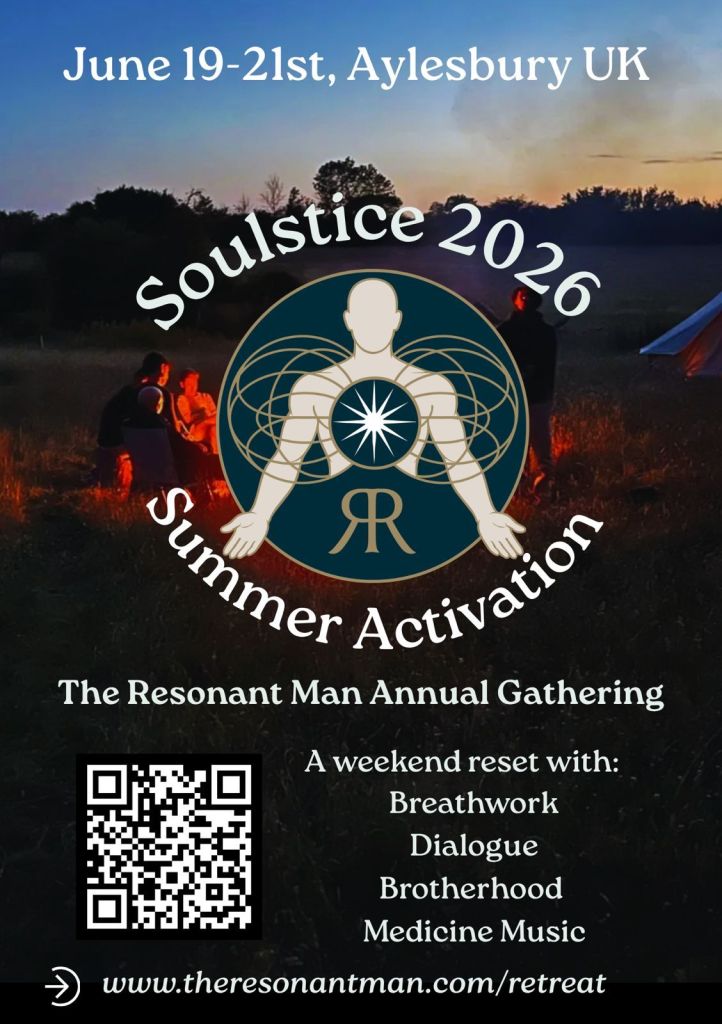
Soulstice

I will be speaking on The Lord of the Rings at a men’s retreat at a farm in the Chiltern Hills in England that will take place between the 19th and 21st June. I will be talking about the moment when the hobbits return to the Shire after all their adventures with a sense of foreboding about what lies ahead but with the comfort of knowing that Gandalf will be with them. Then comes the bombshell.

“I am not coming to the Shire. You must settle its affairs yourselves; that is what you have been trained for,”

So I will be thinking about the question of Initiation. How our life experience and all its adventures have prepared us for what lies ahead. And how we never quite feel ready for the next challenge until we get there.

The hobbits have everything they need to free the Shire from Saruman and his gang. We have everything we need to face the next challenge in our lives.

The retreat is run by a men’s fellowship called The Resonant Man that I have joined and which I value very much, It is convened by Matthew Green, formerly a foreign correspondent for The Financial Times, and Jacob Kishere, a young man living and working in Mexico who has become a good friend over the past year.

There are a few places still available so please scan the QR code on the link for more details.

There are around 2,000 readers each week on my blog and it would be so good to meet some of you in person.

“I Am Forgetting Them!” Merry Thinks of Frodo and Sam in The Midst of His Loneliness.

The Return of the King by J.R.R Tolkien (Harper Collins 1991) pp. 774-775

It has been three days since Aragorn, Legolas and Gimli, and the Grey Company, departed from the Hornburg and early in the day Aragorn begins his great ride across Gondor towards the port of Pelargir in order to come to the aid of its defenders who have been attacked by the Corsairs of Umbar. Following him are “shapes of Men and of horses, and pale banners like shreds of cloud, and spears like winter-thickets on a misty night”. The Dead have come to fulfil the oath that once they made and then broke to Isildur.

And on that same day, at evening, Théoden arrives with his company at Harrowdale, a deep valley amidst mighty mountains. He will rest there that night; the last rest that he will take before he leads the Rohirrim on their great ride to Minas Tirith and the battle that will take before its walls on the Pelennor Fields. The thoughts of all have turned to what lies ahead and a silence has fallen upon the host. Meriadoc Brandybuck of the Shire has ridden that day just a few paces behind the king, and he too has ridden in silence.

Not that the whole journey from the Hornburg has taken place in silence. Merry has enjoyed the hospitable company of the king, sharing tales with him of the doings of the Shire and listening to tales of the deeds of Rohan. But despite Théoden’s gentle courtesy Merry has always felt lonely, aware of the “insupportable weight of Middle-earth” surrounding him, longing for the comforts of home, and thinking of his friends.

“He wondered where in all this strange world Pippin had got to; and what would become of Aragorn, and Legolas and Gimli.” They have been his company since their merry meeting amidst the wreck of Isengard and they are the first to come to his mind and to his heart.

But suddenly the thought of others comes to him “like a cold touch on his heart”. Merry has remembered Frodo and Sam, and he realises that it has been some time since he has done so. His thoughts have first been filled with his own plight and then with those who have been with him along the way. He is ashamed that he has not given the attention of his heart to those with whom he first left the Shire. “And yet they are more important than all the rest of us. And I came to help them.”

I do not think we should blame Merry for not thinking about Frodo and Sam. So much has happened to him since they parted company two weeks earlier at Parth Galen, violently sundered by the attack of the orcs who slew Boromir and who took both he and Pippin prisoner. Two weeks must feel like two years to him given the intensity of his experience, and the immensity of all that lies before him requires all the attention that he can give even though he has little idea of what the next days will bring. But that feeling, that “cold touch on his heart”, does the work that it was intended to do. It returns the attention of his heart to Frodo and Sam at just the moment it needed to do so. For it was early in the morning of that same say that Frodo and Sam left the stronghold of Henneth Annûn in the company of Gollum in order to begin the next stage of his journey to Mordor, bearing the Ring and the hopes of the world.

Perhaps Merry has needed the silence of that day’s ride down into Harrowdale in order to clear enough space in his heart to think of more than just of himself. This is one of the values of silence. Like the experience of most of us when we find ourselves in silence, Merry’s mind has been filled with himself, with thoughts and feelings. Most of the time, and for most of us, we are unaware of what we think and feel. Those thoughts and those feelings simply happen to us. But sometimes enough space is created for another level of awareness to be experienced. We become aware of what we are thinking and aware of what we are feeling. And then sometimes, in those quiet times, we may feel something like Merry’s cold touch, something that draws our attention away from ourselves and away from our usual patterns of thought. It is good that we stop to give such moments our full attention, to lean into the unexpected touches of our hearts. They enlarge our hearts and connect us to people and places who need our attention. We do not know what effect it had, for good, for Frodo and Sam. It isn’t given to us to know such things. There would be too much temptation to manipulate things if we did. But for those of us who try to pray, such moments call us consciously to place someone into the hands of God.

“I Summon You to The Stone of Erech!” On the Breaking of Oaths and The Authority of The Heir of Isildur.

The Return of the King by J.R.R Tolkien (Harper Collins 1991) pp. 769-773

The Dead who follow Aragorn and the Grey Company along the Paths of the Dead clearly have power. We saw that in the last piece on this blog as we followed Gimli’s journey along that dark way and felt his fear, a fear that at last has him “crawling like a beast on the ground”. And it is this power that Aragorn will call upon to aid him in the cleaning of the land of Gondor from all the servants of Sauron.

When Isildur made this people swear loyalty to him as king and overlord, long ago, it was his authority and power that they feared. It was at the Stone of Erech, in a remote valley of Gondor, that the Oath was sworn at the ending of the Second Age, but that oath was broken because they feared and had worshipped Sauron for long years before the coming of Elendil and the Númenoreans to Middle-earth.

The keeping of oaths is a matter of great importance in Tolkien’s legendarium, as is their breaking also. So important is it that when Gimli speaks of swearing an oath to stay with Frodo until the end of his journey, Elrond replies:

“Let him not vow to walk in the dark, who has not seen the nightfall.” (Fellowship p. 274)

Gimli’s words are not a light affair. For a dwarf, the swearing of an oath is a matter of sacred importance; and perhaps that is why Elrond does not permit one on this occasion. He knows that none can foresee the nature of the journey that lies ahead. If Gimli had been bound by an oath to follow Frodo at the breaking of the Fellowship at Parth Galen, then he could not have followed Merry and Pippin across the plains of Rohan and his following of Frodo and Sam would have been to little or no purpose. Worse still it would almost certainly have been a hindrance to Frodo and Sam’s secret journey across Mordor. We might also note the irony in Elrond’s words about vows to walk in the dark after we thought about Gimli’s dark journey in the last piece. While Gimli is right to speak of how sworn words can “strengthen quaking heart”, Elrond is right too to aver that an oath rashly made can break a heart just as easily as it can strengthen it. It is best that he keeps Gimli from that trial. Best too, for the ultimate outcome of the Quest.

But what of the oath first made at the Stone of Erech to Isildur by the mountain people? That was not an oath made in friendship but through fear. There is no difference between them in their essence. Perhaps that is the reason why Jesus warns against the making of oaths in the Sermon of the Mount. Their spiritual power is such that we should fear it and never take it lightly. So, the oath to protect a constitution, or to speak the truth in a court of law, is not merely a form of words, a convenience to be observed merely as a matter of custom, but has a spiritual power that will be enforced in the court of heaven, and therefore should be feared.

The Dead who are summoned to the Stone of Erech know that power. They have endured it through long years without rest. Now, at last, comes the one who has the authority both to enforce their obedience to the oath and to declare the oath fulfilled at last.

“The hour has come at last. Now I go to Pelargir upon Anduin, and ye shall come after me. And when all this land is clean of the servants of Sauron, I will hold the oath fulfilled, and ye shall have peace and depart for ever. For I am Elessar, Isildur’s heir of Gondor.”

The same power that has held that mountain people in a state of unrest through long years now has power to free them also. Aragorn speaks with authority, but that authority does not lie within himself but has been granted to him. He is a man under divine authority and it is with that authority that he now speaks.