“You Have Become a Fool, Saruman, and Yet Pitiable.” Gandalf Breaks The Staff of Saruman and Casts Him From The Order of Wizards.

The Two Towers by J.R.R Tolkien (Harper Collins 1991, 2007) pp. 751-762

Isengard lies in ruins and Saruman is a prisoner within Orthanc. His armies are defeated and now he is caught between two enemies. One, the mighty power that lies within Barad-dûr, knows now that he is a traitor, working only for his own purposes. The others, the King of Rohan who he sought to destroy, the Ents of Fangorn who he contemptuously ignored, and Gandalf who he had once imprisoned and would have sent to Mordor, stand before his doors.

Gandalf and Théoden ascend the steps that lead to the door of Orthanc while the rest of the company await their return below. The Ents remain hidden because Gandalf hopes to persuade Saruman to leave his prison and to come down and feels that if the Ents were present he would fear to do so.

Saruman comes to a window and engages in debate, first with Théoden and then with Gandalf, seeking always to turn things to his own advantage, but as Éomer says to Théoden, “so would the trapped wolf speak to the hounds, if he could.”

Saruman has great power in his voice but by seeking to divide his enemies, speaking singly, first to Théoden and then to Gandalf, he fails in his purpose. First Théoden recalls that Saruman went to war with him unprovoked and murdered children in the Westfold. Then Gandalf recalls his imprisonment within Orthanc. Saruman has done too much wrong to too many to be able to persuade them now that his intentions have been anything but malicious.

But in his speech to Gandalf Saruman reveals what he still believes.

“Much we could still accomplish together, to heal the disorders of the world. Let us understand one another and dismiss from thought these lesser folk! Let them wait upon our decisions.”

Of course, by now, Gandalf knows that when Saruman speaks of we what he really means is I. But even if he didn’t Gandalf has long been a servant and not a master. That is the fundamental difference between the two. Saruman has always regarded others as either more or less powerful than himself. If, like Sauron, they are more powerful, then he will seek to ally himself to them, although he will wait for an opportunity to betray them. It was for this purpose that he sent orcs to capture hobbits and so caught Merry and Pippin. He knew that a hobbit was bearing the Ring, probably taking it to Minas Tirith so that it could be used against the Dark Lord.

This is how Saruman treats the mighty. But for those who he regards as “lesser folk” he has only contempt. The House of Eorl is “a thatched barn where brigands drink in the reek, and their brats roll on the floor among the dogs” and hobbits are “small rag-tag that dangle” at Gandalf’s tail.

And against Gandalf himself he bears almost uncontrollable fury. He has always regarded Gandalf as a foe. Right from the time when the Valar sent the Istari, the wizards, to Middle-earth to contest with Sauron and to encourage and organise resistance to him, Saruman insisted that he, and not Gandalf, should be the leader of the mission. And Saruman always knew that Cirdan of the Grey Havens had given Narya, one of the three Elven Rings, to Gandalf and not to him. When Gandalf demands Saruman’s staff and the keys of Orthanc Saruman replies in uncontrollable rage.

“When you also have the Keys of Barad-dûr itself, I suppose; and the crowns of seven kings, and the rods of the Five Wizards, and have purchased yourself a pair of boots many sizes larger than those that you wear now.”

Of course, apart from the rather pathetic reference to boots, we know that what Saruman has revealed here is what he desires. He is the one who has always desired power and domination. Like a seed growing to a mighty tree this desire has long lodged in his heart but its full extent, his desire to be Lord of Middle-earth, has only become something fully formed quite recently. Before that it may only have been revealed in jealousy of Gandalf, Galadriel and Elrond, and contempt for Rohan or Ents, his near neighbours.

And, at the end, not knowing the consequence, not just of betraying those who had been friends but of the Valar who gave him his mission, he is summoned by Gandalf to stand and hear his judgement and he has no choice but to obey. His staff is broken and he is cast from the Order. Gandalf has the authority to do this and Saruman’s power is broken. God cannot be mocked forever.

“Many Ents Were Hurling Themselves Against the Orthanc Rock; But That Defeated Them.” Why Couldn’t The Ents Destroy Orthanc?

The Two Towers by J.R.R Tolkien (Harper Collins 1991, 2007) pp. 734-744

Last week we thought about how when the Ents destroyed the fortress of Isengard it was if the action of tree roots over a hundred years were “all packed into a few moments.”

But the Tower of Orthanc was different. After Saruman was able to make a hasty retreat into it, only just managing to escape the pursuit of Quickbeam, he got his machinery of war into action and Beechbone was killed by a kind of flamethrower. This threw the Ents into a terrible fury and they launched themselves into an attack upon Orthanc.

“Round and round the rock of Orthanc the Ents were striding and storming like a howling gale, breaking pillars, hurling avalanches of boulders down the shafts, tossing up huge slabs of stone into the air like leaves. The tower was in the middle of a spinning whirlwind. I saw Iron posts and blocks of masonry go rocketing up hundreds of feet, and smash against the windows of Orthanc. But Treebeard kept his head. He had not had any burns, luckily. He did not want his folk to hurt themselves in their fury, and he did not want Saruman to escape out of some hole in the confusion. Many of the Ents were hurling themselves against the Orthanc-rock: but that defeated them. It is very smooth and hard. Some wizardry is in it, perhaps, older and stronger than Saruman”s.”

But Orthanc was not built by wizards but by the Dunedain at the end of the Second Age when Elendil and his people escaped the destruction of Númenor and established the kingdoms of Gondor and Arnor in Middle-earth. As the power of these kingdoms began to wane it fell into the hands of the Dunlendings who were later allies of Saruman at the Battle of Helm’s Deep. Eventually Saruman offered to take possession of the fortress and his offer was gratefully received both by the King of Rohan and the Steward of Gondor and for years after he was a valuable ally to them both and Isengard was an important part of the defences of the West against the growing power that first began to arise in Dol Goldur.

Saruman inherited Orthanc but he built the fortress of Isengard; and it was this fortress that the Ents were able to destroy in a single night. But why did Orthanc remain impregnable? It was from a thought in the comments section following last week’s post that this question began to grow in my mind and I want to try to tackle it this week.

I think that there are two main themes in Tolkien’s thought at work here. One is that as a character begins to invest more and more of themselves, of their essence, into the things that they make, so that essence begins to waste away. A kind of entropy is at work. The greatest example of this is, of course, of Sauron and the Ring. Sauron puts so much of himself into the making of the Ring that when it is finally destroyed he falls with it. But the same principle is at work with Saruman and Isengard. When Merry and Pippin speak dismissively of the one who had them captured and who would have tortured them until he found out all they knew, Aragorn replies that “once he was as great as his fame made him. His knowledge was deep, his thought was subtle, and his hands marvellously skilled.”

The other principle is Tolkien’s sense that when we work in harmony with creation and not seeking mastery over it we are able to make something of real significance and of staying power. So we see the way in which Galadriel makes Lothlórien, a place that Sam Gamgee describes as like being inside a song. And we also listened to Gimli speak of the work that he would do in the glittering caves of Aglarond. Great sculptors speak of finding something within the material that they are working with; something that is essentially present. And in the city of Worcester in England near which I live we could contrast the difference between the gothic beauty of that city’s medieval cathedral and the modernist monstrosity that is the technical college next door to it. The conservative philosopher, Roger Scruton, was once asked to reflect on the unpopularity of new housing developments. His brilliant answer was that if a development were to have the quality of a city like Bath and its beautiful architecture then there would never be an objection to it.

The Royal Crescent in Bath. A beautiful example of Georgian architecture from the 18th century. And the interiors are just as beautiful as the facades.

Scruton, like Tolkien, makes beauty the centre of his thought on the things, and not functionality. When function is subordinate to beauty, in which something is made that is in harmony with the materials that are used and which has a transcendent purpose greater than the agrandisement of the maker then it will last. So Isengard is destroyed in a night and Orthanc is impregnable.

“My Business is With Isengard Tonight, With Rock and Stone.” How The Ents Destroyed Saruman”s Fortress

The Two Towers by J.R.R Tolkien (Harper Collins 1991, 2007) pp. 734-744

The smoking of pipes at the ruined gates of Isengard had created a quiet mood in which nothing is said but Legolas is anxious to know more about the story of the hobbits after their capture by orcs nine days before. Merry and Pippin spoke of their experience with the Uruk-hai and how they were able to escape amidst the confusion of battle when Éomer’s company attacked. As Gimli said about how Pippin was able to cut his bonds with an orc knife at an earlier point in the story the hobbits were lucky but they were able to seize their luck “with both hands”.

Merry and Pippin went on to speak of their meeting with Treebeard and of Entmoot when the Ents discussed what action they should take against Saruman. Then they spoke of how, at the end of their debate, the Ents “suddenly blew up”, of how they marched upon Isengard, and of how they were followed by huorns who came out of the forest behind them.

They spoke of how, as they reached Nan Curunir, the vale of the wizard, they were met by a tremendous sound of trumpets blaring and thought that they had been discovered by their enemies. But then they had realised that the noise was of the emptying of Isengard as Saruman sent his army to war against Rohan and how for an hour they watched them marching southward towards Helm’s Deep.

Treebeard watched them go and then said to Merry and Pippin, “My business is with Isengard tonight, with rock and stone”.

Tolkien describes how the Ents launched their assault upon the fortress, wonderfully showing how the slow, deliberate action of tree roots over a hundred years, an action about which all householders must be aware, was concentrated into a single night’s furious work.

“They pushed, pulled, tore, shook and hammered; and clang-bang, crash-crack, in five minutes they had these huge gates just lying in ruin; and some were already beginning to eat into the walls, like rabbits in a sand-pit.”

Merry and Pippin go on to describe how the destruction continues, how Saruman tried to respond by means of fire from within his impregnable fastness of Orthanc at the heart of Isengard; and how the Ents diverted the waters of the Isen from its natural course and flooded the fortress, turning Orthanc into an island in the centre of a lake, an island in which Saruman was now a prisoner.

I have already spoken of how, in this powerful piece of description, Tolkien shows how the action of a forest upon a house over many years is concentrated within a single night. We know that if any building is neglected for a period of time nature soon reclaims it, drawing it back into itself as what once seemed to be permanent is shown to be merely temporary. Tolkien did not know of James Lovelock’s Gaia hypothesis, in which Lovelock suggested that the earth is a complex self-regulating system within which that which is organic and non-organic interacts in order to maintain the system as a whole but I suspect that he may have been inclined to like it if he did. Many scientists have criticised the hypothesis on the basis that it is teleological, in other words that it is descriptive of a set of conditions that will lead to a particular end, in this case about the survival of planet earth as a place for organic life, but Tolkien was a Christian, and Christians believe that everything is moving towards a conclusion, of a new heaven and a new earth.

In his Music of the Ainur Tolkien places the whole history of the earth within the framework of a single piece of music in which all creatures, both earthly and heavenly are active participants. Only Eru Ilúvatar, only God, knows how the music will end but it will be a beautiful resolution of all that has preceded that end. As the 14th century English mystic, Julian of Norwich put it, “All shall be well”. There may be a time in which figures like Saruman may triumph but as the Ents show, through their business with the rock and stone of Isengard, they cannot triumph forever.

“Strider the Ranger Has Come Back.” Who is Aragorn? Perhaps Pipe-smoking will give us a clue.

The Two Towers by J.R.R Tolkien (Harper Collins 1991, 2007) pp. 730-734

Gandalf takes Théoden and Éomer around the walls of the flooded fortress of Isengard to find Treebeard and leaves Aragorn, Legolas and Gimli behind at the gatehouse with Merry and Pippin. So it is that the three hunters are reunited at last with the captives of the orcs in the very place in which Merry and Pippin were to have been held prisoner by Saruman. The young hobbits are able to provide their guests with a decent meal and a choice of wine or beer and then, when hunger is satisfied and a deep sense of contentment gently descends upon these friends Merry and Pippin are able to provide something that will deepen that feeling and that is Longbottom leaf, pipeweed of the very finest quality.

“Now let us take our ease here for a little!” said Ara Aragorn. “We will sit on the edge of ruin and talk, as Gandalf says, while he is busy elsewhere. I feel a weariness such as I have seldom felt before.” He wrapped his grey cloak about him, hiding his mail-shirt, and stretched out his long legs. Then he lay back and sent from his lips a thin stream of smoke.”

All pipe-smokers will know the particular pleasure that is achieved through the careful practice of their art. A really good pipe requires the right state of mind in order that it might be fully enjoyed. If one comes to a pipe in an agitated state then that feeling will be transmitted to the experience; but if one is able to achieve an inner quiet before lighting a well prepared pipe then both pipe and the state of mind can deepen one another. This is Aragorn’s experience now at the end of nine days endless activity since he decided to go in search of the young hobbits across the plains of Rohan.

With some sadness I have to describe myself as a former pipe-smoker and so I have had to draw upon memories of some years ago. I never smoked more than one or, at the most, two pipes in a day and I always did so when the tasks of the day were done and I had a quiet moment for thought or in the pleasant company of a fellow smoker. So for me the experience of pipe-smoking and inner quiet are intimately and delightfully linked.

My pipe-smoking career came to an end when my older daughter came back from school one day and put a screen-saver on my PC with the words, “Daddy, you will die!” It seemed that she had had a class that day in which the dangers of smoking to health were presented to the children. As she listened to the teacher anxiety grew within her about her own father and so she worked out a way of telling me about this. I love my daughter very much and as soon as I saw the message I knew that I could not be the deliberate cause of anxiety in her and so I gave up smoking my pipe on that very day.

If you want to learn a little about the pleasures of pipeweed then could I please recommend a talk by Malcolm Guite that you can find on his YouTube channel. If you search for him on pipe-smoking you will find a number of short videos there as well as much good material, especially the work that he is doing at present on the retelling of the Galahad tales from the Arthurian legends.

It is Pippin who realises that, as he watches Aragorn smoke his pipe, that he is back in the Prancing Pony with the stranger who will eventually introduce himself as Strider. And as he remembers he speaks.

“Strider the Ranger has come back!”

And Aragorn replies: “He has never been away… I am Strider and Dúnadan too, and I belong to Gondor and the North.”

Pippin belongs to the North and it is there that he first met the man who would be his king both there and in Gondor. it was Bilbo who first introduced us to Aragorn as Dúnadan, man of the West, of Númenor, making us realise his deep lineage, beginning with Eärendil and Elwing, and, before them, Beren and Lúthien. And it was Gandalf who told us that to call Aragorn only a Ranger was to misunderstand him completely. Later Pippin would hail Aragorn as Strider in the presence of the lords of that land which would prompt the Prince of Dol Amroth to ask, somewhat sardonically, whether it would be in terms of easy familiarity like this that kings would henceforth be addressed. Aragorn’s reply displayed his mastery of the moment as well as his mastery of himself.

“Strider shall be the name of my house, if that ever be established. In the high tongue it will not sound so ill, and Telcontar I will be and all the heirs of my body.”

“These Hobbits Will Sit on the Edge of Ruin and Discuss the Pleasures of the Table.” Merry and Pippin Amidst the Wreck of Isengard.

The Two Towers by J.R.R Tolkien (Harper Collins 1991, 2007) pp. 726-729

This week we return from Théoden’s wonder at his first sight of Ents at Helm’s Deep to Merry and Pippin amidst the wreck of Isengard. Not that I think that they mind our neglect, as they are resting after their first good meal since they were captured by orcs over a week before. Treebeard had given them drafts of a drink that not only sustained them but even made them grow, but there is nothing like proper food and drink to achieve contentment and nothing like a hobbit to enjoy it properly.

“These hobbits will sit on the edge of ruin and discuss the pleasures of the table, or the small doings of their fathers, grandfathers, and great-grandfathers, and remoter cousins to the ninth degree, if you encourage them with undue patience.” So says Gandalf to Théoden after Merry has begun to discourse on the history of pipe-smoking in the Shire, and we know this to be true, not just because Gandalf says it but because we remember how Merry and Pippin sat down on the edge of Fangorn to eat a piece of lembas as Éomer’s company did battle with the orcs just a few yards away and how, when Aragorn, Legolas and Gimli found signs of this meal they commented that this was proof that hobbits had been there. Who else would choose such a spot for a meal?

Gandalf does not say it here but this is why he loves the Shire and his visited it so often over many years. There is a sense in which the whole Shire has been sitting on the edge of the ruin of Eriador as it has been since the fall of the Kingdom of Arnor and its successor, Arthedain, at the hands of the Witch-king of Angmar for many years and has quite simply ignored the fact, being entirely absorbed with its own affairs, the pleasures of the table and the small doings of its families. How different this has been from Gondor, for example, with its endless anxiety about the world beyond its borders, although perhaps in Lossarnach and in their lord, Forlong the Fat, there is something of a hobbit spirit.

Gandalf has needed the Shire for many reasons. In part he has needed it as a place of rest amidst his long and weary travels. But he has also needed it as a place of play, a place where he has learned to play. Sam Gamgee wanted Frodo to include a verse about Gandalf’s fireworks in the lament that he had composed about Gandalf in Lothlórien and that is what Gandalf had meant to him and to most of the people of the Shire. There is a sense that as Gandalf incarnated his Olorin spirit in Middle-earth as one of the Istari sent by the Valar to contend with Sauron, it was the Shire, and its “small doings” that shaped that incarnation in a very particular way. Saruman never understood this, laughed at it, and suspected it too. His own incarnation lay within the walls of what he thought was an impregnable fortress, a place where he could plot the conquest of Rohan and even dream of becoming the Lord of the Rings and master of Middle-earth.

That it was Gandalf who triumphed in the War of the Ring that ended the Third Age of Arda, and not Saruman, was in no small measure because of his love of the Shire. This was not just because, by a set of strange circumstances, the Ring came to the Shire, and then from the Shire to Mount Doom, but also because Merry and Pippin came to Fangorn Forest. It was Gandalf himself who told Frodo how he had chosen Bilbo for the Quest of the Lonely Mountain, a story recounted in Lost Tales, telling Thorin Oakenshield that “a foresight is on me.” This foresight, this world changing intuition, was formed within Gandalf’s soul by hours at hobbit tables on the edge of ruin while he smoked his pipe and listened to tales of the small doings of his hosts. It was from these doings that Sauron and Saruman fell.

“Tales By The Fireside.” Théoden Touches The Perilous Realm.

The Two Towers by J.R.R Tolkien (Harper Collins 1991, 2007) pp. 716,717

“Is it so long since you have listened to tales by the fireside?”

So Gandalf asks of Théoden as the King tries to make some sense of what he has just seen as Ents emerge from the magical forest that has come from Fangorn to Helm’s Deep.

I promised last week that we would remain in this reflection on the Perilous Realm that J.R.R Tolkien spent a lifetime pondering and, in the creation of his legendarium, making something that has allowed millions of readers to touch and taste it too.

In his essay On Fairy-Stories Tolkien tells us that a fairy story is not one that is about an elf or a fairy but is about “the nature of Faërie: the Perilous Realm itself, and the air that blows in that country.” He goes on to say that Faërie is essentially indescribable, that it has “many ingredients, but analysis will not necessarily discover the secret of the whole.” Indeed analysis will effectively kill the thing that it seeks to describe. Perhaps it always does, reducing the thing that it has observed to its many parts and so failing to see the whole that it first experienced. Tolkien tells us that Faërie “may perhaps most nearly be translated by Magic- but it is magic of a peculiar mood and power, at the furthest pole from the vulgar devices of the laborious, scientific magician.”

“The vulgar devices of the laborious, scientific magician.” Have we not here been introduced to the Dark Lord himself, hidden in his fastness of Barad-dûr and his most enthusiastic imitator, Saruman? And isn’t the Ring a perfect example of such a device? Saruman was one who lived long in the Undying Land and knew its beauty and yet became seduced by a desire for power, becoming increasingly frustrated by the long, slow history of beauty that, as Gimli describes so well in speaking of the Caves of Aglarond can only be worked with, “with cautious skill, tap by tap- a small chip of rock and no more, perhaps, in a whole anxious day”. Gimli’s description of the work of a true artist in the presence of beauty is light years away from the work of those “laborious, scientific magicians” Sauron and Saruman, who are endlessly frustrated by the slowness of things to be shaped by their will and who become contemptuous of those who are not willing to work as they do. Essentially they become contemptuous of Ilúvatar and the long slow pace of the music of the Ainur that is the story of Creation itself.

Sauron and Saruman live in the same world as Fangorn and Lothlórien, those expressions within Tolkien’s sub-creation of the Perilous Realm, and yet have no understanding of them or of their magic. Their vulgarity is only capable of reducing the magic of these places to their own that is laborious and scientific. But Sauron’s vulgar creation of the Ring is always a temptation to those who have worked long and patiently with the beauty of Middle-earth. When Galadriel is tempted to take the Ring that Frodo freely offers to her she imagines herself as a Dark Queen crying out that “all shall love me and despair!”

It is a misunderstanding of the true nature of evil to imagine Galadriel at this moment as something horrible as Peter Jackson does in the film version of The Lord of the Rings. What the Ring would have given to Galadriel would have been the opportunity to become endlessly and repetitively a terrible beauty that could be seen, desired but never enjoyed. The whole world would be in the thrall of an erotic desire that would endlessly grow in intensity but could never be satisfied. Gimli expresses this when he speaks of “the danger of light and joy”. Legolas rightly praises Gimli for staying faithful to his companions and for giving up the desire that has been awakened within him but Gimli is not comforted by his words.

So perhaps it is safer to keep an experience of beauty within tales by the fireside. As we hear such tales the longing that Gimli knows may perhaps be tasted, may even be a delicious pleasure for a brief moment, but the story will come to an end and it will be time to sleep. Unless, of course, there may be a path that might lead us to an enjoyment of this pleasure; one that never cloys,as the hymn writer puts it.

“The Songs Have Come Down Among Us Out of Strange Places.” Théoden Thinks About The Nature of Fairy-stories.

The Two Towers by J.R.R Tolkien (Harper Collins 1991, 2007) pp.716,717

I promised last week that we would return from the doors of Isengard and their unexpectedly merry wardens in order to return to a conversation in the Deeping-coomb between Théoden and Gandalf.

The conversation takes place when Théoden’s company are about to begin their journey, with some reluctance, to Isengard. Legolas has seen eyes amidst the strange wood that has come from Fangorn such as he has never seen before and then three strange shapes come forward from the trees.

“As tall as trolls they were, twelve feet or more in height; their strong bodies, stout as young trees, seemed to be clad with raiment or with hide of close-fitting grey and brown. Their limbs were long, and their hands had many fingers; their hair was stiff, and their beards grey-green as moss.”

Tolkien describes Ents here as if we had never met them before although we spent some time among them in the company of Merry and Pippin. But now we see them through different eyes. We see them with wonder through the eyes of Legolas and with fear through the eyes of Gimli and the Riders of Rohan.

Gandalf speaks to Théoden. “They are the shepherds of the trees,” he says to him. “Is it so long since you listened to tales by the fireside? There are children in your land who, out of the twisted threads of story, could pick out the answer to your question. You have seen Ents, O King, Ents out of Fangorn Forest, which in your name you call the Entwood. Did you think that the name was given only in idle fancy?”

This is one of the moments in The Lord of the Rings when Tolkien speaks of the themes that he explored in his essay, On Fairy-Stories. As we noted last week this reflection takes place only in scenes involving the Rohirrim. Aragorn and Éomer speak of this when they first meet on the plains of Rohan and now Théoden and Gandalf speak of it together. They speak of “tales by the fireside”, stories told to children. I remember the pleasure of telling stories to my children when they were young. I remember how we would enter the worlds that these tales would evoke as real places. It was one of my favourite moments of the day when all my troubles would be forgotten for a little while. I did not want these moments to end and my wife would have to remind me that the children needed to sleep!

In his essay Tolkien tries to answer the question, “What is a fairy-story?” and as he skilfully dismantle dismantles various attempts to answer the question, offered by scholars or in anthologies of stories such as the collection published by Andrew and Leonora Lang, he draws us ever deeper, and disturbingly, into a realm that he describes as Perilous. He illustrates his point with reference to Walter Scott’s fine poem, Thomas the Rhymer. In it, Thomas, who himself is a poet, meets a beautiful lady who at first he addresses as “The Queen of Heaven”. She replies that this name does not belong to her and that “I am but the queen of fair Elfland, that am hither come to visit thee”. The Queen of Elfland takes Thomas with her to the Perilous Land and he spends seven years there in her company. She describes the road that they will travel together as being neither “the path of Righteousness”, nor “the path of Wickedness” but “the road to fair Elfland”.

Tolkien describes this realm as “wide and deep and high and filled with many things: all manner of beasts and birds are found there; scoreless shoreless seas and stars uncounted; beauty that is an enchantment, and an ever-present peril; both joy and sorrow as sharp as swords.” In Tolkien’s own tale it is Lothlórien that is most Perilous. Faramir understands this well and in his meeting with Frodo and Sam says, “If Men have dealings with the Mistress of Magic who dwells in the Golden Wood, then they may look for strange things to follow. For it is perilous for mortal men to walk out of the world of this Sun, and few of old came thence unchanged, ’tis said”.

This is the world of which Théoden and Gandalf now speak and one that I will return to with you next week if you will. At least to think about it if not to go there in truth, for as I have been writing this piece I have been filled with longing to take “the road to fair Elfland” myself.

“Welcome, My Lords, to Isengard!” The Doorwardens of Isengard Greet Théoden as He Comes to The Fortress of Saruman.

The Two Towers by J.R.R Tolkien (Harper Collins 1991, 2007) pp. 716-729

The pages that follow Gimli’s beautiful description of the Caves of Aglarond comprise a long slow journey into the unknown. One might think that Théoden and his company might ride with a light heart after their great victory over the hosts of Isengard but we have already seen the much vaunted plainness of manner of the men of Rohan when Aragorn, Legolas and Gimli first met them upon the grassy plains while hunting Merry and Pippin as the Uruk-hai were taking them to Isengard. An occasion when Éomer’s men simply dismissed the strangeness of the three companions as an expression of their wildness. And now, as they encounter the strangeness of the forest that has moved from Fangorn to Helm’s Deep the company who accompany their king descend into an unhappy and, occasionally, frightened, silence.

At one point Théoden and Gandalf speak together about the nature of stories that are told only to children and we will return to this in more detail next week reflecting in particular on Tolkien’s famous lecture on Fairy Tales but now I will only note that, while Théoden’s sense of wonder is gradually awakened during the ride to Isengard, he does not share this experience with his men. At last as they approach the outer fortifications of Isengard the growing sense of grim bleakness accompanied by menace seems complete.

This mood begins to shift subtly and gradually as they perceive that “the power of Saruman was overthrown”. The doors of Isengard “lay hurled and twisted on the ground. And all about, stone, cracked and splintered into countless jagged shards, was scattered far and wide, or piled into ruinous heaps.”

The riders gaze upon the ruin of Isengard in uncomprehending silence but then become aware that within its midst there are two small grey-clad figures lying upon the rubble at their ease and that beside them there are “bottles, bowls and platters… as if they had just eaten well, and now rested from their labour.” One of the figures seems to be asleep while the other “leaned back against a broken rock and sent from his mouth long wisps and little rings of thin blue smoke.”

Of course we have just met Merry and Pippin once again taking their ease as soldiers will after battle with whatever is available to them. We last saw the young hobbits with Treebeard on the night before the Ents’ assault upon Saruman when he was wondering if they were all going to their doom, whether it might be “the last march of the Ents”. And now the battle is done and victory won and all the tension is released.

And not just for Merry and Pippin. Soon all the company who are with Théoden and Gandalf are laughing too. It is as if the young hobbits have gently escorted the Riders from their shared experience of gathering gloom and mute incomprehension into something quite different and much more pleasant.

I can think of few better examples of bathos, that swift descent, sometimes of the sublime to the ridiculous, sometimes of the uncanny to the familiar, sometimes of the terrifying to the safe, than this. From the ending of the battle at Helm’s Deep to the encounter with the hobbits there are some twenty pages in my edition of The Lord of the Rings and throughout those pages the mood is as I have described it above. At no point does Tolkien relent in his creation of this feeling of anxious, fearful incomprehension. Not until the bubble is burst by two young hobbits. And who better within all Tolkien’s legendarium to take us into a world that is less fearful and gentler than hobbits.

Except for the Riders of Rohan hobbits also belong to the world of folktales and fairy stories. But unlike the dwimmer-craftiness of wizards (Gandalf included) or the terrifying silent presence of the Huorns of Fangorn hobbits are not to be thought a threat. Most of the time, indeed, they are anxious not to appear such. This lack of apparent threat does of course lead to the downfall of the greatest tyrants of this age. Tyrants always seem to fall to those who they have underestimated. But now the young hobbits do as they are most at their ease in doing. They gently help a group of men descend from a state of heightened anxiety and foreboding to a gentler place. While infuriating the friends who lay down all their dreams and ambitions even their lives in pursuing them across Rohan. But that we will return to on another occasion.

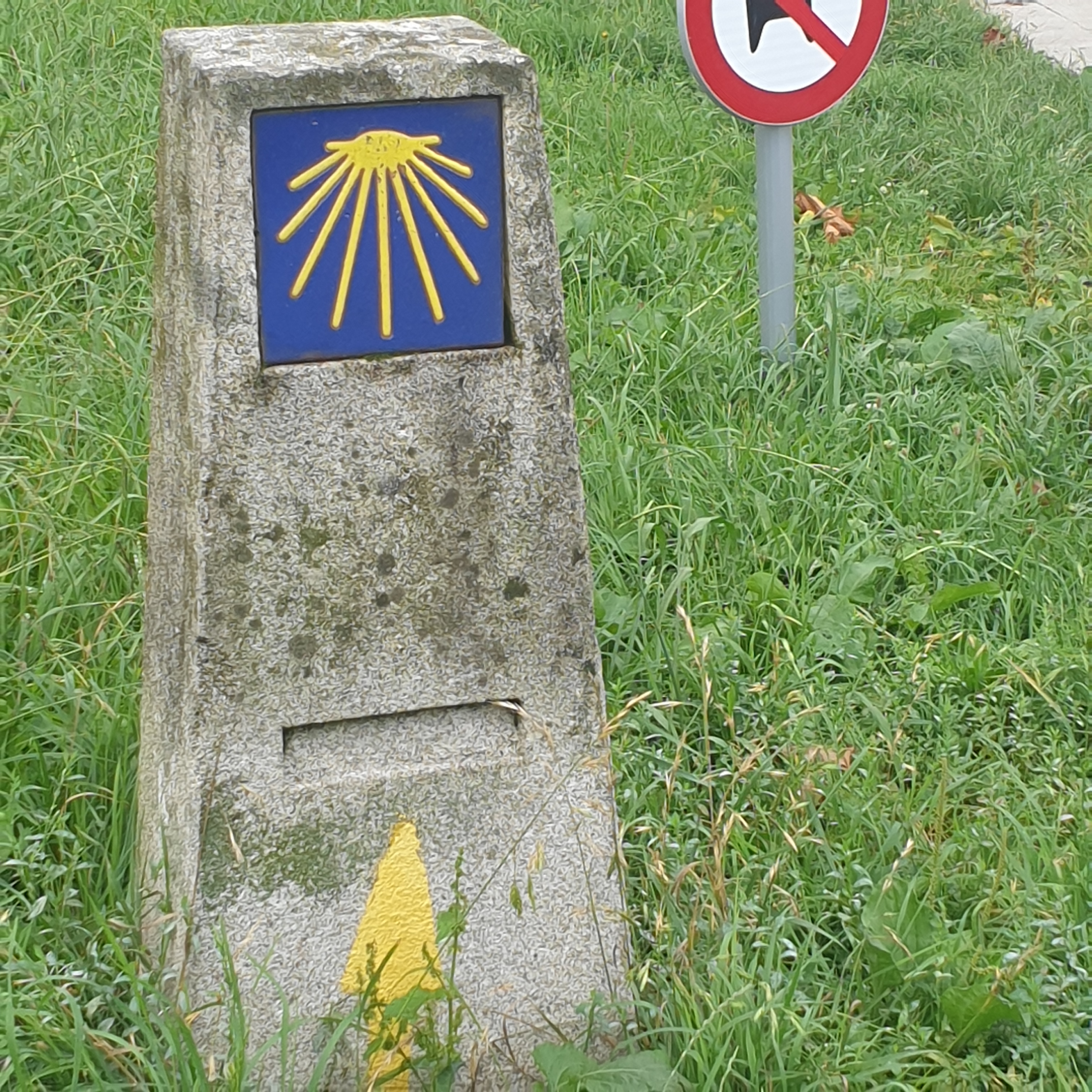
On Pilgrimage on The Camino del Norte.

I have been walking with the Camino del Norte, one of the ancient pilgrim routes that go to Santiago da Compostela in northern Spain for the past week. I have been doing so in the company of my wife, Laura, her sister and brother in law. We began in Biarritz in south western France last Tuesday morning and have now arrived in Guernica at the heart of the Spanish Basque Country.

My feet have become very badly blistered and Laura (who is a doctor) tells me that there will be no more walking for me this year. I feel humbled by this and realise how I regard my body as a servant that should obey me in my every wish. Am I going to learn a new relationship with it? A partnership perhaps?

I found a pilgrim’s credo by Murray Bodo before I left and I have been repeating it often along the way. I will end by sharing it.

I am not in control. I am not in a hurry. I walk in faith and hope. I greet everyone I meet with peace. I bring back only what God gives me.

“I Have Never Heard You Speak Like This Before.” Gimli Speaks to Legolas of The Glittering Caves of Aglarond.

The Two Towers by J.R.R Tolkien (Harper Collins 1991, 2007) pp. 708-715

I once had the privilege of visiting Leonardo da Vinci’s masterpiece, The Last Supper, in the refectory of Santa Maria delle Grazie in Milan. Most visitors are only allowed to remain for fifteen minutes before they have to leave and so I could not spend the time that I would have liked in its presence. And while I was there I learned that the master would sometimes spend an entire day just looking at what he was creating before making a choice of what he should do next.

Gimli would have understood him. Or at least I might say that it would have been the Gimli who had been in the presence of Galadriel in Lothlórien. Indeed as Gimli speaks to Legolas of what he has seen in the caves at Helm’s Deep he uses but one simile in his description. He speaks of how light glows through marble “translucent as the living hands of Galadriel.” For Gimli her beauty alone in all his life’s experience is sufficient to liken and enhance the wonder that he has just seen.

Gimli and Legolas have just been through a terrible battle and when Gimli first emerges from the caves in company with Éomer and Gamling and their men their first thoughts are to take pleasure in the fact that they are both still alive making light of this as soldiers often do. Then it is time for rest and Gimli makes no mention of the experience that will eventually give him his life’s work until he and Legolas are on their way in Théoden’s company to parley with Saruman in Isengard. Their journey begins their having to pass through the wood of Huorns who surround them and while Gimli is afraid Legolas is filled with wonder and announces to his friend that when the war is over he wishes to visit the remote dales of Fangorn in which the Huorns live.

At this Gimli speaks at last.

“There are columns of white and saffron and dawn-rose, Legolas, fluted and twisted into dream-like forms; they spring up from from many-coloured floors to meet the glistening pendants of the roof: wings, ropes, curtains fine as frozen clouds; spears, banners, pinnacles of suspended palaces! Still lakes mirror them: a glimmering world looks up from dark pools covered with clear glass; cities such as the mind of Durin could scarce have imagined in his sleep, stretch on through avenues and pillared courts, on into the dark recesses where no light can come.”

Legolas is deeply moved by Gimli’s words. “I have never heard you speak like this before,” he tells him. And he promises his friend that if they come safely through the perils that lie ahead that he will go with Gimli to see the caves. As long as Gimli is willing to go with him into the depths of Fangorn.

There are those who have pondered the Grail myth that had such a hold upon the medieval European imagination and which seems to be speaking to us once more in this time who discern that there are two distinct experiences of the Holy Grail in the hero’s journey. The first that often comes in the first part of life awakens longing but does not transform. The second comes later in life when the hero has been through much suffering and sorrow and is now ready to see the Grail in a way that transforms them. We do not know what experiences Gimli might have had of truth, beauty and goodness in his early years although surely his capacity to perceive the transcendent beauty of the caves must have been formed in part by such early experiences. But we do know that when he arrived in Lothlórien he had just been through Moria, through Khazad-dûm, that had held such meaning for him as for all dwarves, and had found it to be a place of darkness. It was Galadriel’s welcome that reawakened love within him and which prepared him for the caves. Now he is able to see their beauty and, as Galadriel foretold, not wish to possess and exploit them but to work with them as an artist might work with stone, finding within it the form that always dwelt there.

Is it merely coincidence that Tolkien gave what is possibly the most beautiful speech in The Lord of the Rings to a Dwarf, one of the most problematic of all his sub-creations? I would argue not. At their worst dwarves display some of the meanest characteristics of the human soul, only capable of looking at anything with a view to profit from it. Moria was destroyed because of the awakening of the Balrog through greedy delving after mithril. The Caves of Aglarond will not be treated in this fashion. Gimli and his people will tend them as Leonardo da Vinci tended his masterpiece. Perhaps in this manner they point a way to us to be truly human.