The Two Towers by J.R.R Tolkien (Harper Collins 1991, 2007) pp.858-865
Sam is already battle hardened standing by Frodo at the attack of the Nazgûl at Weathertop, at the attack of wargs near the doors of Moria and again within Moria at the Chamber of Mazarbul when orcs and trolls assailed the Fellowship. It is not battle itself that affects him so deeply, that realisation that someone is your enemy and wishes you harm, wishes even to kill you, it is, as the English poet Wilfred Owen put it, “the pity of war” that touches his heart when the Rangers of Ithilien ambush the Men of Harad as they march northwards to the Black Gate of Mordor.
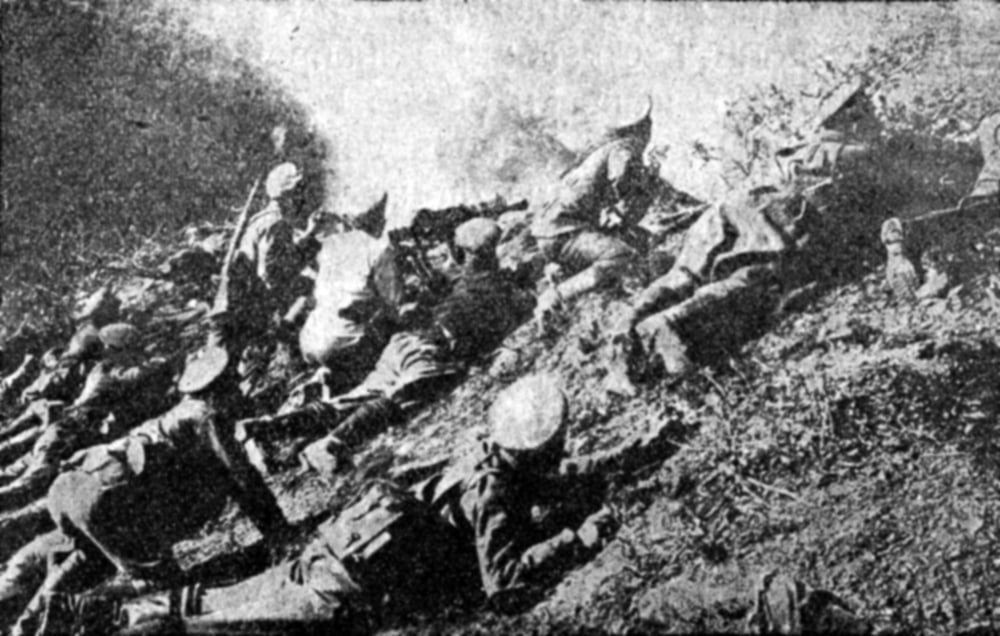
War in the trenches of the First World War of 1914-18
There are few passages within The Lord of the Rings that have the feel of the war literature of the 20th century as this one. Here we are reminded, if we need it, that Tolkien was writing a novel of his century and not a mere pastiche of medieval heroic literature. Tolkien was himself a veteran of the war in the trenches in France and took part in the Battle of the Somme that began on the 1st of July 1916 in northern France and during which a million men were either killed or wounded. The memory of that battle still casts a shadow over western Europe over a hundred years after it took place. My father gave us very little education in any deliberate sense; most of what I learned from him I did by observation rather than because he told it to me, but he was anxious to tell us of the horror of war and how a war in Europe should never be repeated. He himself was a veteran of the Normandy landings of June 1944 and his father of the naval Battle of Jutland of May 1916 and the memory of war played an important part in my education.
The capture of Frodo and Sam by Faramir and his men takes place just before the ambush begins and it is a measure of Faramir, the captain of war, that he does not treat his captives as mere irrelevances in the face of the serious matters of killing and being killed. In the few moments available to him he allows Frodo to tell his story before assigning two of his men to guard them. As they wait for battle to begin Mablung and Damrod speak of their leader and the respect in which they hold him. “He leads now in all perilous ventures,” they tell Frodo and Sam, and they are proud to follow him.
See ‘Faramir the Captain’ by Anke Eissman. Note how relaxed most of his men are. He is in charge and they don’t need to worry about what they have to do.
Tolkien gives us no overview of the battle that follows. We see it through Sam’s eyes, listening to the sound of steel against steel or metal cap, like the sound of “a hundred blacksmiths all smithying together”. We feel the terror as an oliphant charges straight towards them, veering away from them at the very last moment and we see a young warrior of Harad fall dead at their feet. Through all this their main ambition is to survive. Doubtless if battle had overtaken them they would have fought bravely but heroic deeds are not their first concern. This too is true to Tolkien’s memories of the trenches and of modern warfare.
The moment when Sam looks at the dead warrior is deeply moving. We are not shown war from the perspective of the war historian or the general in the staff room. We see it through the eyes of one man alongside other men. “It was Sam’s first view of a battle of Men against Men, and he did not like it much. He wondered what the man’s name was and where he came from; and if was really evil of heart, or what lies and threats had led him on the long march from his home; and if he would not really rather have stayed there in peace”.
Robert Runcie, Archbishop of Canterbury between 1980 and 1991, was a tank commander during the Second World War, winning the Military Cross, the second most important medal for valour that can be offered to the British Armed Forces for rescuing one of his wounded men from a crippled tank while under heavy enemy fire. He was greatly criticised by politicians for expressing sympathy and compassion for Argentine soldiers after the Falklands War of 1982. What moved him to speak of his pity was his memory of an incident in which his tank took out a German tank in battle and how, as was required of him, he checked to see if there were any survivors. He remembered looking into the tank and the dead young men within it and thinking of their mothers, wives and girlfriends who would never see them again. It was a Sam Gamgee moment and it remained with him for the rest of his life.

I haven’t found a photograph of Robert Runcie from the Second World War. You can tell that this is a photo of a British tank on show for the “top brass”, senior British officers, not one in the heat of battle.
 Wisdom from The Lord of the Rings
This is one of those passages that stay in my mind and reach the heart of the Tale and what Tolkien had to say about war and the struggle against evil. I think of it in connection with Faramir’s later comments about the necessity of defensive war to protect that which we love. I appreciate the links you make with your father’s and grandfather’s experiences of war; the fear of facing those who mean you harm. I also recognise the example of Archbishop Runcie, whose courage and experiences so impressed me when I heard him on the radio on the eve of the First Gulf War, making a point similar to Faramir’s. His integrity shone through.
Thank you for such a full and thoughtful comment, Chris. While I spent a few years on the edge of a conflict when in my 20s and came close on occasion to danger I have never been In a situation when someone was actually trying to do me harm. This is a point that Tom Shippey makes about Tolkien and Lewis and one that he feels gave those writers an authenticity that the so-called “moderns” did not share. And I would have loved to have written about Sam’s request for peace so that he can have a little nap after the battle. You can tell by the laughter of Mablung and Damrod that they enjoy the joke and recognise Sam as one of their own.
A moving reflection, thanks for this. I was thinking about Sam’s moment recently (https://thoughtsontolkien.wordpress.com/2024/02/16/ashes-in-the-lord-of-the-rings/) in the context of how the Rohirrim bury the men of Dunland after Helm’s Deep (in contrast to burning the Orcs of Isengard). They treat the dead men with the respect they have for their own dead, as opposed to evil enemies with no hope of redemption. Always enjoy reading your posts!
Thank you so much for leaving this comment and for your kind words about my blog. I look forward to reading what you have written. I don’t know what you think about this but it strikes me that people often seem to think about orcs as sub-human as some think of so called “lesser” races. I often think of C.S Lewis’s warning about creatures that appear to be human but are not. Something to ponder in our age of robotics.
Yes, I think it’s worth considering and Tolkien seems to have struggled with this, especially later in his life. With a few exceptions (e.g. Shagrat/Gorbag) the way Tolkien writes orcs as part of his main tales is to portray them as irredeemably evil or as cannon-fodder. But as he sought to make his world more metaphysically consistent later in life, the idea of this portrayal clearly bothered him and he proposed new theories to bring the creation and existence of orcs more line with his concept of good/evil. I wonder, even if he had 20 more years, if he ever would have been able to land on a theory of the orcs that could have reconciled his earlier portrayals with his later desire for metaphysical consistency…
I have not given much thought to the nature of orcs apart from knowing that Tolkien thought of their origin as Elves that Morgoth captured and then twisted to his own purposes. Saruman also shares in this corrupting work in his breeding of the Uruk-hai. All the so-called creating work done by Morgoth, Sauron and Saruman is a mockery of God as against the work of sub-creation that the servants of God do in honour of him.
Are orcs capable still of redemption. I do not know. The Nazgûl have lost all corporality and become nothing. What of the orcs? Do you have any thoughts?
I think that the best way to read the majority of the Tolkien’s works is to view orcs as irredeemable. Not that this is the most metaphysically sound interpretation, but perhaps it is the best literary interpretation of them. Whether one believes that they are irredeemable because they are pure subcreations of Morgoth (more akin to the automaton dwarves created by Aule, rather than “twisted elves”) or because Morgoth has somehow warped them beyond the ability to have free will that can access good choices, I don’t think matters terribly much. To believe, at least while reading Tolkien’s stories, that orcs are free beings that just so happen to always choose evil, seems to be at odds with almost all of Tolkien’s portrayals of them.
Yes, I think that I agree with that. I do think, as well, of correspondence between J.R.R and Christopher Tolkien when Christopher was serving in the RAF during the Second World War and speaks of orcishness amongst some of his fellows.