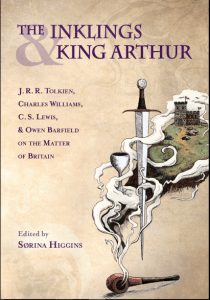
Inklings and Arthur: An Artist’s Perspective by Emily Metcalf

I recently co-authored a piece published in a magazine and was enormously impressed by the artwork created by the house artist. I respond to what other people write by writing. He responded by creating artwork and did two things. He displayed his understanding of our work and he communicated it to others so as to deepen their understanding too. I was deeply impressed. As I say in my response to Earthoak’s comment on Emily Austin’s piece I think she uncovers real depth through her choice of images and the masterstroke of using pipesmoke to weave them together.

Brenton Dickieson's avatarA Pilgrim in Narnia

As guest editor I can freely say, one of the many delights of this blog is Brenton’s brilliance in finding and selecting examples of book covers of works under discussion, post after post. But today we have the exceptional delight of reading the inside story of how a contemporary artist and designer, Emily Austin, went to work and became the maker of the cover of The Inklings & King Arthur. However discerning your enjoyment of it is already, I warrant it will be deepened and increased, as mine was, by reading this.

David Llewellyn Dodds, Guest Editor


I had about 36 hours to come up with a cover proposal for The Inklings and King Arthur.

When I found out about the contest (via editor Sørina Higgin’s posts on Twitter), my husband Ryan and I were away from our Indiana home, en route to watch the total solar eclipse in…

View original post 1,278 more words

The Mercy and the Justice of the King of Gondor

It is the task of kings to be the chief among the judges of the people. All law is administered in the king’s name from the most trivial of cases in the most remote of villages to the weightiest of matters in the greatest city of the land. And most important of all the people must know that the king will always act according to the ancient customs of the land and will be not partial to any and most certainly not to himself and his own interests. The 1662 Book of Common Prayer of the Church of England prays that the council of the monarch may “indifferently minister justice”. C.S Lewis once asked an uneducated member of the Headington congregation of which they were both part what he thought was meant by indifferent justice. The context of the question was that the proposal that indifferent should be replaced by impartial as people would understand it better. The man thought for a moment about Lewis’s question and then replied, “It means making no difference between one and another.” Lewis was satisfied that no revision was required and whenever I have prayed the general intercession in the service of Holy Communion I have always used the version written for the 1662 Prayerbook.

So it is that one of the first tasks that Aragorn has to undertake as king is the minister justice to all in the time between the end of Denethor and his own crowning. In part this means the treatment of the peoples who had been allies of Mordor. Among them are the Easterlings and the peoples of Harad. Aragorn chooses not to punish them and he gives the slaves of Sauron, who readers will remember that Gandalf pitied, land that they can call their own.

At last he has one particularly difficult case to judge. Beregond of the Guard of the Citadel in Minas Tirith had defied the orders of Denethor to aid him in his suicide and in the slaying of Faramir. If Gandalf had not arrived in time Beregond would have been faced with the choice of whether or not he should strike his lord in order to save Faramir but thankfully he was spared that. Nevertheless he slew two fellow members of the Guard and justice has to be done.

“Beregond, by your sword blood was spilled in the Hallows, where that is forbidden. Also you left your post without leave of Lord or of Captain. For these things, of old, death was the penalty.”

Aragorn remits the penalty “for your valour in battle, and still more because all that you did was for love of the  Lord Faramir.”

Note that Aragorn does not forgive Beregond. He remains guilty of the crime that he committed. Remission is not forgiveness but the decision of the judge not to carry out the penalty for a crime. But even though the reasons for the crime have mitigated it a crime has been committed. The king must declare the punishment.

“You must leave the Guard of the Citadel, and you must go forth from the City of Minas Tirith… You are appointed to the White Company, the Guard of Faramir, Prince of Ithilien, and you shall be its captain and dwell in Emyn Arnen in honour and peace, and in the service of him for whom you risked all, to save him from death.”

Tolkien tells us that Beregond perceived the “mercy and justice of the King”. Mercy alone could not suffice. Beregond could only hold his head high by atoning for his deeds. All are satisfied that the law has been respected and all are satisfied that Beregond’s brave deeds have been respected. Perhaps too all may begin to come to terms with the sad and tragic death of Denethor knowing that a man had to commit a crime in order to save Faramir from his despair.

Aragorn begins his reign with an act of wisdom, and soon all the land will hear of this and their faith in the King and of the new life of their land will deepen. They have a king once most and he is a man of justice and of mercy.

The Inklings & King Arthur Roundtable

This is one of the most exciting and important broadcasts that you will hear. Read my comment on Sorina Higgins’ site to see why I think so and listen to the discussion by clicking this link.

Sørina Higgins's avatarThe Oddest Inkling

This past Monday, Signum University hosted a Signum Symposium roundtable discussion celebrating the release of The Inklings and King Arthur. You can watch the recording of the event here:

Promo for the Book: 

Will King Arthur ever return to England? He already has.

In the midst of war-torn Britain, King Arthur returned in the writings of the Oxford Inklings. Learn how J. R. R. Tolkien, C. S. Lewis, Charles Williams, and Owen Barfield brought hope to their times and our own in their Arthurian literature. Although studies of the “Oxford Inklings” abound, astonishingly enough, none has yet examined their great body of Arthurian work. Yet each of these major writers tackled serious and relevant questions about government, gender, violence, imperialism, secularism, and spirituality through their stories of the Quest for the Holy Grail.

This rigorous and sophisticated volume of studies does so for the first time. It is edited by…

View original post 681 more words

Dale Nelson on an “Easy to Read” Modern Arthurian Epic

As regular readers of my blog will know I am reblogging posts from Brenton Dickieson’s excellent blog on C.S Lewis and matters related to the Inklings, A Pilgrim in Narnia. These posts have been requested to help promote the recent publication of The Inklings and King Arthur, a book that I am currently reading and know will be a resource for years to come.
This week’s post is by Dale Nelson and is about Martin Skinner’s long poem, The Return of Arthur. As you will see it is a trenchant critique of contemporary society that remains fascinatingly contemporary despite being written in the 1950s.

Brenton Dickieson's avatarA Pilgrim in Narnia

Two years after his Arthurian novel, That Hideous Strength, was published, and a year before he was discussing Arthur’s multiple “disqualifications” to be a “hero” with Dorothy L. Sayers, Lewis did not allow the complexities of his thoughts about King Arthur to prevent him heartily recommending to a young poet friend that he put Arthur at the heart of a new epic. Dale Nelson, whose acquaintance I happily made thanks to this blog, tells us about it in a way that will probably send the second-hand sales of this work I had never heard of before sky-rocketing.

David Llewellyn Dodds, Guest Editor


Did you ever daydream about taking time to live away from modern light, traffic, and noise, like a medieval monk?

Martyn Skinner (1906-1993) was, with Alan Griffiths and Hugh Waterman, one of three young Englishmen who, in 1930, undertook the fascinating experiment in quasi-medieval living in a…

View original post 1,699 more words

‘The Name is Against Them’: C.S. Lewis and the Problem of Arthur by Gabriel Schenk

Once again I am reblogging an essay in the series being published in association with the launch of The Inklings and King Arthur on Brenton Dickieson’s website, A Pilgrim in Narnia, and guest edited by David Llewellyn Dodds.
This week’s essay is by Gabriel Schenk and deals with the problem of Arthur within the Arthurian myth. Reading this excellent piece of work has stimulated so much questioning within me. I wonder what questions it might raise for you.

Brenton Dickieson's avatarA Pilgrim in Narnia

What a delight and relief it is to give something entrusted to your responsibility, out of your hands, step back – and see it prosper. In this case, the Oxford C.S. Lewis Society, which has gone from strength to strength since the last of my three years as its President, some quarter-century ago. An example of which vitality is Dr. Gabriel Schenk’s post today, which began life as a paper read to the ‘Lewis Soc’, and which deepens our attention to That Hideous Strength last week with a wide, rich context in the thought of Lewis – and Dorothy L. Sayers – about King Arthur.

David Llewellyn Dodds, Guest Editor


British Library MS Additional 59678, fol. 35r (detail)

At sixteen, C.S. Lewis declared Malory’s Morte Darthur “the greatest thing I’ve ever read.” He was surprised by how much he’d liked it:

“I had no idea that the Arthurian legends…

View original post 1,686 more words

A Personal Reflection on Logres and The Matter of Britain by Stephen Winter

This week’s post on the series on The Inklings and King Arthur is by me. It is an attempt to link the wisdom of the Inklings, the Matter of Britain and the current state of my country and of Europe. I would love to engage in conversation with anyone who wants to discuss this so please read and comment.
You may notice a reference to a poet, priest and scholar who refers to Jesus as “Our True Strider”. This is in fact, Malcolm Guite, who contributed the wonderful concluding essay to the book, The Inklings and King Arthur. Glad to make that correction!

Brenton Dickieson's avatarA Pilgrim in Narnia

Having sent out the call for papers, it is delightful to be more a ‘receiving’ than a ‘commissioning editor’, discovering what serendipities Providence supplies. We began last week with Suzanne Bray’s illuminating study of ‘Post-Inklings’ Arthurian fiction of as recently as twenty years ago – in the context of an argument around a century older, and the contributions to it of the first Inkling Arthurian novelist, Charles Williams. Now, Stephen Winter complements this by taking us back to the last Arthurian novel by an Inkling, C.S. Lewis’s The Hideous Strength, to show how one of its most striking features addresses our contemporary situation even more forcefully than it did Lewis’s own, when he wrote it seventy-four years ago. Join us, to contemplate “our haunting”.

David Llewellyn Dodds, Guest Editor


It may feel, for the inhabitants of the British Isles, that recent years have been particularly unsettled. The referendum…

View original post 1,037 more words

The Argument Continues: Late 20th Century Christian and Pagan Depictions of Arthur and the Grail by Suzanne Bray

Dear friends,
In coming weeks I intend to reblog this series of short essays, edited by David Llewellyn Dodds, and appearing originally on Brenton Dickieson’s wonderful site, A Pilgrim in Narnia. My own copy of “The Inklings and King Arthur” arrived yesterday and my hope is that my readers will enjoy both this series of celebratory essays and will also want to buy the book. One of the essays will be by me and I also hope to include a review of The Inklings and King Arthur later on at the conclusion of the series.
If you read my comment on this excellent essay by Suzanne Bray then you will note my belief that a careful study of The Inklings is not just a matter of literary interest for people “who like that kind of thing” but is essential. We are now significantly nearer to the possibility of the kind of world that C.S Lewis described prophetically in “That Hideous Strength” than we were when he wrote it. Soon we will all have to choose sides, Logres or Britain, St Anne’s or the N.I.C.E, Aslan or Jadis, Christmas and Springtime or an eternal winter.
Please look out for these essays on Fridays on my site or find the originals on Brenton Dickieson’s earlier in the week.
Under the Mercy,
Stephen Winter

Brenton Dickieson's avatarA Pilgrim in Narnia

I’m pleased to offer the first of our guest bloggers in the Inklings and Arthur series celebrating the links between the Oxford Inklings and the Matter of Britain. This series is in concert with the new collection, The Inklings and King Arthur, edited by Sørina Higgins. The book has topped a number of Amazon sales lists and the kindle version was released this week. This series will include some of the authors of the collection, including Suzanne Bray, Professor of British Literature and Civilisation at Lille Catholic University in the north of France. She has written extensively in French and English about C.S. Lewis, Charles Williams, Dorothy L. Sayers and other 20th-century Anglican authors.

David Llewellyn Dodds, Guest Editor


In my article for The Inklings and King Arthur, I point out that Charles Williams’s presentation of the Holy Grail, both in his Arthurian poetry and in the…

View original post 1,713 more words

Faramir and Éowyn Begin to Fall in Love and the Healing That This Brings.

When we fall in love it is good to have a friend to confide in. Faramir has never met Merry before but all his encounters with hobbits have been good ones and so he spends a whole day talking with him about Éowyn. Such a day will not have been a hardship to him but rather a delight. As Merry tells him the story of his ride with Éowyn to the Pelennor Fields the beautiful and mysterious woman that Faramir has just met in the Houses of Healing will take firmer shape in his imagination and when he learns of the moment when she stood between the Lord of the Nazgûl and Théoden’s broken body he will have been awed by her courage but not overawed for he would have done the same thing had he stood there in her place. And let us just mention Merry here also for in telling his story to one as wise and as gentle as Faramir he will have found a wholeness within himself in place of the confusion and sorrow of battle that is a great gift. True listening, as Merry finds in Faramir in this day is something that we rarely meet.

So it is in the days that follow when Éowyn and Faramir meet together and talk long as they walk or sit in the garden that the burden of sorrow that they both carry begins to be lifted from both of them. For Faramir this is his hope; for Éowyn a surprise.

It is the Warden of the house who notices this for being one who takes pleasure in all healing he perceives it when he sees it.

But what kind of healing is this? Is it merely the easing of private pain before the inevitable falling of night? If that is so then there is little difference between the comfort that Éowyn and Faramir give to each other than the stories that we hear of Death Camp guards comforting crying children as they escorted them to their murder in the gas chambers. Of course neither Faramir nor Éowyn wish to do one another harm as the guards did in carrying out their orders but the comfort in both cases would be merely an easing of pain before the same inexorable end.

I would argue that something quite different happens as Faramir and Éowyn talk together. All true encounters with goodness are healing because they connect us with a reality that is deeper than whether we emerge from something in triumph or failure, even than whether we live or die. In encountering true goodness we realise that we have met something that transcends such things and in falling in love we sense that this transcendence is profoundly personal. Goodness, Truth and Beauty are not simply ‘out there’ to be admired but lie within, both within the one who loves and in the beloved, centre to centre, subject to subject. When this happens we may not stop to reflect on it, unless such reflection is our normal practice, but we most certainly feel it. The feeling of wholeness and glorious aliveness that we experience when we fall in love is for most of us the most profound thing that we shall ever know.

Of course many will mistake the experience of falling in love with that to which the experience points, the union that lies beyond all things. Mistaking this they will seek the experience over and over again looking for something that is somehow more true, hoping that the next time they fall in love it will be ‘the real thing’. And some will believe that it is the sexual experience that is so glorious a part of the experience of falling in love that is the best reality that they can know and so will pursue the best of this that they can find. I do not think that this will be Éowyn and Faramir’s experience. Even now in the Houses of Healing they know the healing power of falling in love but I believe that they will continue the difficult yet wonderful journey towards true union that marriage gives us. That is, of course, when they realise that this is what they both really want!

Image by Anke Eismann from anke.edoras-art.de


The Launch of The Inklings and King Arthur

Dear friends,
Here at the beginning of a new year a book has been published of considerable importance. A year in the he court of King Arthur was shaped by the great feasts of the liturgical year, Christmas, Easter and Pentecost among the highest of them. At such times the court would not sit to eat until a sign from heaven had been granted to them that they could do so. In the middle years of the 20th century the Inklings showed us that the miraculous pervades the very nature of things in our day just as it did for Camelot. Could I then encourage you in the midst of the Christmas feast (Twelfth Night is on Friday January 5th and followed by the Feast of the Epiphany on Saturday) to expect the wondrous in this dark time of the year (northern hemisphere!). Read this post from Brenton Dickieson and buy the book. It will deepen the way in which you read The Inklings and it will make the world strange again but more wonderful yet.

Brenton Dickieson's avatarA Pilgrim in Narnia

Today is the day that The Inklings and King Arthur is available now on Amazon and other bookseller lists. In 2013, a previously-unpublished work by J.R.R. Tolkien appeared: The Fall of Arthur, his only explicitly Arthurian writing.  The publication of this poem highlighted the many connections between “The Matter of Britain” and not only Tolkien’s legendarium but the work of all the Inklings. While most of Inklings Arthuriana was incomplete, obscure, or unpublished, we have to regard this legend as one of the critical connective tissues of the Oxford Inklings.

Perceiving the link, literary scholar Sørina Higgins invited an examination of the theological, literary, historical, and linguistic implications of the Arthurian writings of all the major Inklings: C.S. Lewis, J.R.R. Tolkien, Charles Williams, and Owen Barfield. The result was The Inklings and King Arthur: J.R.R. Tolkien, Charles Williams, C.S. Lewis, & Owen Barfield on the Matter…

View original post 445 more words

The Ring Claims Frodo

From time to time it is a great pleasure to welcome guest authors to my blog that explores wisdom from Tolkien’s great work, The Lord of the Rings. This week it is a particular pleasure to welcome Anne Marie Gazzolo with whom I have enjoyed a regular correspondence in the Comments Section of the blog for some time now. I have enjoyed reading her book (see below!) and warmly recommend it to you. In this post Anne Marie picks up from my own reflections on the dramatic climax to Frodo and Sam’s journey in the Cracks of Doom that I posted last week and takes them further. I am sure that you will enjoy her reflection and that you will want to read more of her work. 

Anne Marie Gazzolo is the author of Moments of Grace and Spiritual Warfare in The Lord of the Rings, which includes a chapter on The Hobbit. Sign up for her mailing list at http://www.annemariegazzolo.com and get a free copy of her ebook about applying to your life the lessons taught by Hobbits, Wizards, Elves, Men, and Dwarves. Works in progress include Chosen, which focuses on the journeys of Bilbo and Frodo, due out on their birthday 2018, from which this essay comes, and a book of poems inspired by the Quest. Two original fantasy series also await their turn as patiently as they can. You can also connect with her on Facebook and Pinterest.


Despite Frodo’s formidable endurance to the Ring, he becomes increasingly aware his resistance to its demonic assaults weakens the longer he bears it. After he reaches the Sammath Naur, worn out physically, mentally, emotionally, and spiritually, he has nothing left with which to defend himself against the last terrible attack. “Tolkien is close to Paul and Augustine and their long train of followers who argue that real freedom is the liberty to choose and do the good, and that to do evil is to act unfreely, to exercise an enslaved will. … Not all evil is chosen. For while evil can subtly seduce, it can also brutally enforce its will. … The Ring creates a compulsion, in short, that cannot be broken with mere human strength of will” (Ralph C. Wood, Gospel According to Tolkien 70, 71). With the Ring’s power to “burn [the] mind away” (LotR V:4, 796), it is no wonder after months of incessant torment, Frodo’s will gives way. That it lasts as long as it does is a moving testament to its incredible strength, fortified as it is by grace and by Sam. Tolkien wrote, “But one must face the fact: the power of Evil in the world is not finally resistible by incarnate creatures, however ‘good’; and the Writer of the Story is not one of us” (Letters of J. R. R. Tolkien 252). He notes in another letter, “It is possible for the good, even the saintly, to be subjected to a power of evil which is too great for them to overcome – in themselves” (252-53).

At the same time Éowyn speaks of feeling as though she stands upon the edge of an abyss, Frodo truly does stand at the brink of “the spiritual abyss into which Sauron has fallen ages earlier” (Brian Rosebury, Tolkien: A Cultural Phenomenon 37).

As the Ring consumes Frodo, its Bearer can battle it no more. He said yes to Ilúvatar many thousands of times with each painful breath and step, but there is now but a strand of will that can no longer speak. “Towards the end of the quest, Frodo is left with only the capacity to will, as he becomes physical incapable of performing his task. Then, when the moment comes for the actual destruction of the Ring, the theme of self-negation in sacrifice reaches its highest point: the ability to will is taken from him” (Barry Gordon, “Knighthood, Priesthood and Prophecy in The Lord of the Rings”).

Sam hears Frodo use a strange tone of voice, as he speaks terrible words: “I have come…. But I do not choose now to do what I came to do. I will not do this deed. The Ring is mine!” (LotR VI:3, 924). This is not the freely willed act it appears. The hobbit cannot resist the evil power anyone else would fall prey to much sooner, but this does not mean he actively chooses to surrender to it. Frodo does not claim the Ring; the Ring at last claims him. His will is, in actuality, the least free at this time, as he already knew was near. He told Sam not long before, “I am almost in its power now. I could not give it up” (LotR VI:3, 916).

Tom Shippey remarks, “It is…interesting that Frodo does not say, ‘I choose not to do’, but ‘I do not choose to do’. Maybe (and Tolkien was a professor of language) the choice of words is absolutely accurate. Frodo does not choose; the choice is made for him” (Tolkien: Author of the Century 140). Tolkien agrees. “I do not think that Frodo’s was a moral failure. At the last moment the pressure of the Ring would reach its maximum – impossible…for any one to resist, certainly after long possession, months of increasing torment, and when starved and exhausted. Frodo had done what he could and spent himself completely (as an instrument of Providence)…” (Letters 326, italics in original)

The weight of Sauron’s dark power crushes the created, but it has no power over his Creator. The Dark Lord is but a servant himself, serving a greater evil, just as the hobbits serve a greater Good. Morgoth wove evil into the Song from the beginning and into the fabric of Middle-earth from the time of its creation. Ilúvatar could have changed that, but He allowed it to continue, so He could use even that to show it had no power over Him and His designs. Frodo and Sam and so many others suffer because of this evil, but Ilúvatar does not allow it to claim them utterly. He wants to show He can overcome Sauron’s might in the hobbits’ weakness. The Ring plays a part in its own destruction. Frodo, Sam, and Gollum are the vessels to get it there.

“Frodo deserved all honour because he spent every drop of his power of will and body, and that was just sufficient to bring him to the destined point, and no further. Few others, possibly no others of his time, would have got so far. The Other Power then took over: the Writer of the Story (by which I do not mean myself), ‘that one ever-present Person who is never absent and never named’ (as one critic has said)” (Tolkien, Letters 253).

Even if Ring-bearer and Ring-destroyer was thought by others and by Frodo himself to be one and the same, they are actually two different missions in the mind of Ilúvatar. Frodo’s task is to create “a situation in which the object of his quest could be achieved” (Letters 326). This he does perfectly. Indeed, only after Frodo fulfills his vocation does his will fail at last.

In response to readers who cried for Frodo’s condemnation for claiming the Ring, Tolkien argued the Ring-bearer should be judged not from actions resulting from breaking under torment, but like those who were broken by torture while a POW in WWII: “by the will and intentions with which they entered the Sammath Naur; and not demand impossible feats of will…” (252). Frodo’s will and intent to destroy the Ring never alters, but he comes to the Cracks of Doom at the nadir of his own strength and the height of the Ring’s. His will is no longer his own to claim.

Ilúvatar knew the burden would be too much for His child at the end, but He wants Frodo as a living sacrifice, not a dead one. He turns the no the Ring forces out of Frodo’s broken body and will into the yes foreseen from all eternity. “[Gollum] did rob him and injure him in the end – but by a ‘grace’, that last betrayal was at a precise juncture when the final evil deed was the most beneficial thing anyone cd. have done for Frodo!” (234). Because the Ring-bearer pitied Gollum and showed him mercy and compassion, he receives the same. Ilúvatar returns to him what the hobbit relinquished to Him: his self and his life.

Works Cited

Gordon, Barry. “Knighthood, Priesthood and Prophecy in The Lord of the Rings”. Accessed 10/4/17.

Rosebury, Brian. Tolkien: A Cultural Phenomenon. Palgrave Macmillan, 2003.

Shippey, Tom. J. R. R. Tolkien: Author of the Century. Boston: Houghton Mifflin, 2001.
Tolkien, J. R. R. The Letters of J. R. R. Tolkien. Edited by Humphrey Carpenter. Houghton
Mifflin, 2000.

—. The Lord of the Rings. 2nd edition. Houghton Mifflin, 1965, 1966.

Wood, Ralph C. The Gospel According to Tolkien: Visions of the Kingdom in Middle-earth.
Louisville, KY: Knox, 2003.