Frodo is Lucky to Be in Rivendell “After All the Absurd Things” He Has Done Since Leaving Home.

The Fellowship of the Ring by J.R.R Tolkien (Harper Collins 1991) pp. 213-19

As I wrote last week it is altogether too pleasant to think of getting out of bed after nearly three weeks in the wild since leaving Bree. Even Gandalf’s chastisements feel like pleasantries compared to the terror of the attack below Weathertop, the agony of the long miles from that moment and the flight across the Fords of Bruinen with the Black Riders in close pursuit.

Frodo recalls all that has happened to him. “The disastrous ‘short cut’ through the Old Forest; the ‘accident’ at The Prancing Pony; and his madness in putting on the Ring in the dell under Weathertop.” But he is still too tired to be able to judge himself and besides Gandalf continues after a long pause:

“Though I said ‘absurd’ just now, I did not mean it. I think well of you-and of the others. It is no small feat to have come so far, and through such dangers, still bearing the Ring.”

It is a major part of Tolkien’s skill as a storyteller that we have become so used to seeing the story through the eyes of the hobbits as, apparently, they stumble from one near disaster to another from the moment they set out from Bag End that we do not realise what an achievement their safe arrival in Rivendell is. Months later, in the pavilions at the Field of Cormallen, a bard will sing of these things as the deeds of mighty heroes and the armies of Gondor and Rohan will acclaim Frodo and Sam as such. For their part, the hobbits do not believe their own press. Perhaps it is as well that they don’t. To regard oneself as a hero is unwise. In a few weeks time we will be introduced to a character who longs to be seen by others as a mighty hero and have them come flocking to his banner. Things will go badly for him before his final redemption.

We could have looked at the journey of the hobbits from a number of other perspectives than their own. For poor old Fatty Bolger even the choice to go through the Old Forest is madness and that is before he encounters the Black Riders for himself. Aragorn does not think very highly of them, certainly at first when he meets them in Bree. After the raid on The Prancing Pony by the Black Riders and the loss of the pack ponies he gazes long at the hobbits “as if he was weighing up their strength and courage”. We get the impression that, at this stage of the story, he does not have much expectation of their ability to make the journey to Rivendell.

He is nearly right, of course. And so is Gandalf. Frodo and his companions are lucky to have reached Rivendell. But then so too is Aragorn. And, as we shall learn later, so too is Gandalf. Perhaps it is Tom Bombadil who sees things with the most clarity. Tom makes no judgements about the hobbits knowing, as he does, the dangers of the world. Through his experience over many years he has learned the measure of these dangers, both those against which he can pit himself and those against which he cannot. As he says before his final farewell to the hobbits, “Tom is not master of Riders from the Black Land far beyond his country”.

And yet, despite their own frailties, despite their inexperience, even despite the power of the Nazgûl, Frodo and his companions arrive safely in Rivendell. Perhaps, as Frodo says, it was Strider who saved them. Perhaps, as Gandalf puts it, “fortune or fate” helped them, as well as courage. Perhaps, as we weigh up the challenges of life that we must face it is wise if we do not do too much ‘weighing up’. Either we will put too much confidence in our own ability or we will be so terrified that, like Fatty Bolger, we will never try the journey at all. Bombadil’s final advice to the hobbits remains the best. He tells the hobbits simply to be themselves. “Be bold, but wary! Keep up your merry hearts, and ride to meet your fortune!” And this is just what Frodo and his companions have done. And we might say also, this is what fortune has done too.
“Where Am I, and What is the Time?” Frodo Awakes in the House of Elrond.

The Fellowship of the Ring by J.R.R Tolkien (Harper Collins 1991) pp.213-219

I think that I shall be spending the next few weeks with Frodo and Gandalf in the flat ceilinged room with “dark beams richly carved” in the House of Elrond. This is partly because there are few feelings more pleasant than to awaken safely in a comfortable bed after a time of trial. Frodo is so well rested that he has no desire to do anything other than to continue in that state. At first he is so content just to be that he has little or no curiosity about his whereabouts but at last he speaks aloud and says,

“Where am I, and what is the time?” he said aloud to the ceiling.

“In the House of Elrond, and it is ten o’clock in the morning,” said a voice. “It is the morning of October the twenty-fourth, if you want to know.”

And that is another pleasure for me. Few people tell the time, ‘o’clock’, anymore and it is a pleasure to hear that word. But it is a greater pleasure to hear the voice in my head and imagination of the one who speaks in reply to Frodo’s question, for it is Gandalf, and just like Frodo I am always delighted when Gandalf turns up. All my life I have sought the company of men like Gandalf. I have liked many older men but I have met few elders, few truly wise old men. O truly fortunate Aragorn, to have been fathered by two such men, by Elrond and by Gandalf, but then Aragorn was being prepared to become a king, to be the father of his people.

Frodo too has been prepared for a great task and both Bilbo and then Gandalf have been fathers to him. And please note that none of the men mentioned here were biologically fathers to either Aragorn or Frodo. That is a relatively simple task, accomplished in a few moments. To be a father like Gandalf is the work of long years and requires much wisdom. Fascinatingly, in the baptism service of the Anglican Book of Common Prayer of 1662, the priest addresses only the godparents and not the birth parents. If only we had more godparents like Gandalf or Elrond or Bilbo today, men or women who are teachers of wisdom.

In a relatively brief conversation Frodo and Gandalf will say much to each other and their speech will be of great importance. That is another reason why I will gladly spend a few weeks thinking about what they say. They will speak of Frodo’s journey, of Aragorn and the Rangers of the North, of Frodo’s close shaves with death, or with something worse even than death, and with his healing by the skill of Elrond, and they will speak of the danger that lies ahead for all the free peoples of Middle-earth. There will be much for us to think about. But here I will end with a thoughtful speculation on Gandalf’s part as he looks upon the hobbit who appears to be healed.

“Gandalf moved his chair to the bedside, and took a good look at Frodo. The colour had come back to his face, and his eyes were clear, and fully awake and aware. He was smiling, and there seemed to be little wrong with him. But to the wizard’s eye there was a faint change, just a hint as it were of transparency, about him, and especially about the left hand lay outside upon the coverlet.”

What can the wizard see that is hidden from those who cannot see as he can? Does this hint of transparency denote Frodo’s journey towards becoming a wraith as was the intention of the one who left the splinter of the Morgul blade within his body? Gandalf ponders this and other possibilities.

“To what he will come in the end not even Elrond can foretell. Not to evil, I think. He may become like a glass filled with a clear light for eyes to see that can.”

Two kinds of transparency are considered here. One is that shared by the ringwraiths who have rejected their bodies in return for a miserable form of immortality. The other about which Gandalf ponders must surely remind Tolkien’s readers of the glass that Galadriel will give to Frodo in Lothlorien that contains the light of the Silmaril borne by Eärendil in the heavens a light in dark places “when all other lights go out”.

You Shall Have Neither the Ring Nor Me! With the Aid of Glorfindel Frodo Escapes the Nazgûl.

The Fellowship of the Ring by J.R.R Tolkien (Harper Collins 1991) pp 203-09

The long miles of Eriador that seem for so long to have stretched out into an endless distance come to an end in a few moments of fear, anger, hatred and swift flight. Frodo clings to the mane of the horse of a great elven lord who is able to pass before the very faces of the Ringwraiths of Mordor and over the Fords of the Bruinen into the land of Rivendell.

The elven lord is Glorfindel and it is through his aid that Frodo is able to make his escape and, even then, only just. Glorfindel makes only the briefest of appearances in The Lord of the Rings. He appears at this crucial moment; he plays his part in the Council of Elrond; and he attends the wedding of Aragorn and Arwen in Minas Tirith. In fact, so brief is his appearance that Peter Jackson feels able to leave him out of his films altogether, while even Tolkien decides not to make him a part of the Fellowship of the Ring but to take Merry and Pippin instead. But more on the latter choice later when we will give ample space to the Council of Elrond and its deliberations. On the former Jackson wanted to make Arwen a character who would appear less passive than she appears in the book. I have written about this elsewhere (click on the tag regarding Arwen’s banner below) so here it is an opportunity to think about Glorfindel.

As the hobbits journey from the Shire to Rivendell word reaches Elrond from Gildor Inglorien of their plight, of the pursuit of the Nine, and of Gandalf’s mysterious absence. Elrond decides to send out his greatest lords to aid them in their peril, those that could “ride openly against the Nine”, and one of these is Glorfindel.

Indeed we might say that Glorfindel is Elrond’s greatest lord. He is one who has dwelt in Valinor itself, one of the Noldor who in great sadness but out of deep friendship accompanied Turgon, the Lord of Gondolin in the exile from the Undying Lands to Middle-earth, to Beleriand. Not all the elves who made the journey with Fëanor in pursuit of the Silmarils stolen by Morgoth took part in the kinslaying of Alqualondë but all were banned from ever returning to the Undying Lands.

Although the city of Gondolin was the one of the greatest works of the elves in Middle-earth eventually it fell to Morgoth’s armies and Glorfindel fell in battle against a Balrog, falling together with it into a deep abyss and so he died. And if this reminds you of the battle that Gandalf fought with a Balrog in Moria then so too does the rest of Glorfindel’s story. Thorondor, the greatest of the Eagles of Manwë rescued Glorfindel’s body while his spirit passed to the Halls of Mandos, of Waiting. In Tolkien’s legendarium, the Elves were reincarnated after a time of waiting but Glorfindel was rewarded for his bravery and goodness by being allowed to return swiftly to Valinor where he befriended Olórin, who in Middle-earth became known as Mithrandir or Gandalf. At different times both Gandalf and Glorfindel were sent by the Valar to give aid to the peoples of Middle-earth and at the Battle of Fornost in the year 1975 of the Third Age Glorfindel gave aid to Eärnur of Gondor in a battle against the armies of Angmar in a victory so complete “that not a man nor an orc of that realm remained west of the Mountains”. In that battle Glorfindel saved Eärnur from the Witch-king and had driven him from Eriador from that day onwards.

From that day until the time when the Witch-king led the Nine in their desperate search for the Ring Glorfindel dwelt in Rivendell playing his part in keeping Eriador as a place of comparative peace. And just as he had driven the Witch-king from Eriador at the Battle of Fornost so too does he enable Frodo to make his escape and in so doing he drives his ancient foe from the North once more. The Ring is kept from the grasp of Sauron, and Glorfindel drives the Nazgûl into the waters of the Bruinen that have risen in full flood to deny all foes entrance into the land of Rivendell.

The wonderful story of Glorfindel is in keeping with that of Gandalf and of Aragorn. A willingness to serve patiently in obscurity and a preparedness to lay down everything at a moments notice for the common good. The way of the true servants of the light.

Frodo is Cheered by Old Trolls. With a Little Help from a Song by Sam Gamgee.

The Fellowship of the Ring by J.R.R Tolkien (Harper Collins 1991) pp. 197-203

In attempting to keep away from the great East-West Road that runs from Rivendell to the Grey Havens, fearing that it will be upon the road that the Nazgûl will be lying in wait, Strider has taken the hobbits a little too far to the north. It is at this point that Tolkien’s maps of Middle-earth that he drew for The Lord of the Rings give us little guidance about the exact route of their journey. Although it is clear from Tolkien’s wonderfully evocative description that the travellers have to negotiate some difficult terrain with steep climbs and descents the map shows us none of this and we are left to our imaginations to trace their path. Indeed for a long time there is no path. They have to find their way through what is literally a trackless waste until Pippin stumbles upon one.

We remember the paths created by Tom Bombadil in the Old Forest, respectfully even tenderly weaving in and out among the trees following the line of the Withywindle. This path in the wild is a brutal affair “made by strong arms and heavy feet. Here and there old trees had been cut or broken down, and large rocks cloven or heaved aside to make a way. “

Eventually we learn that the heavy lifting machinery is, in fact, three trolls, the very three who years before had captured the thirteen dwarves of the expedition to the Lonely Mountain that had been Bilbo’s great adventure; and the reason why they are now effigies seated on the ground in a clearing in the Trollshaws is that Gandalf had tricked them into continuing an argument about how to cook their prey until the rising sun had turned them into stone.

Throughout this stage of the journey Frodo has been drifting in and out of a shadowy world. We will not find out until later in Rivendell that a tiny sliver of the Morgul blade that had pierced his shoulder has been working its way inwards towards his heart, slowly but inexorably drawing him into the world of shadows in which his attackers dwell, but the progress of this deadly invader does not seem to be an even one and moments like this seem to stay its malevolent influence, for a time at least.

The person whose wholesome influence has this effect upon Frodo is Sam. I wonder if in this scene Tolkien was recalling the way in which soldiers in the trenches of the First World War would try to cheer each other up with songs like the one that Sam sings here in the shadow of the frozen trolls. Probably some of them were pretty bawdy but some would, as with Sam’s simple ditty, have simply made their hearers smile. And Frodo does smile. In the trenches such songs would have kept at bay a slow freezing of the heart for men, lice infested and surrounded by death. Here Sam’s song slows the progress of the splinter towards Frodo’s heart. Frodo jokingly declares that Sam might “end up by becoming a wizard-or a warrior” and wizards and warriors will both play a vital part in this story.

But so too will jesters. That is the word that Frodo uses, somewhat dismissively we have to acknowledge, to describe Sam at this point of the story. Frodo does not yet know that the part that this jester is going to play in getting him and the Ring to the Cracks of Doom is going to be absolutely vital. Sam will prove to be a warrior, although never one by choice, especially in his heroic battle with Shelob in her lair and in his storming of the Tower of Cirith Ungol but it is his simple refusal to abandon his cheerful spirit that will play the kind of role that only someone who is learning to see through the eyes of a child will ever come to value. Those who study to achieve a cultured sophistication will never have that vision. Frodo might have been tempted to be such a sophisticate but his terrible suffering in the course of his Ringbearing journey will teach him that it is not cleverness that sustains us in our darkest days but pure and simple goodness.

Weary Travellers in a Weary Land. The Hobbits and Strider Journey Through Rhudaur, Hiding From the Nazgûl.

The Fellowship of the Ring by J.R.R Tolkien (Harper Collins 1991) pp. 194-98

In The Tale of Years as recounted in the appendices to the final volume of Tolkien’s tale, the time fourteen days during which the hobbits and Strider journey through the wasteland of Eriador, hiding from the Ringwraiths, is a part of the time known as The Great Years, and indeed these years are great. They are the years of The Lord of the Rings whose readers go back to its pages again and again. But the reality for those who live in such times is that they do not know that the times are in any sense, great. Not even Strider, the one who bears the hope of his people, even as he bears the Ring of Barahir, a gift to the father of Beren by Finrod Felagund of Nargothrond in the First Age of Arda, not even he is able to step away from the suffering and, from the vantage point of his greatness, see the days of that miserable trek as merely a brief period before he finally enters into his kingdom.

This, of course, is how we all have to live, none of us knowing the significance of otherwise of any particular event. It may be that we are living in “great years” but as we live them we are not able to discern what kind of years they are and in our living of these years our experience may be that of the weary travellers.

“Frodo’s heart was grieved as he watched them walking beside him with their heads down, and their backs bowed under their burdens. Even Strider seemed tired and heavy-hearted.”

Frodo, as we see here, has some perspective but it gives him no comfort because he is wounded and carried by Bill the Pony while his friends have to carry on their weary backs all their supplies for the journeys. He does not even know if he will live to see Rivendell and neither do his friends.

All the way through the story Tolkien takes us through a mythological landscape in which the lands that we journey through alongside the protagonists of the story tell us something of the history that they have witnessed and so it is in the wastes of Eriador. The October weather is cold and wet and the land through which they pass is barren and lifeless.

“Here and there upon heights and ridges they caught glimpses of ancient walls of stone, and the ruins of towers: they had an ominous look.”

They are in Rhudaur, once a glorious part of the northern kingdom of Arnor, a land of the Dúnedain, a people descended from the Edain, the ancient allies of the Elves in the wars of the First Age of the world against Morgoth. As a reward for their faithfulness they were granted permission to live upon the great Isle of Númenor in the mighty ocean and in sight of the Undying Lands. Strider bears the Ring of Barahir in token of the memory of that faithfulness because Barahir saved Finrod Felagund’s life in the battle of Dagor Bragollach. That is a noble memory but the presence of the ominous towers and walls tells a different story. They tell of the corruption of the people of Rhudaur, first mingling with a people who had no memory of Barahir or Beren, of Númenor, or of Elendil and Isildur, and then falling under the influence of Angmar and its Witch-king, the lord of the ringwraiths who has wounded Frodo and who, even now, seeks him and seeks the Ring in this barren land.

These are the words that describe both the corrupted kingdom through which the travellers pass and the travellers themselves. Weariness, barreness, suffering, fear. Only after these days are ended will anyone speak of them as great. Frodo will be assailed by memories of his wound and the long miles in which the poisoned fragment of the Morgul blade worked slowly but inexorably towards his heart. It will take both the realisation that without these days the liberation of Middle-earth could never have taken place and Frodo’s slow long years of healing to give to these days a new name, to know them as truly a part of The Great Years.

On Deadly Wounds and Their Healing. Aragorn Tries to Offer Frodo Some Relief After the Nazgûl Attack.

The Fellowship of the Ring by J.R.R Tolkien (Harper Collins 1991) pp. 190-94)

There are times in a reading of The Lord of the Rings in which it is necessary to know that we are reading is not the kind of history that is a listing of events but a mythology. Doubtless it would do all students of history good to recognise the quasi-mythological nature of every historical narrative but Tolkien was not attempting a historical narrative that we must then seek to demythologise. He consciously sought to create a mythology, a sub-creation that honoured God. And so it is here in this description of the attack upon the camp below Weathertop by the Nazgûl. Could they have seized the Ring, even slaying the hobbits and Aragorn too? We must assume that they could. That they expected that Frodo would gradually fall under the malign influence of the Morgul-blade, a fragment of which was left in his shoulder, is without doubt, but the very nature of Frodo’s resistance to their attack shows that what happened that night was a spiritual battle as much as a clash between two forces of warriors. If it had merely been the latter I fear that the brave adventure of the hobbits would have ended that night and the Ring taken to be restored to its maker.

As we saw last week Aragorn’s singing of The Lay of Leithian, the Tale of Beren and Lúthien, took the company into the spiritual milieu of the Elder Days and the songs of Lúthien that overcame Sauron and even Morgoth long ago. Aragorn invokes the same powers as did his ancestors and so the fragile circle of light that the Nazgûl invade is a different place to the simple camp that the travellers had earlier created.

So it is that even though, to his shame, Frodo is unable to resist the command of his foes to put on the Ring, he is able, even while wearing it, to invoke the name of Elbereth, the Queen of the Valar, the angelic beings charged by God to watch over the earth.

This was the name invoked by the company of Gildor Inglorien that drove away the Black Rider on that first encounter in the woods of the Shire .

“Snow-white! Snow-white! O Lady dear! O Queen beyond the Western Seas! O light to us who wander here amid the world of woven trees!”

Gildor named Frodo, elf-friend, that night, and such names are not a trivial thing in Tolkien’s world but convey a reality. “More deadly to him was the name of Elbereth,” says Aragorn, speaking of Frodo’s resistance to the Morgul-king’s attack. And just as there is all the difference in the world between the casual naming of Jesus in everyday chatter and a cry to him in desperate need so too the naming of Elbereth by an elf-friend in need has great power, far more power than that of Frodo’s will to resist.

And so the Nazgûl withdraw for a season, ringless for the present but confident that soon Frodo will be a wraith like them and powerless to resist them any longer. But there is another power at work. Aragorn goes off in search of athelas. He knows this land and where he might find what he seeks. “It is a healing plant that the Men of the West brought to Middle-earth… It has great virtues, but over such a wound as this its healing powers may be small.”

Later in the story Aragorn will be revealed to his people through the acts of healing that he will accomplish through the use of this herb but for now he has not yet come into his own, his kingdom, and he can do little more than stay the effects of the Morgul-blade. But perhaps all that he can do as a healer is to assist the healing that another desires. Later Éowyn will be healed, not by Aragorn’s power, but by her willingness to embrace the future and to let the past be at rest. For his part Frodo will be healed by the “Gentle Purgatory” (as Tolkien put it in a letter on the subject) that he will eventually accept and undergo in the Undying Lands. For now Frodo must endure his wound while his foes wait for the opportunity to seize the Ring and so to triumph.

The Tale of Beren and Lúthien Tinúviel. Aragorn Brings Aid at a Moment of Deadly Peril from the Unseen World.

The Fellowship of the Ring by J.R.R Tolkien (Harper Collins 1991) pp. 184-191

Aragorn’s telling of the Tale of Tinúviel is a thing of beauty and draws us in so near that we want to lose ourselves in it as, for a brief moment, are its teller and its four hearers.

“As Strider was speaking they watched his strange eager face, dimly lit in the red glow of the wood fire. His eyes shone and his voice was rich and deep. Above him was a black starry sky.”

The travellers are sheltering in a dell below Weathertop and, as well as the shining of Aragorn’s eyes and the sky, aflame with starlight, the moon rises above the hilltop. Three shinings on a night of ever present danger. For close at hand, five of the Nazgûl, led by their lord, are stealthily approaching the camp. Soon they will attack and a Morgul blade will pierce Frodo’s shoulder yet, as we readers of the tale listen to Aragorn, even if we have read it many times, we are as glad to be lost in it for a moment.

In Verlyn Flieger’s wonderful study, The Splintered Light, she begins by reflecting upon two apparently contradictory elements within Tolkien’s mind and in his work. One is the eucatastrophe of the fairy tale. The entirely unexpected and yet longed for happy ending that transforms all the suffering that has gone before. The other is the dyscatastrophe, the final defeat suffered by even the greatest hero. In his wonderful lecture, The Monsters and the Critics, Tolkien expresses this with heartbreaking poignancy.

“The great earth, ringed with… the shoreless sea, beneath the sky’s inaccessible roof, whereon, as a little circle of light about their halls, men with courage as their stay went forward to that battle with the hostile world and the offspring of the dark which ends for all, even the kings and champions, in defeat.”

“A little circle of light.” Was Tolkien alluding to this when he drew our attention to the shinings in that most fragile of “halls” in the dell below Weathertop? Perhaps, and so we might ask if the ending of the chapter that is so menacingly entitled, A Knife in the Dark, is the dyscatastrophe, the inevitable defeat suffered by all heroes. Frodo himself cries out in despair when he first learns that the Ring itself draws the Nazgûl towards him, “Is there no escape then?… If I move I shall be seen and hunted! If I shall stay, I shall draw them to me!”

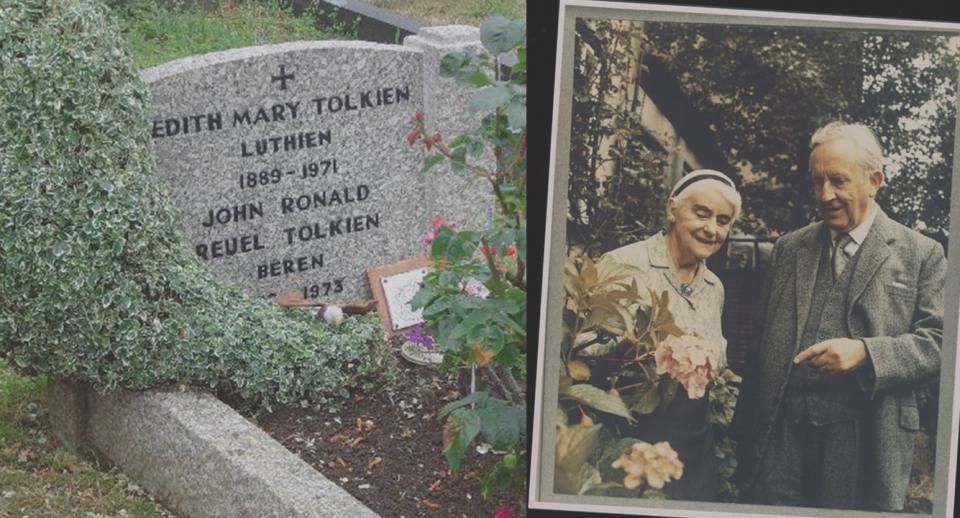
But the tale itself is an inbreaking of light, so bright, into the darkness, that shining eyes, stars and moon are at most a pale reflection of it. For it is the tale of Beren and Lùthien, the greatest of all Tolkien’s love stories, one so precious to him that he wanted those names to be inscribed beneath his and his wife’s names upon their gravestone. Aragorn, whose eyes shine with strange eagerness in the telling of it, perceives his own story as a kind of retelling of the tale.

Edith and John Tolkien. Lúthien and Beren.

“Beren was a mortal man, but Lúthien was the daughter of Thingol, a King of Elves upon Middle-earth when the world was young; and she was the fairest maiden that has ever been among all the children of this world. As the stars above the mists of the Northern lands was her loveliness and in her face was a shining light.”

A theme that recurs throughout the tale is one of the power of word and music. Lúthien is enchanted by hearing the sound of her own name upon the lips of Beren while, first Sauron and then Morgoth himself, of whom Sauron was but a servant, are overcome by Lúthien’s song. Does the chanting of the Lay that tells their tale invoke them at a moment in which “the offspring of the dark” make their attack or, perhaps more importantly even than this, invoke the same powers that aided them in their hopeless struggle with the dark? As Aragorn says to Sam after the attack, “More deadly to him [the Witch-king] was the name of Elbereth.”

The finest minds are those that are able to live with the greatest paradox. Surely at this pivotal moment in The Lord of the Rings the invasion of the desperately fragile “circle of light” and the telling of the tale that invokes a hope that is not broken even by the greatest evil is the coming together of Tolkien’s antitheses of eucatastrophe and dyscatastrophe, of heavenly light and the darkness of hell.

At Weathertop With a Long Journey Ahead. Frodo Longs to Go Home.

The Fellowship of the Ring by J.R.R Tolkien (Harper Collins 1991) pp 180-84

There are moments in any great venture in which its sheer scale becomes all too much. There is no shame in such moments. Who, upon setting out on a great journey, can possibly know all that lies ahead? Modern life seems to require the elimination of as much risk and unpredictability as possible. Those who try to sell us a holiday will brand the experience as an adventure but a true adventure is something in life in which the end is uncertain. A holiday, by comparison, is a distraction from our regular routine.

Later in the story, after he has had much more experience of adventure, Sam will reflect on this with Frodo.

“The brave things in the old tales and songs, Mr. Frodo: adventures, as I used to call them. I used to think that they were things the wonderful folk of the stories went out and looked for, because they wanted them, because they were exciting and life was a bit dull, a kind of sport, as you might say. But that’s not the way of it with the tales that really mattered, or the ones that stay in the mind. Folk seem to have been landed in them, usually- their paths were laid that way, as you put it. But I expect that they had lots of chances, like us, of turning back, only they didn’t.”

And it is upon Weathertop, with the first view of snowcapped mountains ahead of him and long leagues of open country between him and the horizon, that Frodo longs to be safe at home, longs to be able to turn back, wishes “bitterly that his fortune had left him in the quiet and beloved Shire.”

Frodo and his companions have been landed in a story that is quite simply much too big for them. As Gandalf said to Frodo in the sitting room at Bag End it would appear that, first, Bilbo, and then Frodo, were meant to have the Ring. Why this should be is unknown to either them or anyone else. It is not because of their wisdom or might. Later the story will be told about them that will draw attention to both of these qualities but the hobbits will never draw attention to themselves in this regard.

But what of the other heroes that are mentioned in the pages about which we are thinking here? What of Gil-galad and Elendil? They were kings of Elves and of Humankind who were confronted by the might of Sauron at the end of the Second Age. Gil-galad was the last great elven king in Middle-earth, capable of raising an army to fight the Dark Lord in all his power in open battle. Elendil, whose very name means elf-friend, had remained faithful to that friendship when Sauron had seduced Númenor to the worship of Morgoth. He, his family and followers, were literally carried by a great wave to the shores of Middle-earth. It was friendship that brought the last alliance together just as it was friendship that caused the hobbits to leave the Shire with Frodo.

And so it always seems to be. Something compels us to make a choice, to take an action that we never anticipated. There comes a moment in which the thought that we might have to deny something essential about ourselves becomes intolerable. Merry, Pippin and Sam could not have denied their friendship with Frodo to allow him to journey into the wild alone. Elendil could not have denied the friendship that was the meaning of his very name.

And Aragorn, or Strider as we know him in this part of the story, cannot deny the destiny that he must seek to fulfil, spending the years of his manhood as a homeless wanderer in the lands of Middle-earth, sneered at by people like Bill Ferny in Bree. Despite all of his doubts about the hobbits he has promised to save them by life or death if he can.

And so it is on Weathertop, with the signs of Gandalf’s battle about them and the Black Riders assembling on the road beneath them that the companions must try to go on together, hoping against hope.

A Journey into the Wild Pursued by Enemies. The Hobbits and Strider Set Out From Bree to Rivendell.

The Fellowship of the Ring by J.R.R Tolkien (Harper Collins 1991) pp.169-80

Up until this point of the journey the hobbits have been more or less “looked after”. Even though almost from the beginning their steps have been dogged by the pursuit of the deadliest of enemies in the shape of the Nazgûl of Mordor they have been able to find protection from such mighty allies as the company of High Elves led by Gildor Inglorien or Tom Bombadil in the Old Forest and the Barrow Downs. And as well as the hospitality they enjoyed in the house of Tom Bombadil and Goldberry they have been well fed and watered in the farmhouse of the Maggots and the Prancing Pony in Bree.

But now the nature of the journey makes a sudden change with the attack upon the Prancing Pony in the night. The hobbits lose their ponies and set off with a poor half-starved creature belonging to Bill Ferny, the biggest villain in the Breeland, who is certainly in league with the Black Riders and who makes as much money as he can from their misfortune.

When I say, misfortune, I mean the fact that, from their perspective, that what they thought was going to be a road journey by sturdy pony from Bree to Rivendell, has become a hard march, a yomp as soldiers call it, across hard terrain, carrying heavy loads, with no shelter. Their only pony has to carry as much food as it can take for a fortnight’s journey and the hobbits have to take the rest upon their backs. Only Strider is not much discomfited by this. For him a yomp from place to place is normal life and he has but one extra burden to carry and that is the care of four companions about whose capacity to deal with hardship he has many doubts. Butterbur has already voiced these aloud through his remark that the hobbits are acting as if they are on holiday but even with these doubts in mind Strider has already made up his mind.

“I am Aragorn son of Arathorn; and if by life or death I can save you, I will.”

The journey really begins with the crossing of the Midgewater Marshes. Tolkien never liked boggy country. I was about to say that nobody does but at one time a whole way of life was developed by people living in the fenland of eastern England or the Somerset Levels. Those who know their English history will treasure the year 877 when all that remained of free England was the Isle of Athelney hidden deep in the Somerset Levels when Alfred the Great hid there from Danish invaders. Some call this place the birthplace of England, a place so remote that the Danes could not reach it with sufficient forces to capture the king. Others will remember the last defence of Hereward the Wake against the all conquering armies of William of Normandy on the isle of Ely in the Cambridgeshire fens two centuries later when he too used the natural defence of the bog against his enemies. But a bog makes good defence because it is hard to cross by foot. I remember once having to cross one late in the day. I was grateful for the sturdy stick that I had with me. Every step that I took required a careful use of the stick to find ground firm enough to take my weight and I would often use it to swing across from tussock to tussock hoping that I would not miss my footing and find my boots and then my legs disappearing into the ooze. Recently I learned that in the trenches of the First World War British soldiers feared the mud more even than shells exploding about them and that many of them drowned in that mud.

Tolkien knew the mud of the Western Front at first hand and hated it. Is it a coincidence that two of the great journeys of The Lord of the Rings begin with a journey across marshland, the journey from Bree to Rivendell and later the journey of Frodo and Sam from the Emyn Muil to Mordor. For Tolkien nothing would better express the hardships that lay ahead. For the hobbits even the companionship of the greatest traveller of his age cannot protect them from the hardships that they must now endure.

Not All Those Who Wander Are Lost. Gandalf’s Letter Commends Aragorn to the Hobbits.

The Fellowship of the Ring by J.R.R Tolkien (Harper Collins 1991) pp. 160-168

It is Gandalf’s letter that he had left with Barliman Butterbur that eventually convinced the hobbits to trust the strange man who goes by the name of Strider. Of course, when I say, trust, it must be said that Sam Gamgee did not really trust him. Sam has grown up in a small world,”in a little circle of light,” as Tolkien put it in his essay on Beowulf, The Monsters and The Critics, from which “men with courage as their stay went forward to that battle with the hostile world and the offspring of the dark which ends for all, even the kings and champions, in defeat.”

Not that Sam expects his journey to end in defeat. Sam Gamgee is a happy ever after kind of a man who expects things, even the darkest things, to end well. Much will ride upon this quality in the events that lie ahead. But Sam has grown up in a little circle of light and regards the world outside as dark and hostile. He does not know how to distinguish between the offspring of the dark and the kings and champions; not yet at any rate. But the strange man who now stands before the hobbits knows this world very well indeed. Speaking of the Black Riders who are pursuing the hobbits he says:

“They will come upon you in the wild, in some dark place where there is no help.”

This man knows about about the offspring of the dark. “They are terrible!” He has wandered the wild and dark places of the earth for many years having been sent out from the circle of light that is Rivendell by Elrond, its lord, who has been as a father to him. I have written about him and his story in greater detail in other places in this blog over the years and if you click on the tag, Aragorn, at the end of this post, you will be able to read these if you so wish but as this is the first time in The Lord of the Rings in which we meet this king and champion it would be good to say a few things about him.

This is Aragorn, son of Arathorn, chieftain of the Rangers of the North, the last of the line of Isildur, son of Elendil, the hero who cut the Ring from the finger of Sauron with the shards of Narsil his father’s sword. Aragorn still carries those shards, “the blade that was broken”, the symbol of his diminished house. And Elrond sent him out from the circle of light to “that battle with the hostile world and the offspring of the dark” when he was a young man in order that he might undergo an apprenticeship that will lead to this crownless one becoming king.

In this apprenticeship he serves in the armies of Ecthelion, Steward of Gondor, and of Thengel, King of Rohan and he befriends Gandalf, aiding him in his long struggle against the dark. Through all these long years he is sustained by hope, hope that his wandering will not end in defeat but in the renewing , not just of the blade that was broken but of his people. And he is sustained by love, for he loves Arwen Undómiel, daughter of Elrond, who returned his love, but he cannot win her hand in marriage except as king of both Gondor and of Arnor, the first to sit upon both thrones since the great founder of his house, Elendil and he cannot achieve his longings unless the Dark Lord, Sauron, is finally and utterly defeated. So it is that he meets a hobbit who does “want looking after and no mistake”, who might be “on a holiday” and not at the heart of the greatest events of his age and he has to base all his longing upon this encounter and because of his friendship with Gandalf he chooses to do so. “If by life or death I can save you, I will.”

I began these thoughts with a quotation from Tolkien’s essay on Beowulf. In it Tolkien describes an heroic but ultimately hopeless world. Despite their courage the heroes, “even the kings and champions” are finally defeated in their struggle against the dark. Aragorn has no idea whether or not his story will end in defeat. He has to place his trust, all the longings of his life in this slenderest of threads. Is this a story of hope fulfilled or of defeat and darkness? Will Aragorn’s wanderings end in a homecoming or will he be lost in the wilderness?