“It Was Sam’s First View of a Battle of Men Against Men and He Did Not Like It Much.” Tolkien Brings His Memories of War to His Great Tale.

The Two Towers by J.R.R Tolkien (Harper Collins 1991, 2007) pp.858-865

Sam is already battle hardened standing by Frodo at the attack of the Nazgûl at Weathertop, at the attack of wargs near the doors of Moria and again within Moria at the Chamber of Mazarbul when orcs and trolls assailed the Fellowship. It is not battle itself that affects him so deeply, that realisation that someone is your enemy and wishes you harm, wishes even to kill you, it is, as the English poet Wilfred Owen put it, “the pity of war” that touches his heart when the Rangers of Ithilien ambush the Men of Harad as they march northwards to the Black Gate of Mordor.
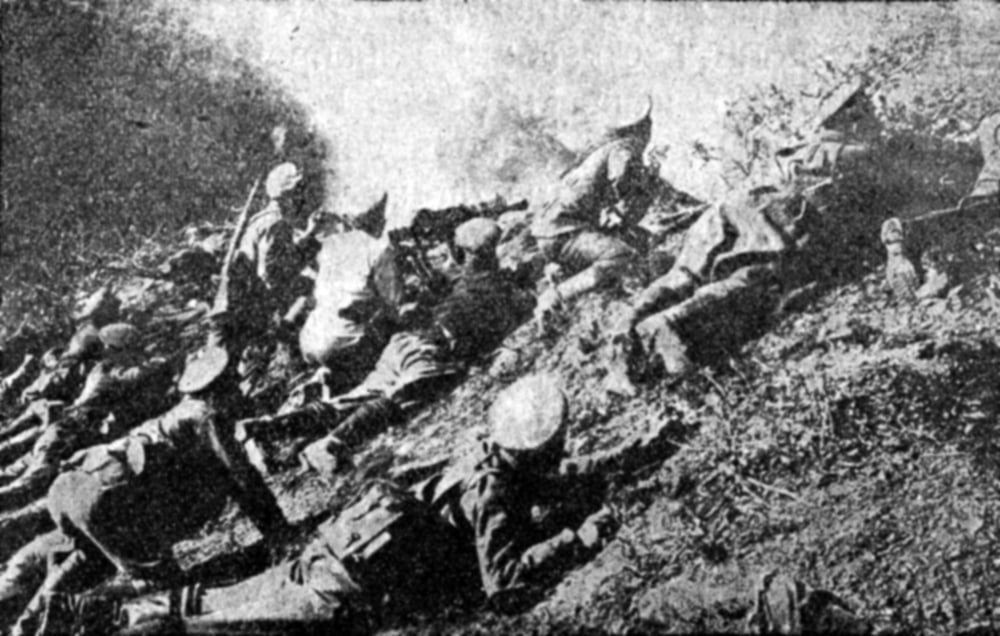
War in the trenches of the First World War of 1914-18

There are few passages within The Lord of the Rings that have the feel of the war literature of the 20th century as this one. Here we are reminded, if we need it, that Tolkien was writing a novel of his century and not a mere pastiche of medieval heroic literature. Tolkien was himself a veteran of the war in the trenches in France and took part in the Battle of the Somme that began on the 1st of July 1916 in northern France and during which a million men were either killed or wounded. The memory of that battle still casts a shadow over western Europe over a hundred years after it took place. My father gave us very little education in any deliberate sense; most of what I learned from him I did by observation rather than because he told it to me, but he was anxious to tell us of the horror of war and how a war in Europe should never be repeated. He himself was a veteran of the Normandy landings of June 1944 and his father of the naval Battle of Jutland of May 1916 and the memory of war played an important part in my education.

The capture of Frodo and Sam by Faramir and his men takes place just before the ambush begins and it is a measure of Faramir, the captain of war, that he does not treat his captives as mere irrelevances in the face of the serious matters of killing and being killed. In the few moments available to him he allows Frodo to tell his story before assigning two of his men to guard them. As they wait for battle to begin Mablung and Damrod speak of their leader and the respect in which they hold him. “He leads now in all perilous ventures,” they tell Frodo and Sam, and they are proud to follow him.

See ‘Faramir the Captain’ by Anke Eissman. Note how relaxed most of his men are. He is in charge and they don’t need to worry about what they have to do.

Tolkien gives us no overview of the battle that follows. We see it through Sam’s eyes, listening to the sound of steel against steel or metal cap, like the sound of “a hundred blacksmiths all smithying together”. We feel the terror as an oliphant charges straight towards them, veering away from them at the very last moment and we see a young warrior of Harad fall dead at their feet. Through all this their main ambition is to survive. Doubtless if battle had overtaken them they would have fought bravely but heroic deeds are not their first concern. This too is true to Tolkien’s memories of the trenches and of modern warfare.

The moment when Sam looks at the dead warrior is deeply moving. We are not shown war from the perspective of the war historian or the general in the staff room. We see it through the eyes of one man alongside other men. “It was Sam’s first view of a battle of Men against Men, and he did not like it much. He wondered what the man’s name was and where he came from; and if was really evil of heart, or what lies and threats had led him on the long march from his home; and if he would not really rather have stayed there in peace”.

Robert Runcie, Archbishop of Canterbury between 1980 and 1991, was a tank commander during the Second World War, winning the Military Cross, the second most important medal for valour that can be offered to the British Armed Forces for rescuing one of his wounded men from a crippled tank while under heavy enemy fire. He was greatly criticised by politicians for expressing sympathy and compassion for Argentine soldiers after the Falklands War of 1982. What moved him to speak of his pity was his memory of an incident in which his tank took out a German tank in battle and how, as was required of him, he checked to see if there were any survivors. He remembered looking into the tank and the dead young men within it and thinking of their mothers, wives and girlfriends who would never see them again. It was a Sam Gamgee moment and it remained with him for the rest of his life.

I haven’t found a photograph of Robert Runcie from the Second World War. You can tell that this is a photo of a British tank on show for the “top brass”, senior British officers, not one in the heat of battle.
Frodo is Lucky to Be in Rivendell “After All the Absurd Things” He Has Done Since Leaving Home.

The Fellowship of the Ring by J.R.R Tolkien (Harper Collins 1991) pp. 213-19

As I wrote last week it is altogether too pleasant to think of getting out of bed after nearly three weeks in the wild since leaving Bree. Even Gandalf’s chastisements feel like pleasantries compared to the terror of the attack below Weathertop, the agony of the long miles from that moment and the flight across the Fords of Bruinen with the Black Riders in close pursuit.

Frodo recalls all that has happened to him. “The disastrous ‘short cut’ through the Old Forest; the ‘accident’ at The Prancing Pony; and his madness in putting on the Ring in the dell under Weathertop.” But he is still too tired to be able to judge himself and besides Gandalf continues after a long pause:

“Though I said ‘absurd’ just now, I did not mean it. I think well of you-and of the others. It is no small feat to have come so far, and through such dangers, still bearing the Ring.”

It is a major part of Tolkien’s skill as a storyteller that we have become so used to seeing the story through the eyes of the hobbits as, apparently, they stumble from one near disaster to another from the moment they set out from Bag End that we do not realise what an achievement their safe arrival in Rivendell is. Months later, in the pavilions at the Field of Cormallen, a bard will sing of these things as the deeds of mighty heroes and the armies of Gondor and Rohan will acclaim Frodo and Sam as such. For their part, the hobbits do not believe their own press. Perhaps it is as well that they don’t. To regard oneself as a hero is unwise. In a few weeks time we will be introduced to a character who longs to be seen by others as a mighty hero and have them come flocking to his banner. Things will go badly for him before his final redemption.

We could have looked at the journey of the hobbits from a number of other perspectives than their own. For poor old Fatty Bolger even the choice to go through the Old Forest is madness and that is before he encounters the Black Riders for himself. Aragorn does not think very highly of them, certainly at first when he meets them in Bree. After the raid on The Prancing Pony by the Black Riders and the loss of the pack ponies he gazes long at the hobbits “as if he was weighing up their strength and courage”. We get the impression that, at this stage of the story, he does not have much expectation of their ability to make the journey to Rivendell.

He is nearly right, of course. And so is Gandalf. Frodo and his companions are lucky to have reached Rivendell. But then so too is Aragorn. And, as we shall learn later, so too is Gandalf. Perhaps it is Tom Bombadil who sees things with the most clarity. Tom makes no judgements about the hobbits knowing, as he does, the dangers of the world. Through his experience over many years he has learned the measure of these dangers, both those against which he can pit himself and those against which he cannot. As he says before his final farewell to the hobbits, “Tom is not master of Riders from the Black Land far beyond his country”.

And yet, despite their own frailties, despite their inexperience, even despite the power of the Nazgûl, Frodo and his companions arrive safely in Rivendell. Perhaps, as Frodo says, it was Strider who saved them. Perhaps, as Gandalf puts it, “fortune or fate” helped them, as well as courage. Perhaps, as we weigh up the challenges of life that we must face it is wise if we do not do too much ‘weighing up’. Either we will put too much confidence in our own ability or we will be so terrified that, like Fatty Bolger, we will never try the journey at all. Bombadil’s final advice to the hobbits remains the best. He tells the hobbits simply to be themselves. “Be bold, but wary! Keep up your merry hearts, and ride to meet your fortune!” And this is just what Frodo and his companions have done. And we might say also, this is what fortune has done too.

On Deadly Wounds and Their Healing. Aragorn Tries to Offer Frodo Some Relief After the Nazgûl Attack.

The Fellowship of the Ring by J.R.R Tolkien (Harper Collins 1991) pp. 190-94)

There are times in a reading of The Lord of the Rings in which it is necessary to know that we are reading is not the kind of history that is a listing of events but a mythology. Doubtless it would do all students of history good to recognise the quasi-mythological nature of every historical narrative but Tolkien was not attempting a historical narrative that we must then seek to demythologise. He consciously sought to create a mythology, a sub-creation that honoured God. And so it is here in this description of the attack upon the camp below Weathertop by the Nazgûl. Could they have seized the Ring, even slaying the hobbits and Aragorn too? We must assume that they could. That they expected that Frodo would gradually fall under the malign influence of the Morgul-blade, a fragment of which was left in his shoulder, is without doubt, but the very nature of Frodo’s resistance to their attack shows that what happened that night was a spiritual battle as much as a clash between two forces of warriors. If it had merely been the latter I fear that the brave adventure of the hobbits would have ended that night and the Ring taken to be restored to its maker.

As we saw last week Aragorn’s singing of The Lay of Leithian, the Tale of Beren and Lúthien, took the company into the spiritual milieu of the Elder Days and the songs of Lúthien that overcame Sauron and even Morgoth long ago. Aragorn invokes the same powers as did his ancestors and so the fragile circle of light that the Nazgûl invade is a different place to the simple camp that the travellers had earlier created.

So it is that even though, to his shame, Frodo is unable to resist the command of his foes to put on the Ring, he is able, even while wearing it, to invoke the name of Elbereth, the Queen of the Valar, the angelic beings charged by God to watch over the earth.

This was the name invoked by the company of Gildor Inglorien that drove away the Black Rider on that first encounter in the woods of the Shire .

“Snow-white! Snow-white! O Lady dear! O Queen beyond the Western Seas! O light to us who wander here amid the world of woven trees!”

Gildor named Frodo, elf-friend, that night, and such names are not a trivial thing in Tolkien’s world but convey a reality. “More deadly to him was the name of Elbereth,” says Aragorn, speaking of Frodo’s resistance to the Morgul-king’s attack. And just as there is all the difference in the world between the casual naming of Jesus in everyday chatter and a cry to him in desperate need so too the naming of Elbereth by an elf-friend in need has great power, far more power than that of Frodo’s will to resist.

And so the Nazgûl withdraw for a season, ringless for the present but confident that soon Frodo will be a wraith like them and powerless to resist them any longer. But there is another power at work. Aragorn goes off in search of athelas. He knows this land and where he might find what he seeks. “It is a healing plant that the Men of the West brought to Middle-earth… It has great virtues, but over such a wound as this its healing powers may be small.”

Later in the story Aragorn will be revealed to his people through the acts of healing that he will accomplish through the use of this herb but for now he has not yet come into his own, his kingdom, and he can do little more than stay the effects of the Morgul-blade. But perhaps all that he can do as a healer is to assist the healing that another desires. Later Éowyn will be healed, not by Aragorn’s power, but by her willingness to embrace the future and to let the past be at rest. For his part Frodo will be healed by the “Gentle Purgatory” (as Tolkien put it in a letter on the subject) that he will eventually accept and undergo in the Undying Lands. For now Frodo must endure his wound while his foes wait for the opportunity to seize the Ring and so to triumph.

The Tale of Beren and Lúthien Tinúviel. Aragorn Brings Aid at a Moment of Deadly Peril from the Unseen World.

The Fellowship of the Ring by J.R.R Tolkien (Harper Collins 1991) pp. 184-191

Aragorn’s telling of the Tale of Tinúviel is a thing of beauty and draws us in so near that we want to lose ourselves in it as, for a brief moment, are its teller and its four hearers.

“As Strider was speaking they watched his strange eager face, dimly lit in the red glow of the wood fire. His eyes shone and his voice was rich and deep. Above him was a black starry sky.”

The travellers are sheltering in a dell below Weathertop and, as well as the shining of Aragorn’s eyes and the sky, aflame with starlight, the moon rises above the hilltop. Three shinings on a night of ever present danger. For close at hand, five of the Nazgûl, led by their lord, are stealthily approaching the camp. Soon they will attack and a Morgul blade will pierce Frodo’s shoulder yet, as we readers of the tale listen to Aragorn, even if we have read it many times, we are as glad to be lost in it for a moment.

In Verlyn Flieger’s wonderful study, The Splintered Light, she begins by reflecting upon two apparently contradictory elements within Tolkien’s mind and in his work. One is the eucatastrophe of the fairy tale. The entirely unexpected and yet longed for happy ending that transforms all the suffering that has gone before. The other is the dyscatastrophe, the final defeat suffered by even the greatest hero. In his wonderful lecture, The Monsters and the Critics, Tolkien expresses this with heartbreaking poignancy.

“The great earth, ringed with… the shoreless sea, beneath the sky’s inaccessible roof, whereon, as a little circle of light about their halls, men with courage as their stay went forward to that battle with the hostile world and the offspring of the dark which ends for all, even the kings and champions, in defeat.”

“A little circle of light.” Was Tolkien alluding to this when he drew our attention to the shinings in that most fragile of “halls” in the dell below Weathertop? Perhaps, and so we might ask if the ending of the chapter that is so menacingly entitled, A Knife in the Dark, is the dyscatastrophe, the inevitable defeat suffered by all heroes. Frodo himself cries out in despair when he first learns that the Ring itself draws the Nazgûl towards him, “Is there no escape then?… If I move I shall be seen and hunted! If I shall stay, I shall draw them to me!”

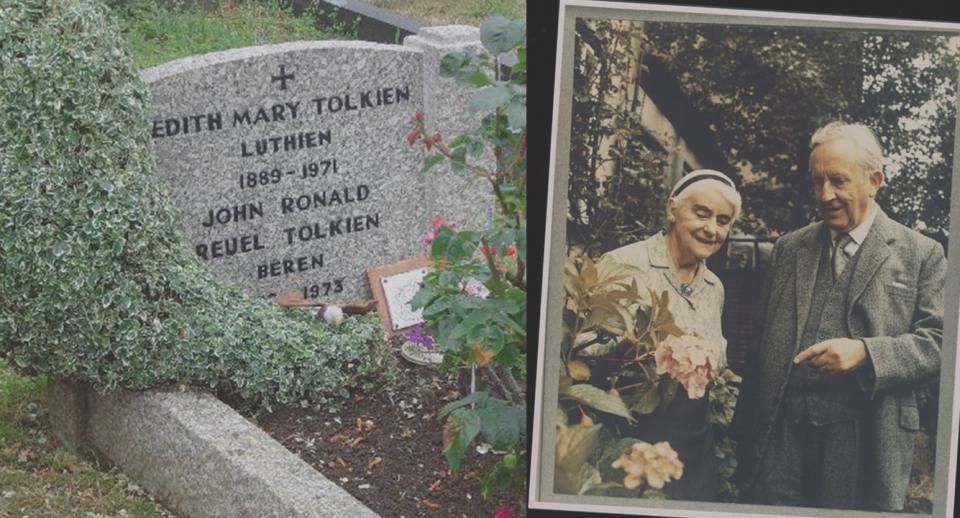
But the tale itself is an inbreaking of light, so bright, into the darkness, that shining eyes, stars and moon are at most a pale reflection of it. For it is the tale of Beren and Lùthien, the greatest of all Tolkien’s love stories, one so precious to him that he wanted those names to be inscribed beneath his and his wife’s names upon their gravestone. Aragorn, whose eyes shine with strange eagerness in the telling of it, perceives his own story as a kind of retelling of the tale.

Edith and John Tolkien. Lúthien and Beren.

“Beren was a mortal man, but Lúthien was the daughter of Thingol, a King of Elves upon Middle-earth when the world was young; and she was the fairest maiden that has ever been among all the children of this world. As the stars above the mists of the Northern lands was her loveliness and in her face was a shining light.”

A theme that recurs throughout the tale is one of the power of word and music. Lúthien is enchanted by hearing the sound of her own name upon the lips of Beren while, first Sauron and then Morgoth himself, of whom Sauron was but a servant, are overcome by Lúthien’s song. Does the chanting of the Lay that tells their tale invoke them at a moment in which “the offspring of the dark” make their attack or, perhaps more importantly even than this, invoke the same powers that aided them in their hopeless struggle with the dark? As Aragorn says to Sam after the attack, “More deadly to him [the Witch-king] was the name of Elbereth.”

The finest minds are those that are able to live with the greatest paradox. Surely at this pivotal moment in The Lord of the Rings the invasion of the desperately fragile “circle of light” and the telling of the tale that invokes a hope that is not broken even by the greatest evil is the coming together of Tolkien’s antitheses of eucatastrophe and dyscatastrophe, of heavenly light and the darkness of hell.

At Weathertop With a Long Journey Ahead. Frodo Longs to Go Home.

The Fellowship of the Ring by J.R.R Tolkien (Harper Collins 1991) pp 180-84

There are moments in any great venture in which its sheer scale becomes all too much. There is no shame in such moments. Who, upon setting out on a great journey, can possibly know all that lies ahead? Modern life seems to require the elimination of as much risk and unpredictability as possible. Those who try to sell us a holiday will brand the experience as an adventure but a true adventure is something in life in which the end is uncertain. A holiday, by comparison, is a distraction from our regular routine.

Later in the story, after he has had much more experience of adventure, Sam will reflect on this with Frodo.

“The brave things in the old tales and songs, Mr. Frodo: adventures, as I used to call them. I used to think that they were things the wonderful folk of the stories went out and looked for, because they wanted them, because they were exciting and life was a bit dull, a kind of sport, as you might say. But that’s not the way of it with the tales that really mattered, or the ones that stay in the mind. Folk seem to have been landed in them, usually- their paths were laid that way, as you put it. But I expect that they had lots of chances, like us, of turning back, only they didn’t.”

And it is upon Weathertop, with the first view of snowcapped mountains ahead of him and long leagues of open country between him and the horizon, that Frodo longs to be safe at home, longs to be able to turn back, wishes “bitterly that his fortune had left him in the quiet and beloved Shire.”

Frodo and his companions have been landed in a story that is quite simply much too big for them. As Gandalf said to Frodo in the sitting room at Bag End it would appear that, first, Bilbo, and then Frodo, were meant to have the Ring. Why this should be is unknown to either them or anyone else. It is not because of their wisdom or might. Later the story will be told about them that will draw attention to both of these qualities but the hobbits will never draw attention to themselves in this regard.

But what of the other heroes that are mentioned in the pages about which we are thinking here? What of Gil-galad and Elendil? They were kings of Elves and of Humankind who were confronted by the might of Sauron at the end of the Second Age. Gil-galad was the last great elven king in Middle-earth, capable of raising an army to fight the Dark Lord in all his power in open battle. Elendil, whose very name means elf-friend, had remained faithful to that friendship when Sauron had seduced Númenor to the worship of Morgoth. He, his family and followers, were literally carried by a great wave to the shores of Middle-earth. It was friendship that brought the last alliance together just as it was friendship that caused the hobbits to leave the Shire with Frodo.

And so it always seems to be. Something compels us to make a choice, to take an action that we never anticipated. There comes a moment in which the thought that we might have to deny something essential about ourselves becomes intolerable. Merry, Pippin and Sam could not have denied their friendship with Frodo to allow him to journey into the wild alone. Elendil could not have denied the friendship that was the meaning of his very name.

And Aragorn, or Strider as we know him in this part of the story, cannot deny the destiny that he must seek to fulfil, spending the years of his manhood as a homeless wanderer in the lands of Middle-earth, sneered at by people like Bill Ferny in Bree. Despite all of his doubts about the hobbits he has promised to save them by life or death if he can.

And so it is on Weathertop, with the signs of Gandalf’s battle about them and the Black Riders assembling on the road beneath them that the companions must try to go on together, hoping against hope.