“A Pawn Did Gandalf Say? Perhaps; But On the Wrong Chessboard.” Pippin Feels Out of Place Amidst Preparations for War in Gondor.

The Return of the King by J.R.R Tolkien (Harper Collins 1991) pp. 749-750

The Nazgûl that passed across the sun casting a shadow into the hearts of the defenders of Minas Tirith has gone and Pippin and Beregond sit silently for a time together for a time with bowed heads. Together they have spoken of the fear that hides within their hearts and a bond has been forged between them. Later this bond will save the life of Faramir and we will think about this on another occasion. Now Pippin of the Shire, one who as we have seen throughout the story is able to find courage and hope even when there seems to be no hope, stands up again and sees “that the sun was still shining, and the banners still streaming in the breeze.”

“No, my heart will not yet despair,” he declares. “Gandalf fell and has returned and is with us. We may stand, if only on one leg, or at least be left still upon our knees.”

When times seem hope-less we need friends who, like Pippin, seem almost constitutionally incapable of giving way to despair. We remember that it was Pippin who, when he and Merry were the captives of the orcs of Isengard, cut his bonds with a fallen orc blade and was able to leave his leaf broach, given to him in Lothlórien, on the plains of Rohan. Would anyone ever see this sign and follow them? Pippin did not know. But he refused to give in.

Defiance is kindled within the heart of Beregond and he stands tall once more. And we can imagine conversations like this taking place throughout the city as soldiers seek to en-courage one another. Indeed so much does Beregond recognise this quality of encouragement within his new companion that he invites Pippin to join him in his company’s mess hall. He wants to give a piece of Pippin to his comrades and they, in their turn welcome all that Pippin can give, plying him with so much food and drink that he has to take special care not to allow his tongue to run away with him. Pippin, the careless, is growing in wisdom on his journey.

And this is not the only way in which Pippin is growing in wisdom. He is beginning to learn what lies, what truly lies, within his heart. We might forgive a young man as he is, one who might naturally seek the approval, even admiration, of his fellows, if he were to begin to boast and swagger among them. Anyone who has ever spent time in the company of young men will know that a good deal of this goes on when they gather together. “Look at me!” they seem to be saying to one another. But Pippin is not a boy any longer. He has seen death and horror and, perhaps most importantly of all, he has known failure. And now as he watches Beregond the warrior of Gondor rousing his heart for battle he recalls some words that Gandalf spoke to him as they left their interview with Denethor.

“The Enemy has the move, and he is about to open his full game. And pawns are as likely to see as much of it as any, Peregrin son of Paladin, soldier of Gondor. Sharpen your blade!”

Gandalf likens the war to a game of chess and Pippin to a pawn upon the board waiting to be moved into position by others, knowing that often it is the part of pawns simply to be sacrificed for what is deemed a higher purpose. Pippin does not resent the title that is given to him. He has no pretence to any higher status within the game. He is no more significant a part of the game than anyone else. Indeed, as he watches Beregond stirring up his courage as he strikes the hilt of his sword he feels himself undeserving even of the title of pawn.

“A pawn did Gandalf say? Perhaps; but on the wrong chessboard.”

Pippin suddenly feels that he has no right to be anywhere near the war that is about to break out, no right to wear the livery of a soldier of Gondor among those who, in his eyes, deserve to be given this title. Perhaps it is just as well that he does not know that all the smiting of hilts and all the cries of defiance are, in truth, and in part at least, the efforts of his new comrades to be hide their own fears. We might even look back to Gandalf’s reply to Frodo when he realised the danger that his possession of the Ring had brought him and cried out that he wished it need not have happened in his time.

“So do all who live to see such times,” Gandalf replied.

So do all. And so does Pippin. And Beregond too.
“For if We Fall, Who Shall Stand? And, Master Peregrin, Do You See Any Hope That We Shall Stand?” Beregond and Pippin on the Walls of Minas Tirith.

The Return of the King by J.R.R Tolkien (Harper Collins 1991) pp. 745-749

After Pippin and Beregond look to the welfare of Shadowfax and find food together they make their way onto the walls of the city and look out, north, east and south as final preparations are made for war. Far below them, on the road that winds through the Pelennor Fields, they see a line of wagons bearing the sad cargo of the women and children of the city heading southward, the ancient sign of war. The most vulnerable are torn from their homes and will rely now upon the kindness of strangers. So it continues until our own times.

Beregond may not be one of the captains of Gondor but he is a man who thinks both widely and deeply, and he begins to reflect upon the strategic peril of his own land and also of the free lands of the West. Already there is news that the Corsairs of Umbar are sailing towards the seaport of Pelargir; and because of the threat they pose the people of the south are staying near their homes in order to defend them instead of coming to the aid of Minas Tirith. And then Beregond ponders the events in Rohan that Pippin has described to him.

“The doings at Isengard should warn us that we are caught now in a great net and strategy. This is no longer a bickering at the fords, raiding from Ithilien and from Anórien, ambushing and pillaging. This is a great war long planned, and we are but one piece in it, whatever pride may say.”

At last Pippin and Beregond look out towards the east from which the darkness comes and Beregond asks of Pippin and of his own heart the question to which he most fears an answer.

“Here will the hammer-stroke fall hardest. And for that reason Mithrandir came in such haste. For if we fall, who shall stand? And Master Peregrin, do you see any hope that we shall stand?”

Is there any hope? That is the question that everything comes to. And as Beregond asks the question so Pippin’s imagination is filled with memories of the journey that he has undertaken. He thinks of the Uruk-hai of Isengard in the woods and the fall of Boromir and he remembers the pursuit of the Nazgûl in the lanes of the Shire at a time when he had little understanding of the peril that they represented. And as he remembers them and all that he has known of their terror a shadow passes across the sun and Pippin turns white and cowers against the wall. Beregond bears no judgement at all as he sees Pippin’s reaction.

“You also felt something?”

“Yes,” muttered Pippin. “It is the sign of our fall, and the shadow of doom, a Fell Rider of the air.”

“Yes, the shadow of doom,” said Beregond. “I fear that Minas Tirith shall fall. Night comes. The warmth of my blood seems stolen away.”

Pippin and Beregond seem overwhelmed by the horror that is coming to assail them. Every hope, every dream that they may have carried in their hearts both for themselves and for those that they love is extinguished in their hearts. All that there is is darkness. We are reminded of the account of the Last Supper that is given by St John and the moment when Judas Iscariot goes from the upper room to betray Jesus to the Temple authorities and the words that conclude this part of the story.

“And it was night.”

In the greatest stories, perhaps even in the story that is our life, there will come a moment when there is only darkness that can be seen and there seems no light beyond it. We saw Sam Gamgee kneel beside the body of Frodo, filled as it was with Shelob’s venom. We fell to the ground in horror with the Fellowship after the fall of Gandalf at the Bridge of Khazad-dûm. At those moments all hope seemed lost. But there was still a moment beyond that. And another one, and another. And in some way another step was taken. And another. As Aragorn said at the eastern gate of Moria. “We shall go on without hope.”

“Maybe It Was the Ring That Called to The Wraith-lord, and For a Moment He Was Troubled.” A Contest of Powers Within the Morgul Vale.

The Two Towers by J.R.R Tolkien (Harper Collins 1991) pp. 730-734.

Travelling through Scotland and having forgotten my usual edition of The Two Towers I am grateful to my sister in law, Elinor Farquharson and her husband, Geoffrey, of Edinburgh, for the loan of their single volume edition of The Lord of the Rings.

The short time that the companions spend at the Cross-roads is one of poignant tension between hope and despair, between light and darkness, and Tolkien immediately draws our attention to this at the beginning of the chapter entitled, The Stairs of Cirith Ungol, as Frodo turns his back reluctantly on the West and his face towards the East and to darkness. Gollum leads Frodo and Sam towards the tower of Minas Morgul and up the first steps of a path that crawls upwards “into the blackness above”.

Frodo is exhausted, feeling the great burden of the Ring for the first time since he entered Ithilien, but perhaps there is another power at work. “Weariness and more than weariness oppressed him; it seemed as if a heavy spell was laid on his mind and body.”

All the way through this passage we are aware of many powers at work, sometimes it would seem in contest with one another. The Lord of Minas Morgul, the Witch King of Angmar, Lord of the Nazgûl, is a master of dark magic and he has wreathed the very air about his fastness with spells that rob any who might dare to venture towards it of the will and strength to continue their journey. Tolkien is not explicit about this but when he says that “it seemed as if a heavy spell was laid on his mind and body” there are dark powers at work here.

Perhaps if this were an ordinary day in the foul history of Minas Morgul it would not have been long before Frodo and Sam were discovered. But this is no ordinary day. It is the day upon which Sauron, filled with fear that one of his foes has taken possession of the Ring, sends forth an army to take possession of Minas Tirith, the greatest fortress of his enemies.

“So great an army had never issued from that vale since the days of Isildur’s might.”

And this great army and all the carefully choreographed terror that goes before it and which surrounds it achieves precisely an end for which it was never intended. So great is the energy of the powers both of Minas Morgul and of Barad-dûr that is poured into the departure of the army, an energy whose intention is to terrify the army of Gondor and to rob it of what courage remains to it, that for a brief moment the powers of the Morgul fortress are unaware of what is taking place beneath their very noses. The Ring of Power is passing the armies of Mordor borne by one whose intention it is to destroy it if he can.

And the Ring-bearer is almost caught. The Nazgûl Lord, the king who almost stabbed Frodo to the heart in the dell below Weathertop, pauses for a moment. “He was troubled, sensing some other power within his valley.”

He begins to reach out towards that power just as he did below Weathertop but unlike on that occasion when Frodo felt compelled to put on the Ring this time he is able to resist. He has a strength now that he did not possess before. Eventually this strength will tempt him to take possession of the Ring but now he knows that he does not yet have the power “to face the Morgul-king- not yet”.

That “not-yet” tells us that one day soon he will try to use the Ring, to become its lord, but now it works in Frodo’s favour.

And there is one more power at work. Frodo becomes aware that his hand is moving, unbidden, at least by him, towards the Ring, but as it does so it finds the star-glass of Galadriel, in which the light of the Silmaril, borne by Eärendil into the undying lands and set as a star in the heavens by Elbereth herself. His hand folds about it and the Witch King ceases from his search and moves on.

At this moment the power of the star glass is enough but what if the Witch King had given his entire attention to his search for the power that briefly he is aware is present in his valley? Would Frodo, even aided by the glass, even aided by the Ring, have had the strength to resist? But this test never takes place. It is an exquisite irony that so much has been put into the choreography of the departure of the army of Minas Morgul that the Witch King is distracted, just enough, from finding the very thing that has the power to destroy his lord.

“The Nine Walkers Shall Be Set Against The Nine Riders That Are Evil.” Thoughts on the Power of Symbols in The Lord of the Rings.

The Fellowship of the Ring by J.R.R Tolkien (Harper Collins 1991) pp. 269

I had intended to start blogging on The Two Towers this week but events in my islands have got me thinking a lot about the nature of power. It will be the subject of my sermon in the village parishes in the Shire, that I care for, tomorrow. The event, of course, to which I refer, is the death of Queen Elizabeth II and this Sunday, the 18th September, will be the eve of her funeral in Westminster Abbey.

I came across an interview with former President, Bill Clinton, on YouTube this last week about Queen Elizabeth. In this interview the question was raised as to why heads of state, including President Biden, from around the world are going to gather in London for the funeral of a woman who wielded very little power and was head of state of a country that also has no longer great geopolitical significance. For a moment, it seemed to me, the interview got a bit stuck until Clinton and his interviewer both agreed on the fact that Queen Elizabeth was “one helluva woman” and both laughed and the interview moved on.

Now, if there is someone who ought to know that power is not merely a matter of (to refer to Joseph Stalin’s crude comment about the Pope) how many army divisions someone has, it ought to be Bill Clinton. I remember once listening to two wise women discussing a fictional biography of Hillary Clinton and noted, with some fascination, that when they started to talk about Bill they were soon giggling like teenage girls. What, I wondered, as a mere male, causes that kind of reaction in normally mature women?

I think, by this point, we are beginning to see that there is more to power than mere strength and this is a major theme that runs through The Lord of the Rings. Right from the start of the Quest in Rivendell Elrond makes it clear that it will not be because of might that Sauron will be overthrown. “Had I a host of Elves in armour of the Elder Days,” he says, “it would avail little, save to arouse the power of Mordor.” For Boromir this very admission diminishes the value that he places upon Elrond and all that he represents. “The might of Elrond is in wisdom not in weapons,” he says, and it is quite clear that he regards weapons more highly than wisdom. How many divisions, he might ask, does Elrond have?

Sauron would ask the same question and it was because of his understanding of power as a simple application of strength that he forged the One Ring in the first place. As the title of the current Amazon series tells us, it is a Ring of Power, of absolute Power. That is what makes it such a fearful thing but it also that which makes Sauron so vulnerable. For one thing he has no understanding of the power of something like friendship. To choose four hobbits to stand against the might of the Nazgûl would seem laughable to him. And as Gandalf says at the Council, “the only measure he knows is desire, desire for power; and so he judges all hearts. Into his heart the thought will not enter that any will refuse it, that having the Ring we may seek to destroy it. If we seek this, we shall put him out of reckoning.”

The very rejection of a certain kind of power is a key theme throughout The Lord of the Rings but Elrond shows that there is another kind of power, about which Sauron also has no understanding, and that is the power of symbol. All symbols point towards something else than themselves. They are, by their very nature, signposts. The Nazgûl are by their very nature simply themselves, men that have become wraiths whose power derives from the Ring of Power and the fear that this creates. The Nine Walkers represent utter freedom of choice. They do not stand against the Nazgûl by reason of enslavement. Nor apart perhaps for Gandalf, and maybe Aragorn, do they stand against them by reason of their wisdom and insight. Saruman will dismiss the hobbits as merely little creatures behaving like young lordlings who need a good lesson in the true nature of power. He has no understanding of the power of the hobbits’ love for one another either.

Tolkien, to the best of my knowledge, makes no explicit reference anywhere to the power of archetype, something that the work of Carl Jung has helped us to understand much better, but I would argue it is this power, and the wielding of this power, that proves decisive in The Lord of the Rings. It is this power, I argue, that Queen Elizabeth instinctively understood throughout her long life. The archetypal power of kingship was granted to her at the intensely mystical ceremony of her coronation in 1952, the key moments of which took place under a canopy in secret away from the television cameras. What enabled her to channel that power so effectively was the deep humility that she gained through a lifetime’s practice of her Christian faith. She knew that power was not her own possession but a gift from the king of kings, so she did not reduce her role to mere crude mockery of that power. The pomp and ceremony never became vulgar but retained a remarkable purity of expression until the very end. Of course, she alone could not hold back the decline of the country over which she ruled. The problems concerning Britain’s political and economic frailty await both our new King and his government but, I would argue, it was that remarkable purity of Queen Elizabeth’s expression of archetypal power that is drawing about 100 heads of state to London this weekend. When we encounter real archetypal power at work we almost cannot help but be drawn towards it.

A short postscript… When I spoke of my village churches in the Shire I was referring to the English county of Worcestershire. Tolkien said of this county that it was “my Shire”, a place of “woods and fields and little rivers”. He loved it deeply and so do I.

“Behold the Argonath, the Pillars of the Kings.” The Heir of Isildur Comes To His Kingdom.

The Fellowship of the Ring by J.R.R Tolkien (Harper Collins 1991) pp. 375-385

After the encounter with Gollum upon the eyot, the small island in the river, the danger of the journey begins to grow. Orcs upon the eastern side of the river fire at the Fellowship and, for the very first time, they meet a Nazgûl, mounted upon his foul winged steed. Legolas uses the bow given to him by the Elves of Lothlórien and brings the creature down from the sky. One cannot help but feel that a company of archers from Lothlórien, armed thus, would have been very useful at the siege of Minas Tirith.

It is not only the threat of enemies that grows as the party travels southwards but the river itself becomes more dangerous. More suddenly than Aragorn had anticipated the boats arrive at the rapids of Sarn Gebir and the Company are forced to carry both them and their baggage on an old portage-way on the western bank of the river until that danger is passed.

Every mile southwards is bringing them all closer to the moment when a choice will have to be made. Either, as Boromir is beginning to urge, they will make their way down to Minas Tirith or they will begin the journey to Mordor. Aragorn has little wish to make this choice and searches for any kind of sign to aid him in the task. His immediate aim is to reach the lake of Nen Hithoel that lies above the Falls of Rauros and which is fenced upon the left by Amon Lhaw, the Hill of Hearing, and upon the right by Amon Hen, the Hill of Sight. It is there that the choice must be made.

And before they reach this point the river cuts a narrow channel between the Pillars of the Argonath.

“As Frodo was borne towards them the great pillars rose like towers to meet him. Giants they seemed to him, vast grey figures silent but threatening. Then he saw that they were indeed shaped and fashioned: the craft and power of old had wrought upon them and, and still they preserved through the suns and rains of forgotten years the mighty likenesses in which they had been hewn.”

The likenesses are of Isildur and Anárion, the sons of Elendil, and first kings of Arnor and of Gondor, and they stand with hands raised and palms stretched outwards “in gesture of warning.” It is a terrible and an awesome place and poor Sam is overcome by terror. Indeed all the company are very afraid, all that is except Aragorn. In the film he is depicted standing proudly in the boat and it is a very impressive scene. Tolkien, more sensibly, has him seated, but his description of Aragorn is equally impressive. He is Strider “and yet not Strider”. He is proud and erect, “his hood was cast back, and his dark hair was blowing in the wind, a light was in his eyes: a king returning from exile to his own land.”

“Fear not!” he said. “Long have I desired to look upon the likenesses of Isildur and Anárion, my sires of old. Under their shadow Elessar, the Elfstone son of Arathorn of the House of Valandil Isildur’s son, heir of Elendil, has nought to dread!”

Nought to dread maybe from these mighty symbols both of Aragorn’s ancestry and his destiny but Aragorn does fear the choice that he must make. He longs to go to Gondor. His heart “yearns for Minas Anor”, the ancient name of the city that is now Minas Tirith, the Tower of the Guard, but he also knows that the task that the Council gave to Frodo was to take the Ring to the Fire and now that Gandalf is gone how can he abandon Frodo?

Eventually, as Galadriel foretold in Lothlórien, his path is already laid before his feet. The path that he will take will lead neither to Minas Tirith nor to Mordor, not yet at least. It will be a series of events that are now entirely unforeseeable that will make the choice clear to him in a way that is impossible as he passes the Argonath or when he climbs Amon Hen. It is clear as he navigates the passage that his heart’s yearning must eventually lead him to his city but it is rare in our lives that the path between our current position and the place for which our heart yearns is a clear one, even for those of us for whom that place is known. Aragorn’s path to his city and to his kingdom will wind and twist through many unexpected places.

“What of The Three Rings of The Elves?” Can They Be Used Against Sauron?

The Fellowship of the Ring by J.R.R Tolkien (Harper Collins 1991) pp. 260-263

When Celebrimbor and Sauron (in his guise of Annatar) studied and then created the Rings of Power during the Second Age of Arda there were three rings made by Celebrimbor alone over which Sauron had no influence. Seven rings were made for the dwarves and nine for humankind. The dwarves proved to be of stubborn stuff and so even when Sauron was wielding the One Ring “to rule them all” these rings and their bearers did not fall under his sway. So began the long unhappy history of Sauron’s search for the rings of the dwarves which ended in Dol Guldur when Sauron took the last of them from Thráin.

The rings given to human lords brought them swiftly under the domination of the Dark Lord. The dwarves were always true to their essential nature, loving the things that they made, implacable both in friendship and enmity, but humankind was always constrained by their mortality in a very particular way. The very brevity of a human life meant that a choice had to be made. It still does. Some would look beyond the confines of their mortality and so live in hope accepting their fate while entrusting themselves to that which lay beyond them. So Aragorn said to Arwen at the end of his life, “We are not bound for ever to the circles of this world, and beyond them there is more than memory”. Or, as in the heroic world of the Rohirrim, they would laugh in the face of despair even as they confronted their own deaths, as did Éomer when it seemed certain to him that he would die in the Battle of the Pelennor Fields. Or, as with the Dunlendings, there was a dull, grim and embittered spirit, a nation of “Gollums”, ever resentful of perceived slights at the hands of others. Or, as with the people of Bree, the spirit and wisdom of Ecclesiastes, “Enjoy life with the wife whom you love, all the days of your life which you have been given under the sun, because that is your portion in life and in your toil at which you toil under the sun”. The hobbits were perhaps closest in spirit to them.

But for the Númenorians and their descendants, the ones who had come closest to Valinor and the immortality of the Elves, there was for many a growing sense that mortality was a curse that had been imposed upon them and one that they should strive to overcome. It was nine lords from among such as these who seized the opportunity given to them in Sauron’s gift of rings and who learned that immortality as a mere extension of existence is an intolerable burden, a curse rather than a blessing.

The Rings of the Elves were not made by Sauron but by Celebrimbor alone although these rings could not have been made without the craft that they had learned together. Perhaps Celebrimbor had some secret suspicion of Sauron or, more likely, the desire like Fëanor before him to make something that was his and his alone, but they were not made for “strength or domination or hoarded wealth, but understanding, making and healing, to preserve all things unstained”. As with the Elves themselves, but as an intensification of who the Elves were, they were bound to the earth itself in joy and in sorrow. In the healing of the hurts of the earth and in the preserving of its beauty they brought great joy. If only we could find the earthly paradises of Rivendell or Lothlórien in our world today or even the Shire as Sam Gamgee was to remake it using Galadriel’s gift; or perhaps such places would best be kept hidden from us as we would probably spoil them by turning them into tourist destinations. Could you imagine some kind of “Lothlórien-world”?

There is a sense in which the three rings of the Elves were used against Sauron. Elrond’s healing power, Galadriel’s adamantine resistance and, above all, Gandalf’s unresting work in warming hearts in a world ever growing cold, all of these fruits of the Elven Rings meant that Sauron had been kept at bay for long years but now as Sauron bent all of his might and malice in the task of the conquest of Middle-earth the rings of the Elves could no longer resist him nor could the combined strength of its free peoples. At the last there could only be one choice that could be made and that was as Elrond counselled the destruction of the Ring.

Frodo is Lucky to Be in Rivendell “After All the Absurd Things” He Has Done Since Leaving Home.

The Fellowship of the Ring by J.R.R Tolkien (Harper Collins 1991) pp. 213-19

As I wrote last week it is altogether too pleasant to think of getting out of bed after nearly three weeks in the wild since leaving Bree. Even Gandalf’s chastisements feel like pleasantries compared to the terror of the attack below Weathertop, the agony of the long miles from that moment and the flight across the Fords of Bruinen with the Black Riders in close pursuit.

Frodo recalls all that has happened to him. “The disastrous ‘short cut’ through the Old Forest; the ‘accident’ at The Prancing Pony; and his madness in putting on the Ring in the dell under Weathertop.” But he is still too tired to be able to judge himself and besides Gandalf continues after a long pause:

“Though I said ‘absurd’ just now, I did not mean it. I think well of you-and of the others. It is no small feat to have come so far, and through such dangers, still bearing the Ring.”

It is a major part of Tolkien’s skill as a storyteller that we have become so used to seeing the story through the eyes of the hobbits as, apparently, they stumble from one near disaster to another from the moment they set out from Bag End that we do not realise what an achievement their safe arrival in Rivendell is. Months later, in the pavilions at the Field of Cormallen, a bard will sing of these things as the deeds of mighty heroes and the armies of Gondor and Rohan will acclaim Frodo and Sam as such. For their part, the hobbits do not believe their own press. Perhaps it is as well that they don’t. To regard oneself as a hero is unwise. In a few weeks time we will be introduced to a character who longs to be seen by others as a mighty hero and have them come flocking to his banner. Things will go badly for him before his final redemption.

We could have looked at the journey of the hobbits from a number of other perspectives than their own. For poor old Fatty Bolger even the choice to go through the Old Forest is madness and that is before he encounters the Black Riders for himself. Aragorn does not think very highly of them, certainly at first when he meets them in Bree. After the raid on The Prancing Pony by the Black Riders and the loss of the pack ponies he gazes long at the hobbits “as if he was weighing up their strength and courage”. We get the impression that, at this stage of the story, he does not have much expectation of their ability to make the journey to Rivendell.

He is nearly right, of course. And so is Gandalf. Frodo and his companions are lucky to have reached Rivendell. But then so too is Aragorn. And, as we shall learn later, so too is Gandalf. Perhaps it is Tom Bombadil who sees things with the most clarity. Tom makes no judgements about the hobbits knowing, as he does, the dangers of the world. Through his experience over many years he has learned the measure of these dangers, both those against which he can pit himself and those against which he cannot. As he says before his final farewell to the hobbits, “Tom is not master of Riders from the Black Land far beyond his country”.

And yet, despite their own frailties, despite their inexperience, even despite the power of the Nazgûl, Frodo and his companions arrive safely in Rivendell. Perhaps, as Frodo says, it was Strider who saved them. Perhaps, as Gandalf puts it, “fortune or fate” helped them, as well as courage. Perhaps, as we weigh up the challenges of life that we must face it is wise if we do not do too much ‘weighing up’. Either we will put too much confidence in our own ability or we will be so terrified that, like Fatty Bolger, we will never try the journey at all. Bombadil’s final advice to the hobbits remains the best. He tells the hobbits simply to be themselves. “Be bold, but wary! Keep up your merry hearts, and ride to meet your fortune!” And this is just what Frodo and his companions have done. And we might say also, this is what fortune has done too.

On Deadly Wounds and Their Healing. Aragorn Tries to Offer Frodo Some Relief After the Nazgûl Attack.

The Fellowship of the Ring by J.R.R Tolkien (Harper Collins 1991) pp. 190-94)

There are times in a reading of The Lord of the Rings in which it is necessary to know that we are reading is not the kind of history that is a listing of events but a mythology. Doubtless it would do all students of history good to recognise the quasi-mythological nature of every historical narrative but Tolkien was not attempting a historical narrative that we must then seek to demythologise. He consciously sought to create a mythology, a sub-creation that honoured God. And so it is here in this description of the attack upon the camp below Weathertop by the Nazgûl. Could they have seized the Ring, even slaying the hobbits and Aragorn too? We must assume that they could. That they expected that Frodo would gradually fall under the malign influence of the Morgul-blade, a fragment of which was left in his shoulder, is without doubt, but the very nature of Frodo’s resistance to their attack shows that what happened that night was a spiritual battle as much as a clash between two forces of warriors. If it had merely been the latter I fear that the brave adventure of the hobbits would have ended that night and the Ring taken to be restored to its maker.

As we saw last week Aragorn’s singing of The Lay of Leithian, the Tale of Beren and Lúthien, took the company into the spiritual milieu of the Elder Days and the songs of Lúthien that overcame Sauron and even Morgoth long ago. Aragorn invokes the same powers as did his ancestors and so the fragile circle of light that the Nazgûl invade is a different place to the simple camp that the travellers had earlier created.

So it is that even though, to his shame, Frodo is unable to resist the command of his foes to put on the Ring, he is able, even while wearing it, to invoke the name of Elbereth, the Queen of the Valar, the angelic beings charged by God to watch over the earth.

This was the name invoked by the company of Gildor Inglorien that drove away the Black Rider on that first encounter in the woods of the Shire .

“Snow-white! Snow-white! O Lady dear! O Queen beyond the Western Seas! O light to us who wander here amid the world of woven trees!”

Gildor named Frodo, elf-friend, that night, and such names are not a trivial thing in Tolkien’s world but convey a reality. “More deadly to him was the name of Elbereth,” says Aragorn, speaking of Frodo’s resistance to the Morgul-king’s attack. And just as there is all the difference in the world between the casual naming of Jesus in everyday chatter and a cry to him in desperate need so too the naming of Elbereth by an elf-friend in need has great power, far more power than that of Frodo’s will to resist.

And so the Nazgûl withdraw for a season, ringless for the present but confident that soon Frodo will be a wraith like them and powerless to resist them any longer. But there is another power at work. Aragorn goes off in search of athelas. He knows this land and where he might find what he seeks. “It is a healing plant that the Men of the West brought to Middle-earth… It has great virtues, but over such a wound as this its healing powers may be small.”

Later in the story Aragorn will be revealed to his people through the acts of healing that he will accomplish through the use of this herb but for now he has not yet come into his own, his kingdom, and he can do little more than stay the effects of the Morgul-blade. But perhaps all that he can do as a healer is to assist the healing that another desires. Later Éowyn will be healed, not by Aragorn’s power, but by her willingness to embrace the future and to let the past be at rest. For his part Frodo will be healed by the “Gentle Purgatory” (as Tolkien put it in a letter on the subject) that he will eventually accept and undergo in the Undying Lands. For now Frodo must endure his wound while his foes wait for the opportunity to seize the Ring and so to triumph.

The Tale of Beren and Lúthien Tinúviel. Aragorn Brings Aid at a Moment of Deadly Peril from the Unseen World.

The Fellowship of the Ring by J.R.R Tolkien (Harper Collins 1991) pp. 184-191

Aragorn’s telling of the Tale of Tinúviel is a thing of beauty and draws us in so near that we want to lose ourselves in it as, for a brief moment, are its teller and its four hearers.

“As Strider was speaking they watched his strange eager face, dimly lit in the red glow of the wood fire. His eyes shone and his voice was rich and deep. Above him was a black starry sky.”

The travellers are sheltering in a dell below Weathertop and, as well as the shining of Aragorn’s eyes and the sky, aflame with starlight, the moon rises above the hilltop. Three shinings on a night of ever present danger. For close at hand, five of the Nazgûl, led by their lord, are stealthily approaching the camp. Soon they will attack and a Morgul blade will pierce Frodo’s shoulder yet, as we readers of the tale listen to Aragorn, even if we have read it many times, we are as glad to be lost in it for a moment.

In Verlyn Flieger’s wonderful study, The Splintered Light, she begins by reflecting upon two apparently contradictory elements within Tolkien’s mind and in his work. One is the eucatastrophe of the fairy tale. The entirely unexpected and yet longed for happy ending that transforms all the suffering that has gone before. The other is the dyscatastrophe, the final defeat suffered by even the greatest hero. In his wonderful lecture, The Monsters and the Critics, Tolkien expresses this with heartbreaking poignancy.

“The great earth, ringed with… the shoreless sea, beneath the sky’s inaccessible roof, whereon, as a little circle of light about their halls, men with courage as their stay went forward to that battle with the hostile world and the offspring of the dark which ends for all, even the kings and champions, in defeat.”

“A little circle of light.” Was Tolkien alluding to this when he drew our attention to the shinings in that most fragile of “halls” in the dell below Weathertop? Perhaps, and so we might ask if the ending of the chapter that is so menacingly entitled, A Knife in the Dark, is the dyscatastrophe, the inevitable defeat suffered by all heroes. Frodo himself cries out in despair when he first learns that the Ring itself draws the Nazgûl towards him, “Is there no escape then?… If I move I shall be seen and hunted! If I shall stay, I shall draw them to me!”

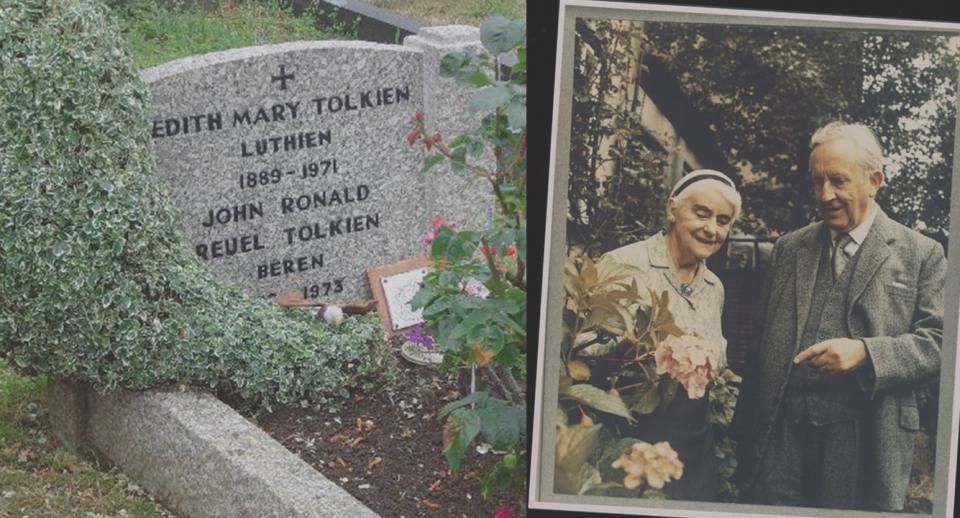
But the tale itself is an inbreaking of light, so bright, into the darkness, that shining eyes, stars and moon are at most a pale reflection of it. For it is the tale of Beren and Lùthien, the greatest of all Tolkien’s love stories, one so precious to him that he wanted those names to be inscribed beneath his and his wife’s names upon their gravestone. Aragorn, whose eyes shine with strange eagerness in the telling of it, perceives his own story as a kind of retelling of the tale.

Edith and John Tolkien. Lúthien and Beren.

“Beren was a mortal man, but Lúthien was the daughter of Thingol, a King of Elves upon Middle-earth when the world was young; and she was the fairest maiden that has ever been among all the children of this world. As the stars above the mists of the Northern lands was her loveliness and in her face was a shining light.”

A theme that recurs throughout the tale is one of the power of word and music. Lúthien is enchanted by hearing the sound of her own name upon the lips of Beren while, first Sauron and then Morgoth himself, of whom Sauron was but a servant, are overcome by Lúthien’s song. Does the chanting of the Lay that tells their tale invoke them at a moment in which “the offspring of the dark” make their attack or, perhaps more importantly even than this, invoke the same powers that aided them in their hopeless struggle with the dark? As Aragorn says to Sam after the attack, “More deadly to him [the Witch-king] was the name of Elbereth.”

The finest minds are those that are able to live with the greatest paradox. Surely at this pivotal moment in The Lord of the Rings the invasion of the desperately fragile “circle of light” and the telling of the tale that invokes a hope that is not broken even by the greatest evil is the coming together of Tolkien’s antitheses of eucatastrophe and dyscatastrophe, of heavenly light and the darkness of hell.

A Journey into the Wild Pursued by Enemies. The Hobbits and Strider Set Out From Bree to Rivendell.

The Fellowship of the Ring by J.R.R Tolkien (Harper Collins 1991) pp.169-80

Up until this point of the journey the hobbits have been more or less “looked after”. Even though almost from the beginning their steps have been dogged by the pursuit of the deadliest of enemies in the shape of the Nazgûl of Mordor they have been able to find protection from such mighty allies as the company of High Elves led by Gildor Inglorien or Tom Bombadil in the Old Forest and the Barrow Downs. And as well as the hospitality they enjoyed in the house of Tom Bombadil and Goldberry they have been well fed and watered in the farmhouse of the Maggots and the Prancing Pony in Bree.

But now the nature of the journey makes a sudden change with the attack upon the Prancing Pony in the night. The hobbits lose their ponies and set off with a poor half-starved creature belonging to Bill Ferny, the biggest villain in the Breeland, who is certainly in league with the Black Riders and who makes as much money as he can from their misfortune.

When I say, misfortune, I mean the fact that, from their perspective, that what they thought was going to be a road journey by sturdy pony from Bree to Rivendell, has become a hard march, a yomp as soldiers call it, across hard terrain, carrying heavy loads, with no shelter. Their only pony has to carry as much food as it can take for a fortnight’s journey and the hobbits have to take the rest upon their backs. Only Strider is not much discomfited by this. For him a yomp from place to place is normal life and he has but one extra burden to carry and that is the care of four companions about whose capacity to deal with hardship he has many doubts. Butterbur has already voiced these aloud through his remark that the hobbits are acting as if they are on holiday but even with these doubts in mind Strider has already made up his mind.

“I am Aragorn son of Arathorn; and if by life or death I can save you, I will.”

The journey really begins with the crossing of the Midgewater Marshes. Tolkien never liked boggy country. I was about to say that nobody does but at one time a whole way of life was developed by people living in the fenland of eastern England or the Somerset Levels. Those who know their English history will treasure the year 877 when all that remained of free England was the Isle of Athelney hidden deep in the Somerset Levels when Alfred the Great hid there from Danish invaders. Some call this place the birthplace of England, a place so remote that the Danes could not reach it with sufficient forces to capture the king. Others will remember the last defence of Hereward the Wake against the all conquering armies of William of Normandy on the isle of Ely in the Cambridgeshire fens two centuries later when he too used the natural defence of the bog against his enemies. But a bog makes good defence because it is hard to cross by foot. I remember once having to cross one late in the day. I was grateful for the sturdy stick that I had with me. Every step that I took required a careful use of the stick to find ground firm enough to take my weight and I would often use it to swing across from tussock to tussock hoping that I would not miss my footing and find my boots and then my legs disappearing into the ooze. Recently I learned that in the trenches of the First World War British soldiers feared the mud more even than shells exploding about them and that many of them drowned in that mud.

Tolkien knew the mud of the Western Front at first hand and hated it. Is it a coincidence that two of the great journeys of The Lord of the Rings begin with a journey across marshland, the journey from Bree to Rivendell and later the journey of Frodo and Sam from the Emyn Muil to Mordor. For Tolkien nothing would better express the hardships that lay ahead. For the hobbits even the companionship of the greatest traveller of his age cannot protect them from the hardships that they must now endure.