“I Must Find The Mountain of Fire and Cast The Thing Into The Gulf of Doom. Gandalf Said So. I Do Not Think I Shall Ever Get There.” Frodo Speaks of His Task to Faramir and of Its Impossibility.

The Two Towers by J.R.R Tolkien (Harper Collins 1991, 2007) p.891

The shock and fear that followed the revelation of the true identity of Frodo’s burden is at an end but what follows is sheer exhaustion. With the last of his strength Frodo tells Faramir of his mission.

“I was going to find a way into Mordor… I was going to Gorgoroth. I must find the Mountain of Fire and cast the thing into the gulf of Doom. Gandalf said so. I do not think I shall ever get there.”

Faramir stares at Frodo with “grave astonishment”, and rightly so. Alongside Frodo’s declaration at the Council of Elrond that he would take the Ring though he did not know the way this is the only time that Frodo actually speaks of his task in plain speech. There is no attempt at heroic language. No boasting. Merely a quiet statement of what has to be done.

“Gandalf said so.”

Frodo claims nothing for himself. He has been given his orders and now he must carry them out. There is nothing more to be said and Frodo says nothing more. Except, as Faramir knows, that Frodo is attempting something that no-one has ever before tried to do. Later in the story Ioreth of the Houses of Healing will tell her friend that Frodo “went with only his esquire into the Black Country and fought with the Dark Lord all by himself, and set fire to his Tower, if you can believe it.” Of course we know that this is not quite what happened but what Frodo achieved is almost as impossible and Faramir recognises this. His grave astonishment is entirely justified. He knows that he stands in the presence of greatness even as Elrond recognised at Frodo’s first quiet declaration, comparing him to Beren and the great heroes of the First Age.

Only Frodo, as we have seen, does not recognise this, nor ever does. He only thinks in terms of what must be done and of its impossibility.

Hope and hopelessness are themes that Tolkien returns to again and again throughout The Lord of the Rings. Aragorn is given the name, Estel, secretly by his mother as she gives herself up to her own death and he spends his life struggling with this destiny, hoping against hope, not with Sam’s cheerful optimism, but a grim determination just to carry on. Frodo is of a similar spirit. There is a job to be done and that is all needs to be said.

What Frodo, and Aragorn, both do, is to give themselves up to something that is greater than themselves. Although Tolkien was himself man of deep Christian faith he never allows the characters in his story the comfort or strength that such faith would bring. Julian of Norwich’s famous declaration that “All shall be well, and all shall be well, and all manner of things shall be well” is something about which they know nothing. They must simply do their jobs because they are both necessary and right. Whether they will be rewarded with success is not something that they can know. So Elrond told Gimli’s father, Glòin, on learning of Sauron’s threats against the dwarves of Erebor that there is naught that the dwarves can do “other than to resist, with hope or without it”.

The heroic figures of The Lord of the Rings are denied faith in God in an explicit sense but the goodness, truth and beauty that they both love and fight for sustain them throughout their struggles. Galadriel may speak of “the long defeat” but this does not weaken her resolve. Tolkien did not believe in an arc of history that tends towards justice but in his belief in the resurrection of Christ, “the greatest ‘eucatastrophe’ possible in the greatest fairy story”, as he put it in a letter, he placed his hope in a final victory that would be one achieved by God alone.

In this sense Tolkien felt closer to the spiritual world of his heroes who had to resist “with hope or without it” than to some general kind of Christian optimism. And so he gives us Frodo, walking step by step towards Mordor even though he does not think that he will ever get there, as a model for our own lives and even as we stare with Faramir’s grave astonishment at him so too do we do the good that we have been called to do both this and every day.
“Your Land Must Be a Realm of Peace and Content, and There Must Gardeners Be in High Honour.”

The Two Towers by J.R.R Tolkien (Harper Collins 1991, 2007) pp. 891,892

Faramir knows that Frodo’s secret is the very Ring of Power. He does not yet know Frodo’s mission, that he has been given the task of casting the Ring into the fires of Mount Doom, but he wonders at this little folk who now keep it.

“If you took this thing on yourself, unwilling, at other’s asking, then you have pity and honour from me. And I marvel at you: to keep it hid and not to use it. You are a new people and a new world to me. Are all your kind of like sort? Your land must be a realm of peace and content, and there must gardeners be in high honour.”

“Are all your kind of like sort?” Faramir asks. The true answer is that just as Faramir is exceptional within Gondor so too are Frodo and Sam within the Shire. Neither are typical of their kinds although there are many good men in Gondor and good hobbits in the Shire. What is providential is that these great ones have found one another in a hostile land and at this critical moment in the story. Within this providential context even Sam’s mistakes, from his negligent care of a smoking fire to his revealing of the true nature of the burden that Frodo bears, only lead to good. Faramir puts this in a different way. Sam was “fated” to stumble, to make such good mistakes and so to aid his master’s mission the better. Later his interventions will be of the most heroic kind.

For a long time when I have read this passage I assumed that the reference that Faramir makes to the high honour in which gardeners must be held in the Shire must have been a gentle joke on Tolkien’s part. When we remember that the very first scene in The Lord of the Rings is set in the Ivy Bush on the Bywater Road near Hobbiton in which Gaffer Gamgee expresses his hope that “no harm” will come of Bilbo teaching Sam to read and write, to “learn him his letters”, it is hard to believe that greatness can come of this family of gardeners at least.

But woven into the rest of the story are very different references to gardens and to gardeners. Galadriel’s gift to Sam, so carefully put together, comes with her recognition that it is Sam, the gardener, who will have to heal his land after the ravages of Saruman there. “Though you should find all barren and laid waste, there will be few gardens in Middle-earth that will bloom like your garden, if you sprinkle this earth there.” Treebeard tells Merry and Pippin of the Entwives who were tenders of gardens and how they would love the Shire if they were to find it. And perhaps most telling of all, Faramir himself was given the task, by Aragorn, of healing the land of Ithilien after the ending of the war of the Ring and so himself became a prince of gardeners.

There is a gardener within the soul of this Captain of Gondor that recognises a kindred spirit in the soul of Sam Gamgee even as he recognises greatness within Frodo’s soul. Faramir, like Sam, will become a healer of the hurts of Middle-earth after warfare is ended and, like Sam, he will tend a garden. Galadriel’s gift to Sam will keep the memory of Lothlórien alive within Middle-earth and Ithilien too will be a blending of wild woodland and cultivated lands, a marriage of Ents and Entwives just as the land that Galadriel made was such a marriage.

Tolkien was drawing upon the memory of Eden in his following of this theme in The Lord of the Rings. Eden is the garden in which everything is in perfect harmony and humankind is connected with itself, with the land and with the divine presence. There is no abuse or exploitation here. There is much more than mere cultivation here and so the Gaffer cannot be a perfect example of a gardener. It is Sam with his internalisation of all that he has seen upon his journeys, especially in Lothlórien, who will subcreate Eden in Middle-earth, or at the very least, a glimpse of it, and so draw his fellows into a delight in what is good, beautiful and true.

Ted Naismith gives us a land at peace with itself in his beautiful depiction of the young mallorn tree in the Shire

“Your Heart is Shrewd As Well As Faithful, and Saw Clearer Than Your Eyes.” Sam Gamgee Shows Us How To Make a Mess of Things and Yet To Get The Biggest Things Right.

The Two Towers by J.R.R Tolkien (Harper Collins 1991, 2007) pp.888-890

It is a catastrophic moment. Frodo has taken such care to keep the conversation with Faramir away from the matter of the Ring. Faramir is aware that there is something that Frodo does not wish to speak about but once he has made his mind up that Frodo is a man of honour he chooses not to press him on this. But Frodo is tired and lapses into silence and Sam takes over the conversation.

Anke Eissman depicts the moment when Frodo begins to drift into sleep and Sam takes up the conversation with Faramir. Note the intensity of the gaze between Sam and Faramir. Great things are about to be revealed.

Sam begins to speak about Galadriel and he falls into a reverie as he does so and within that dreamlike mood suddenly says of Boromir:

“It’s my opinion that in Lórien he first saw clearly what I guessed sooner: what he wanted. From the moment he first saw it he wanted the Enemy’s Ring.”

Suddenly everything changes. The Ring takes centre stage after it has lain hidden and defended and the brother of the man who tried to take it by force from Frodo stands before it surrounded by a troup of warriors. Faramir knows what it is and he knows that his brother tried to take it. It is as he puts it himself “a chance for Faramir, Captain of Gondor, to show his quality”.

And he does show his quality. At this critical moment he chooses not to try to take the Ring. And as when Gandalf and then Galadriel both chose not to take it when Frodo offered it to them and as Bilbo freely let it go when Gandalf told him to do so it is upon these moments of free renunciation that the whole story turns. A number of readers of The Lord of the Rings have noted that Tolkien does something quite unique in his story. That whereas every story of quest is about the finding and getting of something Tolkien tells us a story of letting something go, of casting it away, a story of renunciation. The Ring is a thing that can give great power to the one who possesses it and each one of the characters that we have mentioned chose to renounce the possibility of this power.

Bilbo chooses freely to renounce the Ring after a little persuasion from a good friend.

And what of Sam’s terrible mistake? At this moment Frodo simply sees it as a disaster. What had lain hidden now lies bare before all. The brother of the man who tried to take it knows what it is and where it is. But Faramir sees it very differently.

“Be comforted, Samwise. If you seem to have stumbled, think that it was fated to be so, Your heart is shrewd as well as faithful, and saw clearer than your eyes.”

Clearly Sam was not meant to reveal that Frodo had the Ring of Power in his possession. We thought a few weeks ago about Frodo’s decision not to let Faramir know about the true purpose of his mission. But Sam has come to trust the man who has offered them shelter and has chosen, albeit without reflection, to entrust him with the secret of Frodo’s mission. Frodo himself longs to do the same. It is only the memory of Boromir that prevents him from doing so.

And so it is Sam’s heart, and not his head, that has lead both him and Frodo to this moment. It is Sam’s heart that breaks through all the mistrust that has divided the foes of Sauron from one another for so very long. Gondor’s long separation from peoples who once stood with them as allies is set aside in a moment of heartfelt indiscretion. Not that the heart of Minas Tirith is changed in this moment. Denethor, when he learns of the trusting action of his son, will bitterly declare that if Boromir, and not his brother, had lived he would have brought to his father “a mighty gift”. But all through The Lord of the Rings it is these moments of trust that prove essential to the successful outcome of the great quest and this is one of the most important of all of them. If Faramir had chosen at this moment to take the Ring then all would have ended in darkness and the triumph of Sauron. That he does not do this, but chooses to trust in the mission that Frodo has been given, is crucial to the whole story.

And all becomes possible because of Sam’s heart and not his head.

“It Strikes Me That Folks Takes Their Peril into Lórien, and Finds It There Because They Brought It.” Sam Gamgee Thinks About The Fall of Boromir.

The Two Towers by J.R.R Tolkien (Harper Collins 1991, 2007) pp.888-890

Faramir’s reflections upon the decline of the West bring him to a melancholy mood. Frodo has fallen silent and so Sam enters the conversation asking Faramir why he has not spoken more about Sam’s great love, Elves.

Anke Eissmann depicts the quiet conversation between Faramir and the hobbits.

“No, indeed, Master Samwise,” said Faramir, “for I am not learned in Elven-lore. But there you touch upon another point in which we have changed, declining from Númenor to Middle-earth.”

And so Faramir speaks of the ancient alliance between Elves and Men, the Edain of Beleriand, of whom Beren was one of the great heroes and about whom Tolkien’s early readers were largely ignorant before the publication of The Silmarillion that took place after Tolkien’s death. And he speaks of the gradual sundering of Elves and Men in Middle-earth during the Third Age.

“In Middle-earth Men and Elves became estranged in the days of darkness, by the arts of the Enemy, and by the slow changes of time in which each kind walked down their sundered roads.”

And so through the mouth of Faramir Tolkien draws out his belief that a key feature in the decline of which he speaks is melancholy, not as an occasional mood such as the one into which Faramir has fallen in the quiet of the cave behind Henneth Annûn as night falls about him, but as a settled state of mind. He speaks of a growing fascination with death among the great of his land so that tombs become more splendid than palaces. Later Legolas and Gimli will note the silence of the streets of Minas Tirith and an absence of children as further signs of this state of mind,

Faramir speaks of this and adds that his people have drawn into themselves, into a self-obsessed introspection and have forgotten their roots as the descendants of Elendil, the Elf-friend, whose very resistance to Ar-Pharazôn the last king of Númenor was centred upon the very friendship that gave him his name.

“Men now fear and misdoubt the Elves, and yet know little of them.”

Even Faramir fears to go to Lothlórien, deeming such a journey perilous.

Then Sam makes one of those speeches that those who love him know and delight in and yet Sam himself does not think that he is capable of giving. He speaks of Galadriel both accurately and with words of heartbreaking beauty.

“Beautiful she is, sir! Lovely! Sometimes like a great tree in flower, sometimes like a white daffadowndilly, small and slender like. Hard as diamonds, soft as moonlight. Warm as sunlight, cold as frost in the stars. Proud and far-off as a snow-mountain, and as merry as any lass I ever saw with daisies in her hair in springtime.”

And Anke Eissmann shows Galadriel as she gives the starglass to Frodo in Lothlórien.

Tolkien skillfully and frequently gives some of his most beautiful writing to his simpler characters and in so doing shows his readers that they too have the capacity to encounter and enjoy the sublime. All Sam’s images in his speech are drawn from his experience as a gardener and from some of the new things that he has seen upon his journey. He is one who has practiced William Blake’s counsel to find “heaven in a wildflower” and who, as a consequence, knows heaven when he sees it, as he does in Galadriel.

But because of his encounter with Galadriel he knows that heaven is not like a holiday resort and when Faramir describes Galadriel as perilous Sam shows himself to be one of profound spiritual insight.

“It strikes me that folks takes their peril with them into Lórien, and finds it there because they’ve brought it”

Sean Bean portrayed the way in which Boromir “brought his peril with him ” into Lothlórien quite wonderfully in Peter Jackson’s film.

This is the way in which heaven is not like a holiday resort, a place in which everything should be as the customer wishes because they have paid for it to be so, and if it is not as the customer wishes, angry complaints are made. What complaints would be made about Lothlórien and what difference would it make if you did complain? Readers will remember that Boromir did complain, warning his companions against their hosts. Sam remembers this and it is Boromir that he has in mind when he speaks of bringing peril with them into Lothlórien.

Sam has the capacity to find heaven in a wildflower and in Galadriel too because he has practiced the discipline of finding over a number of years. Sam’s discipline of delight means that he finds beauty wherever he goes and not peril. He is not perfect. His unwillingness to extend mercy to Gollum is a great shortcoming in his moral character but his willingness, even desire, to find, and not merely to remain within existing prejudices, desires and fears, as Boromir did, makes him one of the great characters of The Lord of the Rings.

“At Least by Good Chance We Come at The Right Hour to Reward You For Your Patience.” Frodo and Sam Come to Henneth Annûn, the Window of the Sunset.

The Two Towers by J.R.R Tolkien (Harper Collins 1991, 2007) pp. 878-881

The journey to the place of refuge in which Frodo and Sam will stay that night is not an easy one, especially for Frodo and Sam for they will have to make the journey blindfold. But even Gollum, who we glimpsed briefly through Sam’s eyes at the beginning of this passage seems to be thrown off the trail.

But at the last, after a journey that Tolkien describes by means of the language of sound, the hobbits arrive at their place of rest and find it to be a place of beauty. For Frodo and Sam this will be their last place of refuge upon their long journey before they enter Mordor and there will be no refuge there. The first was at Woody End when they were guests of Gildor Inglorien and his company and there have been many along the way. The house of Tom Bombadil, the Prancing Pony at Bree, the Last Homely House at Rivendell, the secret land of Lothlórien, and now this. Of all the places in which they have rested this provides the least comfort but it is a safe place and it has its reward for those who rest there.

See Alan Lee’s beautiful depiction of the Elves refuge in Woody End.

“They stood on a wet floor of polished stone, the doorstep, as it were, of a rough hewn gate of rock opening dark behind them. But in front a thin veil of water was hung, so near that Frodo could have put an outstretched arm into it. It faced westward. The level shafts of the setting sun behind beat upon it, and the red light was broken into many flickering beams of ever changing colour. It was as if they stood at the window of some elven-tower, curtained with threaded jewels of silver and gold, and ruby, sapphire and amethyst, all kindled with an unconsuming fire.”

If elves had come to this place they would have fashioned a place of wonder just as they did at Woody End in the Shire. They would have learned what the place had to teach them through patient attention and then worked with it to reveal that wonder. As Gimli showed us at the glittering caves of Aglarond that dwarves would pay attention to the gifts of the earth in order to reveal them. And hobbits would discover that which would make it homely just as they had done in the Shire.

But these gifts are gifts of peace and now there is no time to practice them. The men of Gondor have made it a place of temporary shelter just as soldiers did in the trenches of the Western Front in the 1914-18 war in which Tolkien played his part. Whether Faramir returned to Henneth Annûn after the war we are not told but I like to imagine that he did and that some of Legolas’s promised elves from the woodland realm offered their services to create a kingly hall here.

But Frodo and Sam are able to find beauty wherever they go. Perhaps, as Frodo suggests when his eyes are blindfolded, it is a gift that he shares with all hobbits. He spoke at that moment of how, when the Fellowship had entered Lothlórien Gimli had sought to resist the Elves insistence that their eyes should have been blindfolded but that “the hobbits endured it”.

The willingness of hobbits to endure is one of the great gifts that they bring to the story. Of course they are capable of heroic deeds when called upon to undertake them but they do not look for such things. Merry and Pippin are carried across Rohan bound by orcs and Sam follows where Frodo goes without seeking any comfort for himself. And Frodo endures the Ring that he never sought, never desired,but which simply came to him. Later Frodo will be carried into Mordor by orcs and at the end he will be carried up Mount Doom by Sam.

“And do you seek great things for yourself, seek them not,” was a favourite text from the bible of Dietrich Bonhoeffer, the great theologian and resister of the Nazi tyranny, and one that he pondered often while in prison. And the text continues, “but I will give your life as a prize of war” (Jeremiah 45.5). Bonhoeffer learnt that life was to lived as something given, not shaped by ourselves, just as prisoners of war are allowed to live. Frodo understands life in this way and one of the rewards of his patience is an ability to find beauty at many unexpected times and places.

“Whatever Befell on the North March, You, Frodo, I Doubt No Longer.” Faramir Hears Frodo’s Story and Tells of The Death of Boromir.

The Two Towers by J.R.R Tolkien (Harper Collins 1991, 2007) pp. 866-874

Boromir “was alive and strong when we parted. And he lives still for all that I know”, says Frodo to Faramir. “Though surely there are many perils in the world.”

Anke Eissman depicts the moment when Faramir encounters the funeral craft of his brother, Boromir.

“Many indeed,” says Faramir, “and treachery not the least.”

Frodo stands before Faramir and his men as Faramir judges the truth of the story that Frodo tells and also the teller of the tale. How did Boromir die? And what part did Frodo play in his death? Was Frodo a traitor who betrayed his companion to his death at the hands of orcs?

Sam reacts to the implied accusation of treachery with fury and he tells Faramir to mind his own business much to the amusement of Faramir’s men, but Faramir is determined to find out the truth, in part because he wants to know what happened to his brother, in part because he wants to judge Frodo fairly.

What persuades him that Frodo is a truth teller is the story of Lothlórien. As soon as we learn that Faramir knows the most name of the hidden land we know, as we began to think about last week, that he is a man of wisdom. Laurelindórenan, he names it, the valley of singing gold. Treebeard also used the ancient name of that land when he spoke with Merry and Pippin, sadly remarking that just as the name was diminishing to Lothlórien or even Lórien so too the enchantment of the elder days was fading away.

Fading it may be but Faramir still understands its potency. In part this power lies in its beauty. Faramir thinks of the beauty of the belt in which his brother was arrayed in the boat from Lórien that Aragorn, Legolas and Gimli had sent him down the Anduin on the day of the breaking of the Fellowship. He also recognises the beauty of the broach of green and silver leaf that fastens Frodo’s elven cloak about his neck.

But Faramir also recognises the potency of Lothlórien in two other ways. One is in the mystery of Frodo himself. Right at the beginning of his journey Gildor Inglorien names Frodo Elf-friend and Goldberry recognises him as such in the house of Tom Bombadil. Gandalf sees a light shining within him and a certain transparency to his body when Frodo lies in Rivendell recovering from the wound that the Lord of the Nazgûl gave him at Weathertop. Sam saw this light too as Frodo slept in Ithilien, seeing that his face was “old, old and beautiful, as if the chiselling of the shaping years was now revealed in many fine lines that had before been hidden, though the identity of the face was not changed.”

Frodo shares in the enchantment that comes from the elder days but is also marked by the wound he received at Weathertop and by the power of the Ring. Gandalf wondered which of these would prevail within him but concluded that he did not think that he would come to evil but might become “a glass filled with a clear light for eyes to see that can.”

Faramir is one who has such eyes and can perceive this light. “There is something strange about you, Frodo, an Elvish air maybe”, he says. But here we recognise the third element of the potency of Lothlórien that Faramir perceives. Its peril. “It is perilous for mortal man to walk out of the world of this Sun, and few of old come thence unchanged.”

There are tales in so many cultures of mortals straying into Faerie and emerging changed. Later Faramir will speak of what change came over his brother to Frodo and Sam. Now he merely asks the question and perceives something of the beauty and the peril in Frodo.

There is much talk now of re-enchantment and who would deny the need for this in a dying world. But might there be a naive optimism about such speech? We want the beauty without the peril. In C.S Lewis’s Prince Caspian Susan says of the Maenads who surround her and Lucy and who unleash glorious chaos in a Narnia that is dying of rationalism that if Aslan were not with them she would be very afraid. The Christian wisdom of the Cross recognises both the healing that flows from it but also its horror. We cannot separate the two but would love to reduce our desire for re-enchantment to little more than a pleasant walk in the country or a neatly tendered border of pretty flowers in a garden. There is beauty in both of these but this is not the perilous beauty of re-enchantment. It is not what Faramir perceives in Frodo. He perceives it yet he has the wisdom to trust it.

“Faramir’s Face… Was Stern and Commanding, and a Keen Wit Lay Behind His Searching Glance.” Meeting Tolkien’s Faramir and Not Peter Jackson’s.

The Two Towers by J.R.R Tolkien (Harper Collins 1991, 2007) pp.866-871

When I think of Peter Jackson’s version of Faramir I think of the speech that Elrond makes to Gandalf in Rivendell before the Council.

“Men are weak. The race of Men is failing. The blood of Númenor is all but spent, its pride and dignity forgotten. It is because of Men the Ring survives.”

And then I think of the scene in which Faramir takes Frodo, Sam and the Ring towards Minas Tirith in an almost trance like state, seemingly overcome by the Ring’s malignant power.

What a contrast all this is to the man that we meet for the first time within the pages of The Two Towers.

I have been enjoying using this image of Faramir as created by Anke Eissman in the last few weeks. Compare it to David Wenham’s characterisation as illustrated below.

Sam awakes from sleep to find Frodo standing before Faramir and a company of about three hundred men. Faramir interrogating him and it feels as if a trial is taking place. We are told that Sam “could see Faramir’s face, which was now unmasked; it was stern and commanding, and a keen wit lay behind his searching glance.” Later on we hear Frodo’s assessment of the man before he stands, that he was very much like Boromir in looks but “a man less self-regarding, both sterner and wiser.” And later still we read Éowyn’s first assessment of Faramir that she could see “the grave tenderness in his eyes, and yet knew, for she was bred among men of war, that here was one whom no Rider of the Mark would outmatch in battle.” This does not put Éowyn off.

I do not blame David Wenham for the way in which he plays the part of Faramir in Peter Jackson’s films. He does it as was asked of him, as an embodiment of the weakness that Jackson’s Elrond speaks of. In Jackson’s films, rightly celebrated as a cinematic masterpiece even after twenty years, one of the major themes, alongside that of friendship, is power and weakness. The Ring is all-powerful and constantly exerts that power in its immediate and utterly malignant influence over any, Frodo for the most part excepted, who see it. In the scene in which Elrond speaks of human weakness we see Isildur fall immediately under its spell and refusing to destroy it in the fires of Orodruin. “It is because of Men that the Ring survives.”

David Wenham as Faramir and Elijah Wood as Frodo. I can’t quite believe that Wenham’s character is one that a woman like Éowyn would fall in love with. Now Viggo Mortensen’s Aragorn is a different matter entirely!

Contrast this characterisation of Men with the one that Tolkien gives us. Pride and dignity are not spent. Aragorn is not in exile in the North by choice but because it is the land of his birth. Although he is Isildur’s heir he will need to prove that claim in Minas Tirith and there is considerable doubt that his claim will be accepted. Denethor, the Lord of Gondor, is both proud and dignified, and although we will find him cast down by grief over the loss of Boromir, he is not self-indulgent as Jackson portrays him, eating a hearty meal as Faramir risks all in battle, but austere and self-possessed until the end when overcome with despair.

And Faramir is far better portrayed in the work of Anke Eissman than by David Wenham’s and Peter Jackson’s characterisation. When I look at Eissman’s Faramir, sitting before Frodo, in complete command of the situation, I can see the man that Éowyn will first of all respect and later on fall in love with.

St Paul has a word that describes Faramir perfectly and thar is prautes, a word that he uses in speaking of the fruit of the Holy Spirit in his letter to the Galatians (5.22,23). In most translations this is usually rendered as gentleness but this is only a part of the story. Gentleness is all too often mistaken for weakness, a mistake that Êowyn does not fall prey to when she perceives Faramir’s “grave tenderness” but realises that he is one who few could outmatch in battle. In fact Éowyn understands prautes perfectly. It is a subtle mingling of strength and gentleness and Faramir is a fine, even exemplary expression of the word. He was one of Tolkien’s favourite creations and the weeks that we will spend in his company will refresh both the hobbits and I hope, my readers as well.

“It Was Sam’s First View of a Battle of Men Against Men and He Did Not Like It Much.” Tolkien Brings His Memories of War to His Great Tale.

The Two Towers by J.R.R Tolkien (Harper Collins 1991, 2007) pp.858-865

Sam is already battle hardened standing by Frodo at the attack of the Nazgûl at Weathertop, at the attack of wargs near the doors of Moria and again within Moria at the Chamber of Mazarbul when orcs and trolls assailed the Fellowship. It is not battle itself that affects him so deeply, that realisation that someone is your enemy and wishes you harm, wishes even to kill you, it is, as the English poet Wilfred Owen put it, “the pity of war” that touches his heart when the Rangers of Ithilien ambush the Men of Harad as they march northwards to the Black Gate of Mordor.

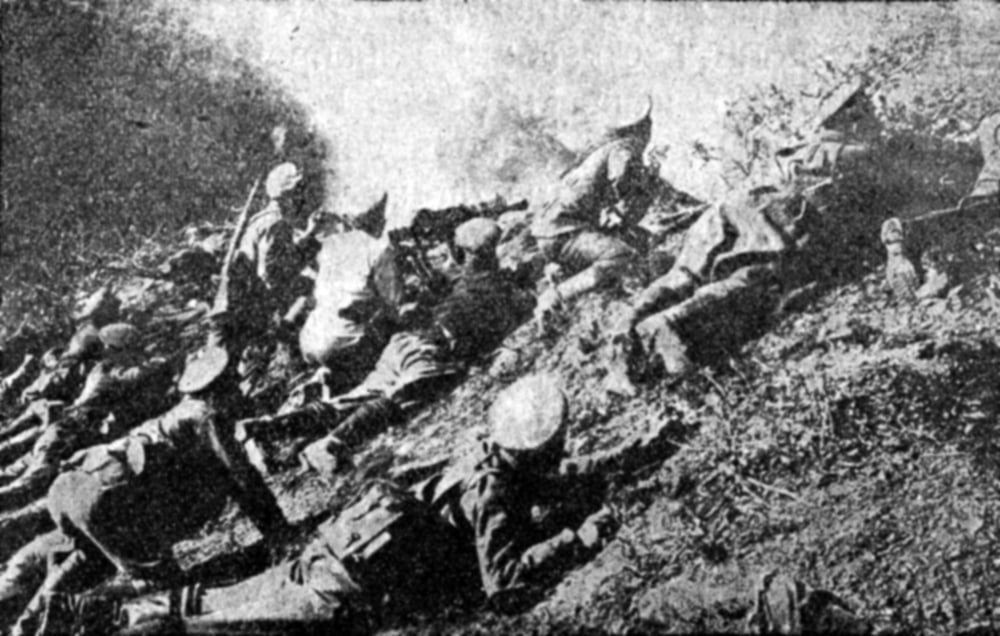
War in the trenches of the First World War of 1914-18

There are few passages within The Lord of the Rings that have the feel of the war literature of the 20th century as this one. Here we are reminded, if we need it, that Tolkien was writing a novel of his century and not a mere pastiche of medieval heroic literature. Tolkien was himself a veteran of the war in the trenches in France and took part in the Battle of the Somme that began on the 1st of July 1916 in northern France and during which a million men were either killed or wounded. The memory of that battle still casts a shadow over western Europe over a hundred years after it took place. My father gave us very little education in any deliberate sense; most of what I learned from him I did by observation rather than because he told it to me, but he was anxious to tell us of the horror of war and how a war in Europe should never be repeated. He himself was a veteran of the Normandy landings of June 1944 and his father of the naval Battle of Jutland of May 1916 and the memory of war played an important part in my education.

The capture of Frodo and Sam by Faramir and his men takes place just before the ambush begins and it is a measure of Faramir, the captain of war, that he does not treat his captives as mere irrelevances in the face of the serious matters of killing and being killed. In the few moments available to him he allows Frodo to tell his story before assigning two of his men to guard them. As they wait for battle to begin Mablung and Damrod speak of their leader and the respect in which they hold him. “He leads now in all perilous ventures,” they tell Frodo and Sam, and they are proud to follow him.

See ‘Faramir the Captain’ by Anke Eissman. Note how relaxed most of his men are. He is in charge and they don’t need to worry about what they have to do.

Tolkien gives us no overview of the battle that follows. We see it through Sam’s eyes, listening to the sound of steel against steel or metal cap, like the sound of “a hundred blacksmiths all smithying together”. We feel the terror as an oliphant charges straight towards them, veering away from them at the very last moment and we see a young warrior of Harad fall dead at their feet. Through all this their main ambition is to survive. Doubtless if battle had overtaken them they would have fought bravely but heroic deeds are not their first concern. This too is true to Tolkien’s memories of the trenches and of modern warfare.

The moment when Sam looks at the dead warrior is deeply moving. We are not shown war from the perspective of the war historian or the general in the staff room. We see it through the eyes of one man alongside other men. “It was Sam’s first view of a battle of Men against Men, and he did not like it much. He wondered what the man’s name was and where he came from; and if was really evil of heart, or what lies and threats had led him on the long march from his home; and if he would not really rather have stayed there in peace”.

Robert Runcie, Archbishop of Canterbury between 1980 and 1991, was a tank commander during the Second World War, winning the Military Cross, the second most important medal for valour that can be offered to the British Armed Forces for rescuing one of his wounded men from a crippled tank while under heavy enemy fire. He was greatly criticised by politicians for expressing sympathy and compassion for Argentine soldiers after the Falklands War of 1982. What moved him to speak of his pity was his memory of an incident in which his tank took out a German tank in battle and how, as was required of him, he checked to see if there were any survivors. He remembered looking into the tank and the dead young men within it and thinking of their mothers, wives and girlfriends who would never see them again. It was a Sam Gamgee moment and it remained with him for the rest of his life.

I haven’t found a photograph of Robert Runcie from the Second World War. You can tell that this is a photo of a British tank on show for the “top brass”, senior British officers, not one in the heat of battle.

“Now if I’ve Gone and Brought Trouble, I’ll Never Forgive Myself.” What Kind of Trouble Does Sam Gamgee’s Fire Bring to The Hobbits in Ithilien?

The Two Towers by J.R.R Tolkien (Harper Collins 1991, 2007) pp. 851-861

I am glad that Frodo and Sam were able to eat the rabbits that Gollum caught before they were caught by the men of Gondor in the woodlands of Ithilien and I am glad that they were able to rest upon a bed of fern that must have felt like the greatest luxury. To be well fed and well rested is of great help when you need to keep your wits about you. I am only sorry that they were not able to smoke a pipe as well but then perhaps they did not have their pipes or pipeweed with them.

Frodo and Sam are in Ithilien, the garden of Gondor, Although it bears the unmistakable signs of Mordor upon it after a few years of occupation it remains a place of beauty and of plenty too. They are surrounded by herbs that grow in profusion and perfume the air, and there are game creatures about that Sam can cook.

The hobbits have eaten nothing more than lembas for about a week now and although it is wonderfully sustaining and even more so when it isn’t mingled with any other kind of food lembas cannot satisfy them in the particular way that a well cooked meal could and Sam, in particular, desires that particular satisfaction.

Perhaps it was always unwise to light a fire in a place where enemies might be lurking, certainly Gollum thinks so, but a fire is necessary if you are going to cook, and maybe if Sam hadn’t relaxed a little too much after eating a good meal then he would not have committed the cardinal error that all children are warned against when learning to make a campfire. Never leave it unattended.

But Sam did make this mistake and a small brand from the fire did start a blaze in a pile of fern lying nearby and the smoke from the fire was spotted by the Rangers of Ithilien, and the hobbits were caught.

These Rangers are a company of men from Gondor who are operating behind enemy lines in the woodlands of Ithilien. Their mission is to make sure that the forces of Gondor can never feel completely at ease in this land. They harry and harass their foes and on this day it is their intention to ambush a force that is travelling northwards from Harad to enter Mordor through the Black Gate, just the kind of force that the hobbits saw on the day when Frodo decided to trust Gollum as his guide into the dark land.

The Rangers are commanded by Faramir, son of Denethor, Steward of Gondor, and the brother of Boromir, who had travelled as part of the Fellowship from Rivendell until he fell at Parth Galen as he sought to defend Merry and Pippin from capture by the Uruk-hai of Isengard. And it was this same Boromir that tried to take the Ring from Frodo and so made him take the decision to go on alone to Mordor. As far as Frodo and Sam are concerned Boromir is still alive and Frodo’s last memory of him is of the madness that overcame him and led him to try to seize the Ring by force.

I have long appreciated the depictions of Faramir by the artist, Anke Eissman. Note how he sits on the ground before his captive and does not seek to dominate him by standing, but his authority is still unmistakable.

So at the moment of their capture Frodo and Sam do not know what kind of trouble they are in and Sam does not know whether he will ever be able to forgive himself or whether he will ever get the opportunity to do so. He cannot know that he has fallen into the hands of one of the noblest of all Tolkien’s creations and that much good will come of this encounter.

We might say that the “chance” meeting between the hobbits and Faramir is mere coincidence, if any circumstance in our lives can ever be described with the word, mere. It was the great Swiss psychologist, Carl Jung, who first coined the word, synchronicity, to describe a series of unrelated events that are connected through their meaning and the meeting of the hobbits and Faramir is a profound expression of this. Later, before they parted, Frodo says to Faramir that Elrond had told him that he would find unexpected friendship upon his journey and we will think more of this on another occasion but it is sufficient to say on this occasion that Sam can forgive himself for his “mistake”, if mistake it truly is.

“Suddenly Sam Laughed, For Heart’s Ease Not for Jest.” Frodo and Sam Find Refreshment in Ithilien.

The Two Towers by J.R.R Tolkien (Harper Collins 1991, 2007) pp. 847-851

You can almost feel the relief in Tolkien’s writing as Frodo and Sam leave the dreadful ash pits of the desolate lands before the Black Gate of Mordor and arrive in the fair land of Ithilien, which, although now under the control of the enemy, has not yet been spoiled.

Frodo and Sam, guided by Gollum, are making their way from the Black Gate down towards the crossing place in the road that runs south towards the sea and east-west from Minas Morgul to Osgiliath, the ancient but ruined capital of Gondor. And as they get further away from the horror of lands that have been utterly ruined by Mordor so their mood begins to change.

Tolkien gives us a rich feast of language so that he can do justice to Ithilien, once the garden of Gondor, far enough from the shadow of the Ephel Death, the mountains of Mordor, to be free of them and yet sheltered by those same mountains from the east wind.

Tolkien was not a meteorologist and so he never discourses in detail about the weather in Middle-earth. His geography, and his meteorology too, is first and foremost mythological and so reflects the way in which the peoples of western Europe saw the world about them in the pre-modern world. The West and the great Atlantic ocean always made that direction one of mystery. In Tolkien’s Middle-earth it is the way to Valinor, the way that the Elves take on their journey to Valinor. It is the way to the Grey Havens, that are themselves a crossroads between worlds. In Europe the wind that comes from the West is warmed by the warm current coming out of the Gulf of Mexico and so it moderates the weather right up into the Arctic Circle in the far north of Norway and brings warm rain to the green lands of western Europe and especially, for Tolkien, to the British Isles that were his native lands.

The East, on the other hand, was always the direction from which danger and threat came. Invading armies always came from the East, whether Saxon, Viking or Norman in the British Isles, or the hordes coming out of the steppes of Central Asia, or the Ottoman Turks coming out of the East up the valley of the River Danube. And the weather that comes out of the East comes out of Siberia and there are no mountain ranges in Europe north of the Alps to provide shelter from the cold east wind or to provide defence from invading armies.

Ithilien is thus a land sheltered from the east and open to the south and west, a land of plenty, and Tolkien’s rich feast of language reflects this.

“Many great trees grew there, planted long ago, falling into untended age amid a riot of careless descendents; and groves and thickets there were of tamarisk and pungent terebinth, of olive and bay; and there were junipers and myrtles; and thymes that grew in bushes, or with their woody creeping stems mantled in deep tapestries the hidden stones; sages of many kinds putting forth blue flowers, or red, or pale green; and marjorams and new-sprouting parsleys, and many herbs and scents beyond the garden-lore of Sam.”

Readers will note the sheer length of that sentence with its profusion of semicolons and Tolkien’s pleasure in writing a list. Each shrub and herb is named until we arrive at the limit of Sam, the gardener’s, knowledge, and we are invited into the unknown, not as a place of danger, but a place to be explored so that new pleasures can be experienced and enjoyed. Tolkien sums it all up through a phrase in which, just for a moment, he leaves the language of the north and strays for a moment into the classical Mediterranean world.

“A dishevelled dryad loveliness.”

And Sam laughs, “for heart’s ease not for jest”. Frodo indeed laughed for jest in the ash pit before the Morranon when Sam recited his verse about the oliphaunt, and it lifted his spirit, breaking the spell of despair in which he was held in the long hours of that day. That laughter broke into his darkness but the dark still lay about him. Sam’s laughter is of a different kind. It is an expression of delight, the laughter of heaven. It is as if as Sam breathes in the rich scents of the garden, this is his outbreath.

So we come into the last place of refreshment for the hobbits before they enter the darkness of Mordor, a moment of grace before they are abandoned to the horror that they alone, unaided, must face. They do not know what lies before them but they are able to draw strength from this place because, unlike Gollum, this is how they have trained their hearts.