“It is Likely Enough… That We are Going to Our Doom: The Last March of The Ents.” The Ents Go to War at Isengard.

The Two Towers by J.R.R Tolkien (Harper Collins 1991, 2007) pp.623-635

The night that Merry and Pippin spend in Wellinghall is the first since they escaped from the Orcs and the first that they have had in a home, a place of safety, since leaving Lothlórien, and so they sleep long and refreshingly.

Treebeard takes them to Entmoot, the council in which the Ents will deliberate what course of action they must take.

“Deciding what to do does not take Ents as long as going over all the facts and events that they have to make up their minds about”, Treebeard says to the hobbits, and he estimates that this will take a couple of days or so. He sends Merry and Pippin off with a younger Ent called Bregalad or Quickbeam who has already made up his mind about what should be done and the hobbits spend those days in his company as the Moot continues.

It is on the third day, a bleak and windy day, in the afternoon, that all falls silent and then with a great crash and the quivering and bending of the trees that the Ents march towards them.

We come, we come with roll of drum: ta-runda runda runda rom!”

The Ents are marching to Isengard and to war.

It is through Merry that we learn something about Isengard. Merry is the organiser of the four hobbits, the original company of the Ring that left the Shire some months before these events. He organised the purchase of Crickhollow in Buckland, and, as the real reason why Frodo is leaving Hobbiton became clear it is Merry who made secret preparation for leaving the Shire. He is rather proud that while Pippin spent his days in Rivendell idling away the time he tried to find out as much as he could about what might lay ahead.

“Isengard is a sort of ring of rocks or hills, I think, with a flat space inside and an island or pillar of rock in the middle, called Orthanc. Saruman has a tower on it. There is a gate, perhaps more than one, in the encircling wall, and I believe there is a stream running through it; it comes out of the mountains, and flows on across the Gap of Rohan.”

Orthanc is not Saruman’s work but much older having been built by the Númenorians in the days of Elendil. It was a sign of their decline that during the first part of the Third Age it became a lawless place far from the authority of Minas Tirith and a thorn in the side of the new kingdom of the Rohirrim who had settled in the plains of Calenardhon that lay between the southern end of the Misty Mountains to the north and the mountains of Gondor to the south. So it was that when Saruman took possession of Isengard in 2759 of the Third Age both the Steward of Gondor and the King of Rohan welcomed him gladly seeing him as a valuable ally who would watch over the strategically vital Gap of Rohan.

It would seem that Saruman was able to keep his true intentions secret right until the moment he took Gandalf prisoner during the time in which Frodo was making preparations to leave first Hobbiton and then the Shire, although Treebeard seems to have been aware of these intentions for some time and the presence of orcs in Isengard. Even after going to war with Rohan Saruman was able to keep Théoden from making a strong response through the efforts of Grima Wormtongue his chief counsellor who was able to convince Théoden that Saruman’s true wish was for peace.

It is with the arrival of Merry and Pippin in their pure, gentle and artless simplicity that the dam finally bursts and the slowly simmering anger of the Ents finally comes pouring out of Fangorn and down to Isengard. It is as if Nature herself finally rises up against the powers that would destroy her. But even as the Ents march upon Isengard and upon Saruman Treebeard is aware that Nature may fail, that it is “likely enough that we are going to our doom: the last march of the Ents”. But, he adds, “if we stayed at home and did nothing, doom would find us anyway, sooner or later”. The possibility that disenchanted Nature could yet reawaken and rise against a world of “metal and wheels” was something that the Inklings pondered both through the character of Merlin in C.S Lewis’s That Hideous Strength and through Treebeard in The Lord of the Rings. Tolkien allows such a revolt to take place but recognises the heartbreaking fragility of Nature that may yet fall before the walls of Isengard and before technology.

“He Has a Mind of Metal and Wheels; and He Does Not Care For Growing Things”. Treebeard Speaks of The Treason of Saruman.

The Two Towers by J.R.R Tolkien (Harper Collins 1991,2007) pp.611-617

The home that Treebeard has shown to Merry and Pippin is the fruit of exquisite patience. We might almost say the patience of Nature herself except, as we saw Treebeard speak of the hill upon which he first met the young hobbits, it had only stood there since that part of the world was shaped. There was a history before that moment too.

So, as I wrote last week, the Wellinghall that Treebeard shows to the young hobbits has been a careful crafting of earth, water, growing things and light over many years. It has as much in common with an art installation as it does a dwelling place and, although it has been ages in its making, if Treebeard had brought Merry and Pippin to it just a few days later it would be different. The spring that wells up from beneath the earth would have shaped it in a new way and as the year moved onwards into springtime so the rising of the sap within the trees that are the walls of Wellinghall would subtly transform them and would fill the air with a delicious aroma.

But Saruman is a different matter altogether.

“I think that I now understand what he is up to. He is plotting to become a Power. He has a mind of metal and wheels; and he does not care for living things, except as far as they serve him for the moment.”

One could hardly find a greater contrast between any two beings than between the minds of these two neighbours. If Treebeard has lovingly worked with Nature for long ages of time both in the making of his home and in his work as a shepherd of the trees Saruman is impatient both with Nature herself and with all living things. As Treebeard puts it, in the mind of Saruman the one needful thing is that it must “serve him for the moment”; and it is worth noting that phrase, for the moment, for as W.H Auden spoke of factory workers, all are “put to temporary use”. Robots are taking the place of those who work in factories and doubtless if Saruman had lived long enough he would have replaced his specially bred orcs, the Uruk-hai, with robots. It might be that his orcs can withstand the sun in a way that other orcs cannot, but eventually it will be possible to create a robot that will be able far to outlast even the strongest orc. And whereas Saruman could not be completely confident about the obedience of his Uruk-hai he need never have any anxiety about robots. The temporary usefulness of any creature that serves him for the moment would have come to an end. And we might even add that the quality of malice which he required in his servants, which was so useful to him, but which required constant attention as with Uglúk’s need to keep reminding his troops that the prisoners were not to be harmed, could be programmed into a robot in a completely reliable manner.

Saruman’s impatient “mind of metal and wheels” is about to be put to the test by the shepherds of trees and by their Huorns, trees that are growing in awareness and becoming more like their shepherds as Treebeard put it. And when it is tested in this manner it will be his impatience that will be his undoing. His anxiety to defeat Rohan quickly will lead him to empty his fortress of Isengard not fearing any enemy nearer by; his weaponry will not be sufficient to drive away either Ents or Huorns; and whereas the Tower of Orthanc, rising out of the very bones of the earth itself and built by Númenorians at the very height of their powers, cannot be assailed by Ents, the walls of Isengard are a fragile thing and easily overthrown.

Perhaps all lovers of “living things” should be grateful for Saruman’s impatience. If he or any like him were able to wait long enough then life itself might be abolished. The Ring of Power is, of course, the ultimate expression of a mind of metal and wheels, a mind that is a machine, at least for that age of Arda. In our own age the principle that made the Rings of Power is at work in new ways and perhaps with even greater effectiveness.

“I Am Not Altogether on Anyone’s Side, Because Nobody is Altogether on My Side.” Treebeard, the Ents and Forests in The World of Middle-earth

The Two Towers by J.R.R Tolkien (Harper Collins 1991, 2007) pp. 611-617

The homes in which people live tell you much about them. Of course, many people have little choice in the kind of home in which they live, but even when that choice is limited for people they will still seek to do something to tell a story about themselves. I remember when as a young man I taught in an African school in Zambia I would sometimes go to visit a student’s family in one of the villages nearby. One thing always stood out to me on these visits and that was that the family I visited may have possessed very little but everything was presented with great care and the simple hut was clean and life lived with great dignity. Those who know the descriptions of the simple homes of early settlers travelling west among the American continent will recognise this need for dignity. I came across great poverty in African villages but I did not encounter squalor until I worked as a parish priest in some run down neighbourhoods of Birmingham, England.

Treebeard’s home is an expression of his dignity as the oldest of the Ents and of a carefully crafted balance between earth, the flowing of water over the earth, that which grows in the earth, and light. It is the play of light upon stone, water and tree that gives Wellinghall its particular character. The name in its English form and therefore in the Common Tongue of Tolkien’s Middle-earth comes from the idea of a spring welling up from the earth beneath it and the hall that was built there.

“A little stream escaped from the the springs above, and leaving the main water, fell tinkling down the sheer face of the wall, pouring in silver drops, like a fine curtain in front of the arched bay.”

The “arched bay” had been shaped out of the lower slopes of Methedras, the last of the Misty Mountains and so we are brought into a home in which the worlds outside and inside flow together in a carefully crafted manner. If in a typical western home a great effort is made to create something which keeps the interior quite separate from that which lies outside this is most certainly not the case with Wellinghall.

Treebeard’s home is, as far as he can achieve it, an adaptation to the world of earth, water, tree and light in which he has lived since time immemorial. There is no agriculture or industry within his world. Even his food is derived from the welling waters of the young Entwash that flow through his home although there is clearly some kind of intoxicant that occurs within them, or has been added to them. But it is an intoxicant that energises rather than enervates. We remember that when Merry and Pippin first drank from the waters of the Entwash as they escaped into the forest from the orcs they did not notice that “the cuts and sores of their captivity had healed and their vigour had returned”.

Perhaps what we see in the ecology of Fangorn Forest is what can happen when a very particular set of relationships are able to develop over a long period of time. It is important to note that Fangorn is never presented as a kind of paradise in a way in which Lothlórien appears to be. Treebeard himself speaks of the impact of darkness upon it and his work as the shepherd of the trees is both to protect the forest from external forces that seek to harm it and from the darkness that might destroy it from within.

Even as he speaks with Merry and Pippin we seem to see Treebeard become increasingly aware that he has failed to protect his forest. The depredations that first came with the return of the Númenorians in the Second Age and whose activities led to the large scale destruction of the forest that once had lain right across Eriador and of which the Forest of Fangorn was only its eastern end seem to have been something with which Treebeard had to learned to live with, albeit reluctantly. But now the deliberate destruction of the forest by Saruman is something that he cannot tolerate. It may be that a world in which no-one has really been on the side of the trees and their shepherds is one that has led Treebeard to stay out of the struggles for power and for freedom in the wider world about him. He has not been “altogether on anyone’s side” because “nobody is altogether” on his side but now he realises that unless he chooses a side his forest will be destroyed completely. He has to take action.

No-one is “altogether” on Treebeard’s side but some seek to destroy his world completely.

“Why Did Celeborn Warn Us Against Your Forest?” Treebeard Tells the Hobbits Something of The Story of Forests and Ents.

The Two Towers by J.R.R Tolkien (Harper Collins 1991, 2007) pp. 607-611

Carefully but firmly holding Merry and Pippin in the crooks of his arms Treebeard makes his way through the Forest of Fangorn. The hobbits have had plenty of experience of being carried in the past few days but the last one was by orcs, “seized like a sack” and crushed into their necks. Their arms were gripped like iron with orcs’ fingernails biting into their flesh. This is very different, soon Merry and Pippin begin to feel “safe and comfortable”, hobbit curiosity gets the better of Pippin and there is something he wants to know.

“Please, Treebeard,” he said, “could I ask you about something? Why did Celeborn warn us against your forest? He told us not to risk getting entangled in it.”

It is a theme that runs through The Lord of the Rings that its free peoples have become divided from one another so that there is a sense of hiddeness and wariness about each land in which strangers are treated with suspicion. So normal has this become that when Gandalf, who has worked harder than any to break down barriers between peoples, is confronted with the words pedo mellon a minna on the western doors of Moria he assumes that a secret password is required of him. In fact all he needs to do is to say the word, friend, mellon, and the doors open. This is a fact that I note was completely ignored in the recent Amazon dramatisation, The Rings of Power. We live in suspicious times once more and, like Gandalf, assume that doors will be closed against us. Even the stories that we tell tend to be of suspicion and wariness rather than friendship and openness.

Treebeard speaks of this as he ponders Celeborn’s own land, the Golden Wood, turning over Elven words as one might allow a fine wine to linger upon the tongue before swallowing it. Lothlórien too is a dangerous place, “and not for anyone just to enter in”. We might note that when Gandalf took Gollum prisoner it was to the realm of Thranduil that he took him and not Lothlórien. The secretness of that land needed to be preserved.

It is darkness that has divided the peoples of Middle-earth, darkness not as a welcome pause between periods of daylight in which rest can be taken and moonlight and starlight enjoyed for their own sake but as a thing of threat in which enemies might be hiding ready to do harm. Treebeard speaks of “the Great Darkness”, presumably referring to the time that followed the destruction of the Trees of Light in Valinor by Morgoth in the First Age, a time in which darkness did not merely mean an absence of light but had a quality of its own, the kind of hopelessness to which Dante refers in the motto that stands above the Gates of Hell in his Divine Comedy. It is this kind of darkness that entered parts of the realm of Fangorn just as it did in parts of The Old Forest near the Shire. Treebeard speaks of some trees in the forest especially in the valleys under the mountains that are “sound as a bell, and bad right through.”

The Ents have watched over the forest since time immemorial and they have tried to teach the trees about light, opening their hearts to it, softening those hearts. And they have tried to keep unwary folk away from danger. And it must surely be a fruit of their work that at the end of The Lord of the Rings Legolas takes Gimli upon a voyage of discovery through Fangorn that is a source of delight and wonder and not one of danger and threat. It is not just because of Sauron’s fall that the darkness has been lifted, the time for that has been much too brief, it is because through the work of the Ents that the forest is full of light. But perhaps Legolas and Gimli had the services of an Ent to guide them through the forest. We are not told. A guide such as Treebeard could take a guest into secret places safely, unfolding them to those who wish to take time to enjoy them. This would be a different way of getting to know a forest than to take a truck along a highway that has been driven through its heart like a sword thrust.

Hill Is a Hasty Word for a “Thing That Has Stood Here Since This Part of The World Was Shaped.” Treebeard Calls Us to Learn to Speak With Less Haste.

The Two Towers by J.R.R Tolkien (Harper Collins 1991, 2007) pp. 603-607

Merry and Pippin begin to tell their story to Treebeard but soon Merry suggests that Treebeard put them down.

“You must be getting tired of holding us up,” he says.

Treebeard replies by saying that he doesn’t tire easily but that perhaps it is time to go, to leave the place on which they are standing. And then he ponders the name of this thing.

“Hill?” suggested Pippin. “Shelf? Step?” suggested Merry.

Treebeard repeated the words thoughtfully. “Hill. Yes, that was it. But it is a hasty word for a thing that has stood here ever since this part of the world was shaped. Never mind. Let us go.”

And so Treebeard, in just a few words, challenges us to examine the ways in which we use language, a way is usually unexamined, we might even say, thoughtless. We first learn the names of things from our parents and other adults; a code that we share in common with all who speak our mother tongue. Hobbits, in Tolkien’s world, abandoned their own original language and adopted the Common Tongue, or Westron, that enabled the peoples of Middle-earth, such as Ents and Hobbits, to speak with one another. It is another way in which Hobbits are able to be a kind of Everyman in The Lord of the Rings. Tolkien did some work on the Westron language but unlike the languages of the Elves that emerged from a first principle of language, from the mythology that was the Elves first and essential experience of reality, Westron was a translation from English back into an invented language.

Merry and Pippin, like most hobbits, have very little understanding of the ancient languages of Middle-earth. They are modern people for whom language has lost its ancient connection to an experience of its world that is rooted in myth and mystery. Those who still speak Gaelic in Scotland are able, if they so choose, to walk about a Hebridean island and through the names of each place they come to, tell the story of their island. Tolkien, through his knowledge of Old English, could do something similar with the place names of England, particularly in the ancient shires of Worcester and Oxford. The name of the town near which I live in Worcestershire is Droitwich, from the Old English wic or village and dright which might be dirt (drit). English, unlike Gaelic which tells stories, has always been a practical language. We might say that it is a hasty language. It encourages you to get on with things. Gaelic encourages you to stop and ponder the stories of things.

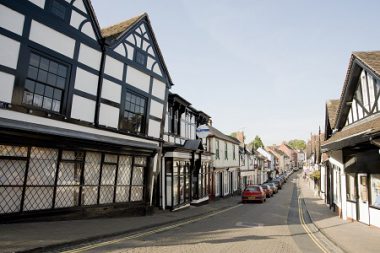
The old High Street in Droitwich

Treebeard is not particularly interested in getting on with things. He has no gardens to tend or food to grow. As he says to the young hobbits his food is a drink “that will keep you green and growing for a long, long while” and unlike ale or beer this drink involves no manufacturing process. His task is to be a shepherd to the trees of the forest and like shepherds, or herdsmen, throughout the world for much of the time, the work requires a close attention to all that is going on and Treebeard has been paying attention for thousands of years. His language, perhaps more like Gaelic, invites you to stop and ponder.

His attentiveness and his long memory is expressed in the telling of stories and the hill on which he has been standing that day has a very long story indeed. Treebeard’s life is lived in long practiced harmony with the forest in which he has lived for long ages and his language is contemplative, an expression of that harmony.

The French Orthodox scholar, Olivier Clément, speaks of this kind of contemplation thus:

“Here is a little spiritual exercise by means of the humblest of sensations- of breathing, of rejoicing under the blue sky, of touching a stone, or the bark of a tree, of gazing… at the majesty of a tree- I try to reach the transcendence of a thing. The object is visible and at the same time invisible; I must seek its inner self, let myself be led by it”

Treebeard has been led by the “inner self” of his forest for a very long time.

“My Name is Like a Story.” Treebeard Gives a Lesson in Language as Participation in Life.

The Two Towers by J.R.R Tolkien (Harper Collins 1991, 2007) 603-607

Last week I wrote about the first encounter between Merry, Pippin and Treebeard as if they had met at a party and had begun the process of getting to know each other. Of course, my suggested image of a party has to be qualified by the possibility that Treebeard might have killed the young hobbits before any conversation took place. That really is some party!

But Treebeard hears the nice voices of the hobbits and decides not to act too hastily and once that decision has been made the whole business of getting to know each other can begin.

For Merry and Pippin this is a simple matter. “Nobody else calls us hobbits; we call ourselves that.” But for Treebeard a name is a very different affair altogether. One one level a name is something that one can present to another so that the business of getting to know a person can begin. “Well, I am an Ent, or that’s what they call me. Yes, Ent is the word. The Ent, I am, you might say, in your manner of speaking. Fangorn is my name according to some. Treebeard others make it. Treebeard will do.” All of this is mere preliminary to real communication. Nothing much has really been said as yet. The real business is yet to start.

“‘ I am not going to tell you my name, not yet at any rate’. A queer half-knowing, half-humorous look came with a green flicker into his eyes. ‘For one thing it would take a long while: my name is growing all the time, and I’ve lived a very long time; so my name is like a story. Real names tell you the story of the things they belong to in my language, in the Old Entish as you might say.”

Treebeard gives a clue about himself in speaking of Ents from the “old lists” of living things in which he tries, and fails, to find hobbits. The Ents are “earthborn, old as mountains.” Pippin later described Treebeard in these terms, “something that grew in the ground… had suddenly waked up, and was considering you with the same slow care that it had given to its own inside affairs for endless years.” Ents are a part of the ancient story of the earth and are yet as immediate and sudden as waking up on a spring morning and finding that everything is alive once more.

Treebeard, like nature herself, takes a particular pleasure in the process of concealment. In speaking of concealment I do not mean deception. He is not trying to throw anyone of the track by pretending to be what he is not. What he does through concealment is to invite another into the long business of getting to know him. I am reminded of the beautiful thing that the great writer, Gabriel Garcia Marquez, said of his wife of many years. “I have known her for so long that she has become a complete mystery to me.” Marquez speaks of the particular pleasure that is gained in remaining in a relationship for a long time and yet never losing a curiosity in who the other is. The reward for this curiosity is not a series of facts that can be consigned to a database that can be forgotten until it becomes necessary to access the data contained therein. The reward is mystery. It is an invitation to go ever deeper and to know that one will never get to the end of the going and that each act of discovery will be a delight over which you can linger and enjoy.

And language, for Treebeard, is a participation in the story of all things. It is not a dispassionate observation of observable facts, that quality that Treebeard describes as hastiness. It is an ongoing response to the hospitable invitation that another gives to get to know them, to listen to their story. And once Treebeard has decided not to kill the young hobbits the business of allowing the hobbits to get to know him can begin.

“Nice Little Voices; They Reminded Me of Something I Cannot Remember.” What Draws Treebeard to Merry and Pippin?

The Two Towers by J.R.R Tolkien (Harper Collins 1991, 2007) pp. 603-607

In last week’s post I noted the complete lack of tension in the first moments of the encounter between Merry, Pippin and Treebeard on the hill top in the Forest of Fangorn. Although the first part of their conversation is an enquiry that asks about the identity of the other it is as if both the Hobbits and the Ent are asking one another whether they might have met on some previous occasion. It all feels like they have met at a party and have begun that process of getting to know each other. Except that, for Treebeard at least, there was the possibility that he might have killed the hobbits first.

“Very odd indeed! Do not be hasty, that is my motto. But if I had seen you, before I heard your voices – I liked them: nice little voices; they reminded me of something I cannot remember – if I had seen you before I heard you, I should just have trodden on you, taking you for little Orcs, and found out my mistake afterwards.”

It is Merry and Pippin’s voices that save their lives and their voices that remind Treebeard of something. Perhaps Tolkien gives us a clue to this something as the young hobbits first enter the forest.

“Out of the shadows the hobbits peeped, gazing back down the slope: little furtive figures that in the dim light looked like elf-children in the deeps of time peering out of the Wild Wood in wonder at their first Dawn.”

Everything in the journey from the plains of Rohan into the Forest of Fangorn, from the crude grasp of their Orc captors into Treebeard’s careful grip is a journey into a world in which everything is both very old and yet one in which an original innocence can flourish. It is this innocence that Treebeard hears in the “nice little voices” of the young hobbits. It is a world still unstained by evil and it calls to that within the ancient Ent which still longs for this world.

I think that we might say that it is the “nice little voices” of Merry and Pippin that bring down the walls of Isengard. They awaken something within Treebeard that he thinks is worth fighting for. We see this effect right through The Lord of The Rings. Hobbits speak of something young and fresh in an ageing, tired world. As they arrive in Rivendell and then Lothlórien, bearing the Ring of Power that is so terrible an expression of the lust for power and control that first stirred within Melkor long ago, they call Elrond and then Galadriel to the act of faith and sacrifice that is possible only to someone who believes in the future. It is the kind of faith that is so often reawakened by the birth of a child. It is reawakened in Treebeard by the childlikeness of Merry and Pippin, guilelessly climbing up the hill upon which Treebeard is standing in the early morning in order to enjoy the feel of the sun upon his ancient limbs once more.

If there had ever been any sense that the hobbits’ behaviour was some kind of a strategy then Elrond and Galadriel would never have accepted the realisation that with their coming their own long sojourn in Middle-earth was coming to an end. And Treebeard would never have decided to risk everything upon a march of the Ents upon Isengard that as Treebeard was to say might be their last. And this, surely, is why the Valar guide a Hobbit to that place, deep beneath the Misty Mountains, where the Ring just happens to have been mislaid by Gollum. No other creature in Middle-earth could have been entrusted with something like the Ring. And, as Gollum’s own sad history demonstrates, even a hobbit can be corrupted by the power of the Ring. Was he, or perhaps Déagol, meant to be the Ringbearer long before first Bilbo and then Frodo took this responsibility?

Frodo has to fight a terrible battle against the corruption of the Ring and yet at all times others recognise an original goodness within him and consider him worthy of the responsibility of bearing the Ring. They see this goodness in Sam, in Merry and in Pippin as well. But, in Merry and in Pippin in particular, they see this goodness before the inner struggles through which Frodo has to pass and in Treebeard, something is reawakened that belongs both to an ancient past and to a hope of renewal. Such original goodness always has this potential.

“Fangorn is My Name.” Merry and Pippin Meet Treebeard on a Hill in The Forest.

The Two Towers by J.R.R Tolkien (Harper Collins 1991,2007) pp. 600-607

Merry and Pippin make their escape from the Orcs up the Entwash into the Forest of Fangorn and at first they are driven by fear of their captors. But at last they pause, struggling for breath in the stifling stillness of the forest and try to assess their position. Which way should they go and what provision do they have for their journey?

A careful examination of their position would not give the hobbits much hope. They have only lembas to eat and enough for only five days and where will they go? But we have already seen that they are content to live in the moment and soon their curiosity about their immediate surroundings begins to grow and, for a while at least, concern for their prospects fades away.

It is the age of the forest that fascinates them and the feeling of age. Pippin likens the forest to the “old room in the Great Place of the Tooks”, where the Old Took, Gerontius, who Bilbo knew, lived year after year while the room grew old about him. “But that is nothing to the old feeling of this wood.”

The moment in which the young hobbits meet Treebeard for the very first time is handled very differently in Peter Jackson’s film than it is in Tolkien’s original telling of the story. The obvious difference is that Tolkien gives us no pursuing orcs. They are lying slain on the grass of Rohan by this point and Grishnákh was killed while trying to take the hobbits to Mordor. But the other difference is that there seems to be a complete absence of fear on the part of Merry and Pippin as they are lifted from the ground by “a large Man-like, almost Troll-like, figure, at least fourteen feet high, very sturdy, with a tall head, and hardly any neck.” I will come back to this strange absence of fear next week in my reflection. As always I do not consider it to be an oversight on Tolkien’s part, one that Peter Jackson corrects.

What we are given is wonder. The first thing that Merry and Pippin become aware of is Treebeard’s eyes and it is Pippin, the one who is normally unreflective, who tries to describe those eyes.

“One felt as if there was an enormous well behind them, filled up with ages of memory and long slow steady thinking; but their surface was sparkling with the present; like sun shimmering on the outer leaves of a vast tree, or on the ripples of a very deep lake. I don’t know, but it felt as if something that grew in the ground- asleep, you might say, or just feeling itself as something between root-tip and leaf-tip, between deep earth and sky had suddenly waked up, and was considering you with the same slow care that it had given to its own inside affairs for endless years.”

What Pippin seems to be describing is nature itself in all its heartbreaking beauty. I say heartbreaking because even as we read these words we are so aware of the fragility of the world that Treebeard expresses and represents. And in this Tolkien reveals himself as a modern writer who is aware that nature is standing at bay as a debased culture, orc like in its character, knows only one relationship to the natural world and that is dominance, abuse and rape.

One of my pleasures in writing these reflections is seeking for appropriate artwork to aid them. Although I enjoyed the films that Peter Jackson made and, in particular, loved the landscapes within which he set the story I have found much more help for my own work from the imaginations of artists. This week I have used an image by the excellent Anke Eissmann once again who finds such character in the faces of Merry and Pippin and I have found a wonderful depiction of Treebeard’s face by Alan Lee. If Eissmann always gives us character in her work Lee gives us mystery. There is a transcendent quality to all his work. Each image is a kind of portal to a reality beyond the surface that can be touched or simply regarded. This is certainly true of his depiction of Treebeard and as I looked at it I began to see a likeness to his depiction of the figure of Merlin in Bragdon Wood from C.S Lewis’s That Hideous Strength. Again, in future weeks, I want to come back to this likeness. I do not know if it was intentional on Lee’s part but that sense that something is awakening, emerging from the earth in both Treebeard and Merlin, is one that excites, even intoxicates me. I hope that you will enjoy this exploration with me and that, perhaps, you will share your insights and responses in the comments section below.

“You Seem to Have Been Doing Well, Master Took.” Merry and Pippin Escape From The Orcs Into Fangorn Forest.

The Two Towers by J.R.R Tolkien (Harper Collins 1991,2007) pp. 591-599

The Orcs have taken Merry and Pippin close to the eaves of Fangorn Forest on their way towards Isengard but there they are halted by Éomer’s company who swiftly surround them with a ring of watch fires in the night. Neither side make any move until a small group of the Riders come in close, slip off their horses and kill several orcs before disappearing into the night. Uglúk and the orcs who had been guarding the hobbits dash off to stop a general stampede and the hobbits are left with Grishnákh, a terrible orc from Mordor.

It soon becomes clear that Grishnákh has been sent from Mordor with orders to bring hobbits back to Barad-dur and it even seems that he knows something about the Ring. Pippin becomes aware of this first and begins to make noises that imitate Gollum. We can only assume that he knows about Gollum’s mannerisms from stories that Bilbo would have told as he has never met him but the noises have their effect. Grishnákh is almost overcome with desire and picks up the hobbits, one under each arm, and tries to escape between the fires.

He does not succeed. He is killed by the Riders who miss the hobbits in the dark and so Merry and Pippin are able to make their escape.

Later there is a charming scene in which Aragorn, Legolas and Gimli succeed in tracking the route that Merry and Pippin take from the orc encampment into the Forest of Fangorn. Legolas tries to make sense of the hobbits’ escape.

“A bound prisoner escapes both from the Orcs and from the surrounding horsemen. He then stops while still in the open, and cuts his bonds with an orc-knife. But how and why? For if his legs were tied, how did he walk? And if his arms were tied, how did he use the knife? And if neither were tied, why did he cut the cords at all? Being pleased with his skill, he then sat down and quietly ate some waybread! That is enough to show that he was a hobbit, without the mallorn-leaf. After that, I suppose, he turned his arms into wings and flew away singing into the trees. It should be easy to find him: we only need wings ourselves.”

The answer to the question about the knife is that earlier in the forced march across the plains of Rohan there had been a bloody argument amongst the hobbits’ captors about what to do with their prisoners. In the brief moment of chaos that followed the fight before Uglúk was able to restore control Pippin was able to cut the cords that bound him using the knife of one of the orcs that had been killed. He quickly retied them loosely before his captors were able to find out what he had done and so it was that after Grishnákh was killed he was able to use his freed hands to use Grishnákh’s sword to cut the other bonds and so he and Merry were able to make their escape. Merry is impressed by his friend’s inventiveness, hence his remark that Pippin has done “rather well”.

But before they complete their escape Pippin takes a mallorn leaf filled with wafers of lembas, removes some of them from the leaf and shares them with Merry. And soon the taste of lembas brings back to the hobbits “the memory of fair faces, and laughter, and wholesome food in quiet days now far away.”

Tolkien drew upon his belief in the efficacy of the eucharist in his creation of lembas. He outlined that belief in a letter he wrote to his son, Christopher.

“Out of the darkness of my life, so much frustrated, I put before you the one great thing to love on earth: the Blessed Sacrament… There you will find romance, glory, honour, fidelity, and the true way of all your loves on earth.”

Tolkien went on to tell his son that the more frequently he received the sacrament the more he would be nourished by it and when Frodo and Sam find that they have nothing else to eat in their journey through Mordor than lembas Tolkien remarks that they were more sustained by it than if they had mixed it with other forms of food. Merry and Pippin find new strength and cheerfulness after the trauma of their cruel treatment at the hands of their captors and so continue their journey into Fangorn.

“Where Do We Get Bed and Breakfast?” On Merry and Pippin and Coping With Difficulties.

The Two Towers by J.R.R Tolkien (Harper Collins 1991,2007) pp.583-591

I was going to give this piece the title of “On Hobbits and Coping With Difficulties” but then I asked myself the question, “how would Ted Sandyman deal with this?”, or Lotho Sackville Baggins or the Shirrifs who arrest Frodo, Sam, Merry and Pippin on their return to the Shire after all their adventures? The point is that hobbits have as much variety in character as any other people.

So let us return to the way in which Merry and Pippin try to cope with the horror of being taken prisoner by orcs. In last week’s piece we found Pippin briefly giving into self-pity and we saw that this is a trope that runs through the story up until the Battle of the Pelennor Fields. But then we saw how Pippin rapidly turned from this to the practical problem of getting free. Pippin, in particular, is not given to very much introspection but both he and Merry share a particular quality together and that is to try to make light of difficulty by the use of humour.

Later in the story Merry will speak of this to Aragorn in the Houses of Healing in Minas Tirith.

“It is the way of my people to use light words at such times and say less than they mean. We fear to say too much. It robs us of the right words when a jest is out of place.”

You only have to open your mouth in England and say a few words and the person with whom you are speaking will begin the process of placing you in a particular social background and will start to treat you accordingly. But class is not something that is set in stone in English culture. It is possible to move from a lower to higher class. Education plays an important role in this process and Tolkien’s education at King Edward’s school in Birmingham and at Oxford University meant that when war came in 1914 he was made an officer and not placed among the ranks.

And it is in the rhythms of speech and the language used by Tolkien’s fellow officers that we will find Merry and Pippin. The use of “light words” is not only a characteristic of the officer class in England it is regarded as essential behaviour. And so Merry speaks of the horror of being taken captive by orcs as “a little expedition” a country walking holiday at the end of which “bed and breakfast” will be found in a pleasant country cottage. By speaking in this manner Merry signals to Pippin that he is alright and Pippin is reassured. And so we see the interplay in The Lord of the Rings between the England of the early 20th century in which Tolkien grew up and the heroic age whose literature Tolkien loved. Again it is an interplay about which Merry and Pippin comment in Minas Tirith when Pippin speaks of having to live “on the heights” as he is brought out of the Shire, the England of the early 20th century, into the heroic world that is represented by Aragorn and Faramir, for example.

We might briefly comment upon the Orcs before concluding these thoughts. Readers of The Chronicles of Narnia by C.S Lewis might remember how Lewis comments on how, in The Magician’s Nephew, Frank, the London cab driver (my grandfather’s profession by the way), begins to revert to the country style of speech that he would have used before moving to London in search of work. This style of speech is the same that Sam Gamgee uses and Lewis is commenting on this reversion favourably. The opposite direction of travel is towards an urban style of speech that is used by Bill Sykes in Charles Dickens’s Oliver Twist, for example, and expresses his brutal nature. This is the language of the Orcs. Both Tolkien and Lewis hated the effect, as they saw it, that urban living had upon people and it is no mistake that the orcs often live in the industrial landscapes of Isengard and Mordor. Could Orcs make the same journey that Frank does in The Magician’s Nephew? I will leave that question to my readers.