Hill Is a Hasty Word for a “Thing That Has Stood Here Since This Part of The World Was Shaped.” Treebeard Calls Us to Learn to Speak With Less Haste.

The Two Towers by J.R.R Tolkien (Harper Collins 1991, 2007) pp. 603-607

Merry and Pippin begin to tell their story to Treebeard but soon Merry suggests that Treebeard put them down.

“You must be getting tired of holding us up,” he says.

Treebeard replies by saying that he doesn’t tire easily but that perhaps it is time to go, to leave the place on which they are standing. And then he ponders the name of this thing.

“Hill?” suggested Pippin. “Shelf? Step?” suggested Merry.

Treebeard repeated the words thoughtfully. “Hill. Yes, that was it. But it is a hasty word for a thing that has stood here ever since this part of the world was shaped. Never mind. Let us go.”

And so Treebeard, in just a few words, challenges us to examine the ways in which we use language, a way is usually unexamined, we might even say, thoughtless. We first learn the names of things from our parents and other adults; a code that we share in common with all who speak our mother tongue. Hobbits, in Tolkien’s world, abandoned their own original language and adopted the Common Tongue, or Westron, that enabled the peoples of Middle-earth, such as Ents and Hobbits, to speak with one another. It is another way in which Hobbits are able to be a kind of Everyman in The Lord of the Rings. Tolkien did some work on the Westron language but unlike the languages of the Elves that emerged from a first principle of language, from the mythology that was the Elves first and essential experience of reality, Westron was a translation from English back into an invented language.

Merry and Pippin, like most hobbits, have very little understanding of the ancient languages of Middle-earth. They are modern people for whom language has lost its ancient connection to an experience of its world that is rooted in myth and mystery. Those who still speak Gaelic in Scotland are able, if they so choose, to walk about a Hebridean island and through the names of each place they come to, tell the story of their island. Tolkien, through his knowledge of Old English, could do something similar with the place names of England, particularly in the ancient shires of Worcester and Oxford. The name of the town near which I live in Worcestershire is Droitwich, from the Old English wic or village and dright which might be dirt (drit). English, unlike Gaelic which tells stories, has always been a practical language. We might say that it is a hasty language. It encourages you to get on with things. Gaelic encourages you to stop and ponder the stories of things.
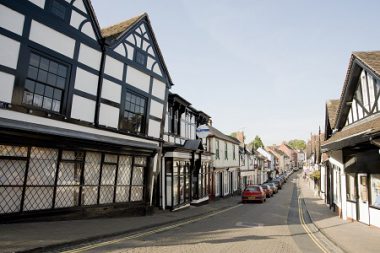
The old High Street in Droitwich

Treebeard is not particularly interested in getting on with things. He has no gardens to tend or food to grow. As he says to the young hobbits his food is a drink “that will keep you green and growing for a long, long while” and unlike ale or beer this drink involves no manufacturing process. His task is to be a shepherd to the trees of the forest and like shepherds, or herdsmen, throughout the world for much of the time, the work requires a close attention to all that is going on and Treebeard has been paying attention for thousands of years. His language, perhaps more like Gaelic, invites you to stop and ponder.

His attentiveness and his long memory is expressed in the telling of stories and the hill on which he has been standing that day has a very long story indeed. Treebeard’s life is lived in long practiced harmony with the forest in which he has lived for long ages and his language is contemplative, an expression of that harmony.

The French Orthodox scholar, Olivier Clément, speaks of this kind of contemplation thus:

“Here is a little spiritual exercise by means of the humblest of sensations- of breathing, of rejoicing under the blue sky, of touching a stone, or the bark of a tree, of gazing… at the majesty of a tree- I try to reach the transcendence of a thing. The object is visible and at the same time invisible; I must seek its inner self, let myself be led by it”

Treebeard has been led by the “inner self” of his forest for a very long time.

A Dishevelled Dryad Loveliness

Frodo and Sam have journeyed through many landscapes since they left Bag End together stepping out onto the Road that Bilbo once sang about, that “Goes ever on and on”. From the gentle woodlands and fields of the Shire to the tangling branches of the Old Forest to the wilds of Eriador; from the magical lands of Rivendell and Lothlorien to the dreadful desolation before the Gate of Mordor, they have seen so much that will change them for ever.

Now they have arrived in the land of Ithilien, once the garden of Gondor upon its northern borders but now fallen into the hands of the Enemy who has already begun his work of destruction. But the foul work of his servants has only recently begun and although Frodo and Sam see many signs of that work they still see for the first time upon their journey Spring “busy about them” with small flowers “opening in the turf” and birds singing. And Tolkien tells us that “Ithilien, the garden of Gondor now desolate kept still a desolate dryad loveliness”.

I cannot think of another occasion in The Lord of the Rings where Tolkien strays from his own mythology, so carefully formed, to bring in an image from another. Perhaps it was a mistake. But it is a phrase of such beauty that maybe we can imagine that if on re-reading his work Tolkien noticed it there, a stray from a classical land, he allowed it to remain and to work its own particular magic upon the land that he described by means of it.

For Ithilien is a land that for centuries has been tended by men and women. It bears testimony to the possibility that human beings of the highest civilisation are capable of living in such harmony with nature they can make a garden that can yet give space to wildness. After many pages of dreariness Tolkien gives space himself to rich language as he writes of the many things that still grow there, of groves and thickets “of tamarisk and pungent terebinth, of olive and of bay…and many herbs of forms and scents beyond the garden-lore of Sam”. Simply to write the names of the plants that grow in this land is to write a poetry that delights the senses as well as mind and spirit.

In his recently published book, Landmarks, that wonderful writer about wildness, Robert Macfarlane notes that a recent edition of the Oxford Junior Dictionary had culled many words related to nature from its pages so that “acorn, adder, ash, beech, bluebell, buttercup, catkin, conker, cowslip, cygnet, dandelion, fern, hazel, heather, heron…” had all been removed to be replaced for the first time with “attachment, block-graph, blog, broadband, bullet point, celebrity, chatroom, committee, cut-and-paste, MP3 player and voicemail”.

The cull did not go unnoticed and when the head of children’s dictionaries at the OUP was asked about them she replied that the dictionary needed to reflect the consensus experience of modern-day childhood. “When you look back at older versions of dictionaries, there were lots of examples of flowers, for instance,” she said; “that was because many children lived in semi-rural environments and saw the seasons. Nowadays, the environment has changed.”

Nowadays the environment has changed and if we are to accept what she says, children no longer see the seasons. It is hard not to think that if Frodo and Sam were to find themselves in our own world they might think that the servants of the Enemy had been at work among us and that the diminishment of our language was a part of that work even as they saw “wounds made by the Orcs and other foul servants of the Dark Lord” all of whom were just trying to make a living.

I passed by proud swans this morning watching carefully over their newly born brood of five cygnets and a heron rising ponderously from the ground a little further on and rejoiced in them. I have hopes that one day I will see otters near by as others have seen them in the past year. And I write these words in a blog, using a broadband connection and complain when the connection lets me down as it sometimes does in my semi-rural home and I am grateful to them for what they enable me to do.

How do I live this tension well?