“That at Least is Enough to Show That He Was a Hobbit.” Aragorn, Legolas and Gimli Search for News of Their Friends.

The Two Towers by J.R.R Tolkien (Harper Collins 1991, 2007) pp. 636-639

When Gimli awakes under the eaves of Fangorn, with his “very bones” chilled, after the night in which the strange visitor came to the camp and the horses loaned to the three hunters ran away, Merry and Pippin are spending the day together with Bregalad as Entmoot continues. The young hobbits are safe in the care of the Ents although Aragorn, Legolas and Gimli could not possibly know this. Indeed Gimli, at least, still regards Fangorn Forest as a place of threat and menace and not, as we have learned, as a place of refuge and kindly welcome to those who are fleeing from danger.

We know that there is little possibility that the hunters will find Merry and Pippin, at least at this point in the story, but they are resolved to continue the search until either they find them or fail, even perish, in the attempt.

The search for clues begins close to the site of the battle in which Éomer’s company first surrounded, and then wiped out, the orcs who were taking Merry and Pippin to Isengard, and it is Aragorn, the greatest tracker of the age, who makes the first find.

“‘Here at last we find news!’ said Aragorn. He lifted up a broken lead for them to see, a large pale leaf of golden hue, now fading and turning brown.”

It is one of the mallorn-leaves of Lórien in which the elves had carefully wrapped the gift of lembas, the waybread that proves so important in sustaining the travellers, especially Frodo and Sam, upon their journey. And there are other signs nearby. One is the presence of lembas crumbs, another the cut cords of the bonds that had held Merry and Pippin, and the other the orc blade that Pippin had used to cut Merry’s bonds.

Legolas is perplexed by the strange tale that these signs seem to tell but Aragorn is able to interpret their meaning. As we know Pippin had been able to free his hands earlier in the forced march across the plains of Rohan. We know too that Grishnákh had tried to escape the battle carrying Merry and Pippin one under each arm in the hope that he could take them to Mordor and claim a reward for bringing a prize to the Dark Lord that Saruman had clearly coveted so much. And we know that Grishnákh was discovered and then killed by the Rohirrim who were not able to discover the hobbits because they were wearing their elven cloaks.

And there is a further detail about which all the companions are able to agree. It is clear that before they continued their journey, one, or as Aragorn guesses and hopes, both of the hobbits sat down to eat a meal of lembas.

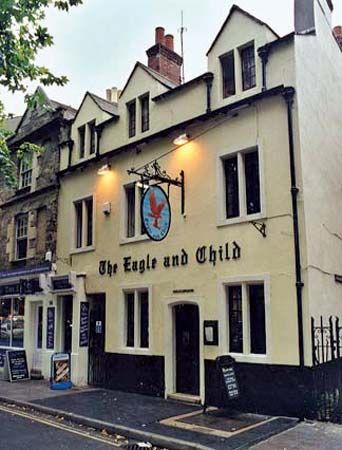
The first main scene of The Lord of the Rings is located in The Ivy Bush, a small inn on the Bywater Road that the Gaffer Gamgee, Sam’s father, likes to frequent. This is no random detail. Hobbit life is built around the enjoyment of food, drink and good company. Tolkien described himself as “a Hobbit (in all but size). I like gardens, trees and unmechanized farmlands; I smoke a pipe and like good plain food.” He might have added his liking for beer, ale and the company of friends. It is no mere accident that some of the finest literary work of the 20th century, work that was wonderfully imaginative, brilliantly critical and profoundly philosophical, arose from The Inklings who used to gather in The Eagle and Child on St Giles’ in Oxford.

The Eagle and Child on St Giles’s in Oxford. It is temporarily closed for a major refurbishment. We are assured that it will be sympathetic. When it reopens I look forward to enjoying its pleasures. Would anyone care to join me there? Perhaps as we enter we could call out, as C.S Lewis used to do, “Any pies today?”

It is no mistake that one of the main things that makes the four hobbits , and especially Merry and Pippin, who set out upon the impossible journey first to Rivendell and then southwards towards Mordor so likeable, is their simple pleasure in food and drink. As Gandalf said of Bilbo and of hobbits in general in The Hobbit, “If more of us valued food and cheer and song above hoarded gold, it would be a merrier world.” It is the possibility of a merrier world that touches so many of the hearts of those who meet Merry and Pippin in their journey, even the glacial hearted Denethor of Gondor. And at this moment of the story as Aragorn, Legolas and Gimli search amidst the debris of battle for signs of their friends it transforms the mere doing of a duty into a passionate and loving self-sacrifice.

“Nice Little Voices; They Reminded Me of Something I Cannot Remember.” What Draws Treebeard to Merry and Pippin?

The Two Towers by J.R.R Tolkien (Harper Collins 1991, 2007) pp. 603-607

In last week’s post I noted the complete lack of tension in the first moments of the encounter between Merry, Pippin and Treebeard on the hill top in the Forest of Fangorn. Although the first part of their conversation is an enquiry that asks about the identity of the other it is as if both the Hobbits and the Ent are asking one another whether they might have met on some previous occasion. It all feels like they have met at a party and have begun that process of getting to know each other. Except that, for Treebeard at least, there was the possibility that he might have killed the hobbits first.

“Very odd indeed! Do not be hasty, that is my motto. But if I had seen you, before I heard your voices – I liked them: nice little voices; they reminded me of something I cannot remember – if I had seen you before I heard you, I should just have trodden on you, taking you for little Orcs, and found out my mistake afterwards.”

It is Merry and Pippin’s voices that save their lives and their voices that remind Treebeard of something. Perhaps Tolkien gives us a clue to this something as the young hobbits first enter the forest.

“Out of the shadows the hobbits peeped, gazing back down the slope: little furtive figures that in the dim light looked like elf-children in the deeps of time peering out of the Wild Wood in wonder at their first Dawn.”

Everything in the journey from the plains of Rohan into the Forest of Fangorn, from the crude grasp of their Orc captors into Treebeard’s careful grip is a journey into a world in which everything is both very old and yet one in which an original innocence can flourish. It is this innocence that Treebeard hears in the “nice little voices” of the young hobbits. It is a world still unstained by evil and it calls to that within the ancient Ent which still longs for this world.

I think that we might say that it is the “nice little voices” of Merry and Pippin that bring down the walls of Isengard. They awaken something within Treebeard that he thinks is worth fighting for. We see this effect right through The Lord of The Rings. Hobbits speak of something young and fresh in an ageing, tired world. As they arrive in Rivendell and then Lothlórien, bearing the Ring of Power that is so terrible an expression of the lust for power and control that first stirred within Melkor long ago, they call Elrond and then Galadriel to the act of faith and sacrifice that is possible only to someone who believes in the future. It is the kind of faith that is so often reawakened by the birth of a child. It is reawakened in Treebeard by the childlikeness of Merry and Pippin, guilelessly climbing up the hill upon which Treebeard is standing in the early morning in order to enjoy the feel of the sun upon his ancient limbs once more.

If there had ever been any sense that the hobbits’ behaviour was some kind of a strategy then Elrond and Galadriel would never have accepted the realisation that with their coming their own long sojourn in Middle-earth was coming to an end. And Treebeard would never have decided to risk everything upon a march of the Ents upon Isengard that as Treebeard was to say might be their last. And this, surely, is why the Valar guide a Hobbit to that place, deep beneath the Misty Mountains, where the Ring just happens to have been mislaid by Gollum. No other creature in Middle-earth could have been entrusted with something like the Ring. And, as Gollum’s own sad history demonstrates, even a hobbit can be corrupted by the power of the Ring. Was he, or perhaps Déagol, meant to be the Ringbearer long before first Bilbo and then Frodo took this responsibility?

Frodo has to fight a terrible battle against the corruption of the Ring and yet at all times others recognise an original goodness within him and consider him worthy of the responsibility of bearing the Ring. They see this goodness in Sam, in Merry and in Pippin as well. But, in Merry and in Pippin in particular, they see this goodness before the inner struggles through which Frodo has to pass and in Treebeard, something is reawakened that belongs both to an ancient past and to a hope of renewal. Such original goodness always has this potential.

“Fool of a Took!” Gandalf and Pippin at The Well in The Guardroom in Moria.

The Fellowship of the Ring by J.R.R Tolkien (Harper Collins 1991) pp. 303-306

The weary travellers have come to a place in which three choices lie before them. Not that it is the Company that will make the choice. Every one of them has given this task to Gandalf. He is the guide through the vast mines of Khazad-dûm. But at this point Gandalf is unsure about which way to go and too weary to make a decision. There is a guardroom nearby and they decide to rest within it.

At the centre of the room there is a well that is completely unprotected and Pippin is strangely drawn towards it. Is it Aragorn’s words of warning that have this effect? “One of you might have fallen in and still be wondering when you were going to hit the bottom.” How deep is the well? Pippin needs to know and so he drops a stone into it. It is many seconds before the stone plunges into water in the depths below and when it does it makes a sound that reverberates around the cavernous walls of the well.

It is necessary now for engineers to suspend their disbelief. We have reflected on other occasions about the weaving of history and mythology within The Lord of the Rings and it is clear now that we have entered the realms of mythology, that which never happened but is always true. While we cannot conceive a well so deep that to raise a bucket of water by hand would be a task that would take a very long time indeed we can and do conceive abysmal depths in “the dark places of the earth”. We both fear such places within our own psyche and, as with Pippin, are strangely drawn towards them.

Perhaps we are both afraid of and drawn towards what might lie there. “Tap-tom, tom-tap, tap-tap, tom”

“That was the sound of a hammer, or I have never heard one,” says Gimli. Has something been awoken by Pippin’s “foolish stone” that should have been left undisturbed? Should we ever awaken that which lies deep within us?

“Fool of a Took!” Gandalf growls at Pippin. “This is a serious journey, not a hobbit walking-party. Throw yourself in next time, and then you will be no further nuisance. Now be quiet!” And poor Pippin is given the first watch, “as a reward”.

Some readers may recall a gruff old teacher from their childhood experience of school. One who they respected but also feared, if only for the angry rebuke that they might occasionally receive. The relationship between Gandalf and Pippin seems very much like that of master and pupil. Pippin is not one of those brilliant pupils such as is Aragorn or Faramir or Frodo. Each of these come to understand the mind of their master to such a degree that he is able to entrust any task to them and know that they will carry it out, not just because they have become capable of doing so but also because they carry the meaning of that task in their hearts even as he does. There is a sense in which Aragorn, Faramir and Frodo become sons to Gandalf and in the case of Faramir in particular this becomes a source of resentment, one of many, in Denethor, Faramir’s biological father.

Pippin is a different kind of pupil. In his saving of the life of Faramir he displays that he understands the heart of his master. But Pippin does something else that I am not sure that any of Gandalf’s other pupils do. He awakens affection in the heart of the gruff old wizard. This is not because of his aptitude or ability but because of his childlike nature. Later in the story after Pippin’s misadventure with the Stone of Orthanc Gandalf takes Pippin with him to Minas Tirith, to keep him from any further mischief, but also, I think, because at this crucial moment in Gandalf’s long life, he needs Pippin. Pippin brings a comfort to Gandalf that no-one else can. “All wizards should have a hobbit or two in their care, to teach them the meaning of the word.” Even now in the fearful dark of Moria, with the terrible abyss of the well close by, Gandalf soon relieves Pippin of his lonely duty, speaks kindly to him and sends him off to get some sleep. The guide is watching over all his charges and we can all rest. For a little while at least.

“There Must Be Someone of Intelligence in The Party”. On the Choosing of The Heroes Who Will Help Frodo to Take The Ring to The Fire.

The Fellowship of the Ring by J.R.R Tolkien (Harper Collins 1991) pp.264-267

Elrond honoured Frodo’s offer of himself to take the Ring to the Fire by speaking of the heroes of the past. “If you take it freely,” he says, “I will say that your choice is right; and though the mighty elf-friends of old, Hador and Húrin, and Túrin, and Beren himself, were assembled together, your seat should be among them.”

When The Lord of the Rings was first published in 1954 little was known of these names except for Beren because of the story that Strider told to the hobbits in the camp below Weathertop on the night on which the Nazgûl attacked and wounded Frodo. The Silmarillion was not published until after Tolkien’s death and in the years since our knowledge of them all has grown thanks to the work of Christopher Tolkien. But if all we knew of them was the list that Elrond gives us, that phrase, “mighty elf friends” would be sufficient to evoke our deepest respect and even a little awe.

The four “mighty elf-friends of old” that Elrond names are figures of the First Age of Arda. They were the mortal Children of Ilúvatar who, upon entering Beleriand, chose to side with the Elves against Morgoth. Deeply flawed though they were, it was their implacable denial of despair in the face of the seemingly inevitable victory of darkness that shines out again and again through the long defeat of that age. Typical of this spirit we read of Húrin at the terrible battle of Nirnaeth Arnoediad.

“Last of all Húrin stood alone. Then he cast aside his shield, and wielded an axe two-handed; and it is sung that the axe smoked in the black blood of the troll guard of Gothmog until it withered, and each time that he slew Húrin cried: “Aurë entuluva! Day shall come again!”

It is of heroes like this to which Elrond likens Frodo, not because of his martial ferocity but because of his quiet courage in the face of an impossible task. When he and Sam and Bilbo meet with Merry and Pippin, Frodo describes his mission as “a hopeless journey”. There is no point at which he regards it as anything less than hopeless and yet he never thinks of turning back, of resting in Rivendell, “a long while, perhaps for good”.

Frodo is a hero to stand with the Elf-friends of old because of the choice that he makes but what of Sam, Merry and Pippin? At first glance we might think that Tolkien uses them as some kind of comic relief and Pippin’s words about “someone with intelligence in the party” and Gandalf’s response to what Pippin says seem to show that this is indeed their purpose in the story. But at all times Tolkien wants us to see that the bonds of fellowship that bind the hobbits together have a power that cannot be measured through force of arms or even their intelligence. Later when Elrond chooses the party that will accompany Frodo, Sam and the Ring, he is minded to choose someone like Glorfindel, a mighty elf-lord, but Gandalf disagrees.

“I think, Elrond, that in this matter it would be well to trust rather to their friendship than to great wisdom”

It is not that Gandalf has given way to sentimentality at this vital moment in the story but that he is true to his own charism, the grace that he has been given and which he has long nurtured. His teacher, the Lady Nienna, taught him to see with pity, not with blame and to warm the hearts of free peoples everywhere. He knows the power of a warmed heart especially when the world has grown cold and time and again, I suspect without really knowing why, his heart was drawn to the Shire and the simple hospitality of its people. His pleasure in good, simple food, good beer and a pipe to follow dinner meant that his own heart was warmed when he made these visits and if the only fruit of them was rest and the enjoyment of fireworks then this would have been sufficient for him but it was to these simple folk to whom the Ring was entrusted. Folk who live in the “merrier world” in which “food and cheer and song” are valued above hoarded gold.

Keep Up Your Merry Hearts. Tom Bombadil Bids the Hobbits Farewell.

The Fellowship of the Ring by J.R.R Tolkien (Harper Collins 1991) pp. 141-145

Tom Bombadil tells the hobbits that he will accompany them on their journey from the barrow in which they have been imprisoned until they reach the Road once more. As Tom puts it, the hobbits are “so good at losing themselves” that he will not feel happy until he has “seen them safe over the borders of his land”.

The hobbits are delighted that they will have Tom’s company for a little while longer. They enjoy his joy and they feel safe with him. He has rescued them from disaster twice; once from Old Man Willow and once from the barrow wight. On both occasions they stumbled into danger entirely unawares. We should not blame them. Until now they have all lived lives entirely free from danger, the kind of lives that we all wish for our children, for no-one wishes that their children’s lives should be deliberately put at risk, but now they will often be in danger and they need to learn how to live with this.

Tom gives them sound advice. Probably, as with most advice that we are given, the hobbits will soon forget what Tom has told them, but somewhere his words will take root within them. In the days that lie ahead they will face many dangers, toils and snares and each experience will make Tom’s words more real until both word and experience will be woven together as one. When they are finally returning to the Shire, and begin to hear ominous news about what awaits them, Gandalf leaves them to enjoy a good long chat with Tom Bombadil and tells them that they do not need looking after any longer.

Tom’s words to the hobbits are both a celebration of what they already are and, at the same time, a warning of the qualities that they need to develop if they are to have a chance of surviving what lies ahead.

“Be bold, but wary! Keep up your merry hearts, and ride to meet your fortune.”

The hobbits understand this kind of wisdom. It is a wisdom shared through proverbs that are easy to teach and to recall. It is a wisdom well known in non-literate peasant cultures but no-one should make the mistake of mistaking simplicity for shallowness. Tom Bombadil’s wisdom is profound.

The quality that Tom celebrates in the hobbits is their “merry hearts”. He recognises this quality within himself and he approves of it in them. Throughout the story others will both remark upon the hobbits’ childlikeness, seeing this especially in Merry and Pippin, and many will enjoy it. Even Denethor, in all his world-weariness and cynicism, will for a brief moment seek to keep Pippin near him, surely recognising as he does so something that he has long lost but misses still. Throughout The Lord of the Rings there is the feel of a world grown old and sad, a world that is passing away. Merry and Pippin will make others glad that they are alive or at least remind them of a time when they were glad and, perhaps, rekindle within them the hope that they might find such gladness again.

But merriness will not protect them from harm. Already they have encountered terrible danger and on each step that they take they will be surrounded by it. Their merry hearts will enable them to endure dangers but they will need to learn boldness tempered by wariness if they are to have a chance of surviving them. As we have seen, wariness is most certainly something that they have not yet learned.

I am not sure that Merry and Pippin will ever learn wariness and Frodo and Sam will be forced to place their entire lives into the care of someone who wishes them nothing but harm. Simply by going on with this journey the hobbits are embracing boldness. Simply by riding eastwards along the Great Road they are facing their fortunes, separately and together. And simply by being themselves they are riding towards their fortunes with merry hearts.

For those interested in exploring the use of proverbs in The Lord of the Rings I would warmly recommend The Proverbs of Middle-earth by David Rowe.