“We Are a Failing People, a Springless Autumn.” Faramir Tells Frodo and Sam of The History of Gondor and of His Loss of Hope.

The Two Towers by J.R.R Tolkien (Harper Collins 1991, 2007) pp. 884-887

One of the main themes of The Lord of the Rings is the decline of the West. Later on in the story Denethor, the Steward of Gondor, will declare to Gandalf that the West has failed and that there is no hope against the dark and Sauron its lord.

Faramir seems to have as little hope as does his father and says as much to Frodo as they converse together after dinner.

“What hope have we?” said Faramir. “It is long since we had any hope. The sword of Elendil, if it returns indeed, may rekindle it, but I do not think that it will do more than put off the evil day, unless other help unlooked-for also comes, from Elves or Men. For the Enemy increases and we decrease. We are a failing people, a springless autumn.”

If one of the main themes of Tolkien’s great work is the decline of the West so too is the matter of Hope. Faramir speaks of help from Elves or Men but describes it as “unlooked-for”. He cannot imagine from where such hope might come even though he speaks warmly of the ancient alliance with the people of Rohan, their distant kin from of old. It is, of course, a delicious irony that the hope of the West is even now sitting before him in the form of a hobbit and his faithful servant. Elrond both recognised and welcomed this irony and Denethor will later dismiss it as a fool’s hope and Denethor will be right. It is my conviction that it was one of the greatest moments of the twentieth century and a moment whose influence is, if anything, greater in our own century, when Tolkien found himself writing words on a blank piece of paper while doing the tedious task of marking examinations, “in a hole in the ground there lived a hobbit”.

An evocative illustration by Daniel Reeve. (With thanks to Marcel Bülles for alerting me to my original incorrect attribution.)

Hobbits arrived both unlooked-for in Tolkien’s mind and even unwelcome. They interrupted his life’s work, the creation of a legendarium to which he had devoted himself for many years. They made him some money, a very useful and necessary thing for a man with a large family, but he always felt that they kept him from The Silmarillion, the great work whose existence we owe to his son, Christopher.

But, as he was to say in his foreword to the second edition of The Lord of the Rings, “the tale grew in the telling”, so that the figure who sat before Faramir in Henneth Annûn was very different and much greater than anything that Tolkien had initially conceived. In many ways Bilbo was a figure akin to the tricksters much beloved of old English folktales like Jack the Giant Killer a figure who won the prize by quick wits and good luck. Such figures would appear in the great mythologies of Europe such as the Grail Legend merely to offer some comic relief. This is how Denethor sees Pippin later on. Faramir recognises something different in Frodo but even he does not recognise just how different Frodo is.

If there is hope to be found in Faramir’s world then perhaps it might be found in “the sword of Elendil” that Aragorn wields, but Faramir is right in saying that the best that Aragorn can do is to put off the evil day. The victory won at the Pelennor Fields is just such a thing. The army that Aragorn leads that follows this victory is “scarce as many as the vanguard of [Gondor’s] army in the days of its power”, such as the army that overthrew the Witch-king of Angmar in Eriador. Aragorn knows that his assault upon Mordor is utterly impossible. There is only one hope, the fool’s hope that Frodo can take the Ring to Mount Doom and destroy it there.

It is here that I would argue that only an imagination formed by long practice of Christian faith is capable of creating the figures of Frodo Baggins and Samwise Gamgee. I am prepared to be persuaded that other religious traditions are capable of this but even then would argue that if they are then they will be very closely akin to Christianity at this point. Even many who call themselves Christian do not look for hope in the unlooked-for places. Like Faramir we cannot imagine what they might be so we do not look beyond the tried and tested or beyond a slightly better version of what we already know.

But I think that I might be judging Faramir too harshly. When he finally discovers Frodo’s mission through Sam’s unintentional assistance he recognises it for what it is. He knows that all the truth that he has ever learned, in Númenor that was, Elvenhome that is and above and beyond all “that which is beyond Elvenhome, and will ever be” has led him to the moment when he can see that Frodo’s mission is the hope of the West and that, at the same time, it is a fool’s hope as well.
“We Look towards Númenor That Was, and Beyond to Elvenhome That Is, and To That Which is Beyond Elvenhome and Will Ever Be”. Faramir Prepares to Eat in The Divine Presence.

The Two Towers by J.R.R Tolkien (Harper Collins 1991, 2007) pp. 882-884

While on the journey to Henneth Annûn, Faramir had spoken to Frodo and Sam about his love for the memory, the ancientry, the beauty and the present wisdom of the city of the Men of Númenor, Minas Tirith, and his desire, therefore, to defend that city against Sauron, the Lord of Darkness. Faramir lives in a big world and before he sits to eat with his guests and his men he leads them all in a simple ceremony in which all stand and face west “in a moment of silence”.

This is the only ceremony that takes place throughout the entirety of The Lord of the Rings until the crowning of the High King of Gondor and of Arnor. There might be an argument to be made that the peoples of Middle-earth are ritually malnourished, an argument that could be made about the West in our own time, but Tolkien had good reason not to give his secondary creation a ritual structure. His creation was a mythical history of our own world but in a world before the incarnation of Christ, the True Myth as he famously explained to C.S Lewis, the moment in which myth and history became one in first century Palestine.

Faramir remembers “Elvenhome that is” as depicted by Alan Lee.

His anxiety was that any attempt to create a ritual life for his sub-creation would at best be inadequate and at worst idolatrous. There is only one place of worship built in the whole of Tolkien’s legendarium and that was built by Ar-Pharazôn, the last king of Númenor, for the worship of Morgoth because Ar-Pharazôn had been seduced by Sauron who had convinced him that Morgoth was the ultimate power of the universe. So the only place of worship was idolatrous and rejected by Elendil, the Elf-friend, and his followers, of whom Faramir was a descendant.

So when Faramir leads his men in a moment of ritual before they sit to eat it is done in silence so that there can be no danger of idolatry, the worship of that which is false. But this does not mean that there is no content to the ceremony and when Faramir explains it to Frodo he shows him the world in which he lives.

“We look towards Númenor that was, and beyond to Elvenhome that is, and to that which is beyond Elvenhome and will ever be.”

Númenor is the memory and the ancientry of which Faramir spoke upon the way. While the Númenor of Ar-Pharazôn was destroyed by a great wave by Eru Ilúvatar at the end of the Second Age Elendil escaped with his followers to Middle-earth and created there the kingdoms of Gondor and Arnor. Elendil honoured the ancient friendship that the Númenorians had enjoyed with the Elves, a friendship that meant that he fought alongside Gil-galad in the last great alliance between Elves and Men that overthrew Sauron taking the Ring from his hand. Faramir recognises this as he speaks of Elvenhome that is, Valinor that lies beyond the wreck of Númenor.

And he also recognises “that which is beyond Elvenhome and will ever be”. He recognises God, Eru Ilúvatar, the source of all being and life. Later when he takes Éowyn into his arms for the very first time he tells her of the wave that destroyed Númenor. In doing this he shows that he understands that Eru had intervened once directly in the affairs of Arda and also feels that something similar has just happened at the moment in which the Ring has gone to the Fire.

Frodo feels “strangely rustic and untutored” when Faramir explains all this to him. He recognises that Faramir lives in a bigger world than he does. Faramir probably lives in a bigger world than any of his men but because they honour him as their leader so too they honour his inner life and that which he believes. He is the greatest holder of the memory, the ancientry, the beauty and the present wisdom of his people. One man holds all of this, a fragile link with it all, but the world in which Faramir lives is not held by him. He is held by it as are his men and his people whether they do so consciously or not. Soon Faramir’s world will be assaulted by the darkness and tested to its very limits. It will stand, not because of its own might, but because of that which stands beneath, around and within it, and will hold it even and especially in its darkest moments.

“At Least by Good Chance We Come at The Right Hour to Reward You For Your Patience.” Frodo and Sam Come to Henneth Annûn, the Window of the Sunset.

The Two Towers by J.R.R Tolkien (Harper Collins 1991, 2007) pp. 878-881

The journey to the place of refuge in which Frodo and Sam will stay that night is not an easy one, especially for Frodo and Sam for they will have to make the journey blindfold. But even Gollum, who we glimpsed briefly through Sam’s eyes at the beginning of this passage seems to be thrown off the trail.

But at the last, after a journey that Tolkien describes by means of the language of sound, the hobbits arrive at their place of rest and find it to be a place of beauty. For Frodo and Sam this will be their last place of refuge upon their long journey before they enter Mordor and there will be no refuge there. The first was at Woody End when they were guests of Gildor Inglorien and his company and there have been many along the way. The house of Tom Bombadil, the Prancing Pony at Bree, the Last Homely House at Rivendell, the secret land of Lothlórien, and now this. Of all the places in which they have rested this provides the least comfort but it is a safe place and it has its reward for those who rest there.

See Alan Lee’s beautiful depiction of the Elves refuge in Woody End.

“They stood on a wet floor of polished stone, the doorstep, as it were, of a rough hewn gate of rock opening dark behind them. But in front a thin veil of water was hung, so near that Frodo could have put an outstretched arm into it. It faced westward. The level shafts of the setting sun behind beat upon it, and the red light was broken into many flickering beams of ever changing colour. It was as if they stood at the window of some elven-tower, curtained with threaded jewels of silver and gold, and ruby, sapphire and amethyst, all kindled with an unconsuming fire.”

If elves had come to this place they would have fashioned a place of wonder just as they did at Woody End in the Shire. They would have learned what the place had to teach them through patient attention and then worked with it to reveal that wonder. As Gimli showed us at the glittering caves of Aglarond that dwarves would pay attention to the gifts of the earth in order to reveal them. And hobbits would discover that which would make it homely just as they had done in the Shire.

But these gifts are gifts of peace and now there is no time to practice them. The men of Gondor have made it a place of temporary shelter just as soldiers did in the trenches of the Western Front in the 1914-18 war in which Tolkien played his part. Whether Faramir returned to Henneth Annûn after the war we are not told but I like to imagine that he did and that some of Legolas’s promised elves from the woodland realm offered their services to create a kingly hall here.

But Frodo and Sam are able to find beauty wherever they go. Perhaps, as Frodo suggests when his eyes are blindfolded, it is a gift that he shares with all hobbits. He spoke at that moment of how, when the Fellowship had entered Lothlórien Gimli had sought to resist the Elves insistence that their eyes should have been blindfolded but that “the hobbits endured it”.

The willingness of hobbits to endure is one of the great gifts that they bring to the story. Of course they are capable of heroic deeds when called upon to undertake them but they do not look for such things. Merry and Pippin are carried across Rohan bound by orcs and Sam follows where Frodo goes without seeking any comfort for himself. And Frodo endures the Ring that he never sought, never desired,but which simply came to him. Later Frodo will be carried into Mordor by orcs and at the end he will be carried up Mount Doom by Sam.

“And do you seek great things for yourself, seek them not,” was a favourite text from the bible of Dietrich Bonhoeffer, the great theologian and resister of the Nazi tyranny, and one that he pondered often while in prison. And the text continues, “but I will give your life as a prize of war” (Jeremiah 45.5). Bonhoeffer learnt that life was to lived as something given, not shaped by ourselves, just as prisoners of war are allowed to live. Frodo understands life in this way and one of the rewards of his patience is an ability to find beauty at many unexpected times and places.

“Better Fear Undeserved Than Rash Words”. Can Frodo Trust Faramir?

The Two Towers by J.R.R Tolkien (Harper Collins 1991, 2007) pp. 874-878

The question of trust is one of life’s greatest challenges. When we are able to trust someone it creates a liberty that enlivens and energises like nothing else. When trust is betrayed the very foundations of the soul are undermined. In Dante’s Inferno it is traitors who are placed in the deepest circle of hell. Faramir himself has had to struggle with the question, “Can he trust Frodo?”. When he was interrogating Frodo after the battle against the Haradrim it was the one thing that he was striving to establish. Boromir was dead and here was someone who clearly had known him. Had Frodo played some part in his brother’s death?

“Treachery not the least.” Can Faramir trust Frodo? Anke Eissman depicts Faramir’s interrogation of Frodo.

One of the central themes of The Lord of the Rings is the creation of the bonds of fellowship. Fellowship is in the very title of the first volume of Tolkien’s great work, the one title in which he had full confidence, having wished himself that the book should have been published in a single volume and not three as his publisher decided to do. When Elrond formed the Fellowship following the Council in Rivendell and Frodo’s courageous offer to carry the Ring to the Fire of Orodruin in Mordor he had two purposes. One was the decision to choose nine walkers to stand in opposition to the Nazgûl, Sauron’s nine riders. This was a symbolic choice and not a practical one. Perhaps only Gandalf of the nine could match any of the Nazgûl in combat. That one of the hobbits should play a part in the death of their chief was due, not to his prowess in battle, but to the part played by deeper and providential forces at work, another of the central themes of Tolkien’s great work.

The other purpose in Elrond’s choice, and the purpose that we are considering in this reflection, was to create a fellowship of the free peoples of Middle-earth; elves, men, dwarves and hobbits. That these had been sundered from one another over long years had been one of the greatest sorrows of its long history. There had been no alliance of men and elves since the end of the Second Age and the war against Sauron in which Elendil the only High King of both Gondor and Arnor, and Gil-galad, the last High King of the Elves in Middle-earth, were able, just, to stand against Sauron in battle and to overthrow him. Indeed it had been one of Sauron’s main purposes throughout the Third Age once he began to take shape again following his defeat and the loss of the Ring, was to weaken those essential bonds of fellowship among his enemies. Elves and Dwarves had long mistrust in one another as we learned when Gimli came to Lothlorian. Indeed it was one of the greatest fruits of the stay of the Fellowship in that land that Gimli gave his heart to Galadriel and formed a deep friendship with Legolas, the son of an elven king who had once held Gimli’s own father prisoner. Elves and Men had become sundered as the elves had slowly withdrawn into secret lands and a secret way of living, the outcome of which was that elves had become a thing of legend in the minds of men, even an uncanny thing, a thing to be feared little less than Mordor itself. And hobbits, if they were known at all, were largely disregarded as a people of small consequence.

Throughout the Third Age it was examples of friendship between its free peoples that was always remarkable. Elrond’s own “Last Homely House” in Rivendell was a place of hospitality to all free peoples, and its way, The Prancing Pony in Bree played a similar role but on a lesser scale. That Elves never made use of its welcome played its part in the growing belief amongst other peoples that they were fey and to be feared. The west door of Moria through which the Fellowship entered with such difficulty had a password of beguiling simplicity. All a traveller needed to do in order to gain access to the greatest kingdom of the Dwarves was to say the word, friend, and the door would open. And the friendship between Dale and the kingdom under the mountain, near neighbours in the north of Middle-earth, was a rare example of friendship between Dwarves and Men.

Indeed each of these examples brought prosperity and strength and it was to deepen, even create, friendship to which Gandalf devoted his long sojourn in Middle-earth, using Narya, the even ring of fire to “rekindle hearts in a world that grows chill. In our own human history it was the creation of Christian monasteries, first formed in the deserts of Egypt and Syria in the 4th century, and then in the West of Europe following the fall of the Roman Empire, places of hospitality, learning and healing, that played a central role in the renewing of Europe, giving a part to friendship in the history of that continent that stood in sharp distinction to the role of power in the Roman Empire and in the many attempts to recreate empire in the centuries since that time.

So can Frodo trust Faramir? Or is fear, even if undeserved, a wiser cause of action? Perhaps the whole future of Middle-earth rests upon the choice that Frodo will make. Fortunately for all it is Sam’s simplicity that will make the choice for all and that is wonderfully providential.

“I Do Not Love The Bright Sword For Its Sharpness, Nor the Arrow For Its Swiftness, Nor The Warrior For His Glory.” Faramir Speaks of War.

The Two Towers by J.R.R Tolkien (Harper Collins 1991, 2007) pp. 874-878

Faramir is a warrior. When Éowyn first meets him in the Houses of Healing in Minas Tirith after the Battle of the Pelennor Fields she assesses him shrewdly as a warrior herself, “bred among men of war, that here was one that no Rider of the Mark could outmatch in battle”.

But Faramir does not love war or the way of the warrior. After the War of the Ring and after he marries Éowyn of Rohan he will devote his life to the arts of peace. Together with his bride he will restore the land of Ithilien to its former beauty. Later in his encounter with Frodo and Sam Faramir will say of the Shire, “Your land must be a place of peace and content, and there must gardeners be in high honour”.

Faramir would be a gardener himself, not an industrial scale food producer, one who reduces the land to compliant submission with pesticides and chemical fertilisers, but one who would allow the land to find its true wildness in which the growing of food would take its natural place. In essence he would be one who would re-unite the Ents and the Entwives, if that were possible, working as a sub-creator to make a land where both could live at peace with one another. When Treebeard met Merry and Pippin and learnt of the Shire he commented that it was a land that the Entwives would love. The Ents would love the Old Forest, a land in which the hobbits felt themselves to be alien. Is there a land where both could live together in harmony?

But here we must return to the reality of war. Faramir is now a warrior by necessity. Mordor has already seized control of Ithilien and Faramir and his men are operating behind enemy lines. And they would take the rest of Gondor too and then land by land the rest of Middle-earth also. Mordor is an empire that would make the whole earth its slave, that would make it like Mordor itself. So, as Faramir puts it himself, “War must be, while we defend our lives against a destroyer who would devour all”.

So Tolkien was not a pacifist in an absolute sense, one who regards war as unjustified in all cases, even that in which an enslaving enemy seeks to devour a peaceful land. But neither Tolkien, nor Faramir, love war for its own sake.

“I do not love the bright sword for its sharpness, nor the arrow for its swiftness, nor the warrior for his glory. I love only that which they defend: the city of the Men of Númenor; and I would have her loved for her memory, her ancientry, her beauty, and her present wisdom. Not feared, save as men may fear the dignity of a man, old and wise.”

This is a theme that runs throughout all Tolkien’s works. That the arts of peace are superior to the arts of war. We remember the last words that Thorin Oakenshield said to Bilbo as he lay dying after the Battle of the Five Armies. “If more of us valued food and cheer and song above hoarded gold it would be a merrier world.” And yet, as Aragorn says at the Council of Elrond, the northern lands of which the Shire is one would have known little of peace unless they had been defended. “What roads would any dare to tread, what safety would there be in quiet lands, or in the homes of simple men at night, if the Dúnedain were asleep, or were all gone into the grave?”

So Tolkien never quite resolves the question of how much must a land and its people be prepared to defend themselves against potential threat, and perhaps it can never be fully resolved. So Faramir must be a warrior by necessity even though he longs to practice the arts of peace. And perhaps this is where we must leave the debate for now. Perhaps Faramir gives us a sense of how to live with this tension. He is trained for war and yet longs for peace, He is unyielding in war as he showed in the battle against the Haradrim in which we first met him and yet he is gentle in all his dealings with the hobbits who are now his prisoners. Such a tension requires a hard practice and discipline. The fruit of that discipline is the man who now speaks his heart to Frodo, one of the greatest of all Tolkien’s creations.

“Not a Mistress of Many Slaves, Not Even a Kind Mistress of Willing Slaves.” Faramir Speaks of Patriotism to Frodo and Sam.

The Two Towers by J.R.R Tolkien (Harper Collins 1991, 2007) pp. 874-878

As Faramir guides Frodo and Sam towards Henneth Annûn he speaks thoughts aloud that, perhaps, he has not shared with anyone else. We have already met his brother, Boromir and know that he was a man of a very different spirit. Later we will meet his father, Denethor, and we will learn that Faramir could not have shared his heart with him. Denethor, as we will learn, discerned much of what lay in his younger son’s heart and laid the blame for this at Gandalf’s door. There is little doubt that Gandalf was a great influence upon Faramir. As with Frodo in the Shire and Aragorn in Rivendell he found out young men and taught them, but they needed to be young men of the right spirit. That Frodo, Aragorn and Faramir all emerged at exactly the same time must have been the cause of great delight for one who came to teach, as Gandalf had done. For it was through teaching, not through the exercise of power, that Gandalf came to change the world.

Last week we learned that Faramir too had no desire for power if it came from an evil source. He has some sense of the nature of Isildur’s Bane even though he does not yet know that it is the Ring of Power that Sauron made to enable him to rule all things. Now we learn what Faramir believes about power itself and the power of his own country.

“For myself,” said Faramir, “I would see the White Tree in flower again in the courts of the kings, and the Silver Crown return, and Minas Tirith in peace: Minas Arnor again as of old, full of light, high and fair, beautiful as a queen among other queens: not a mistress of many slaves, nay, not even a kind mistress of willing slaves.”

Tolkien wrote these words towards the end of an age in which his own country, Great Britain, had ruled over an empire, greater in area and in population, than any that had existed before it. By the time he died, in 1973, most of this empire had gone. One particular empire no longer existed but the idea of empire was as strong as ever. The British Empire had been one of many that had existed throughout world history and after its decline and fall it has not been the idea of empire that has disappeared, merely a particular expression of that idea.

As you can see, I have used the word, decline, in speaking of this history and that is how it is usually understood. For about a century after the defeat of Napoleon at Waterloo, Britain was the greatest world power but the story since then has been one of decline. The assumption made here is that the exercise of power, if you have it, is how things are. And when power is spoken of it is military power that we are speaking about. We remember that when Boromir spoke at the Council of Elrond he made reference to the counsel that his host might offer in a somewhat dismissive manner. This “counsel” was all that he expected. It was only when discussion turned to the Ring that he became really interested because he understood this kind of power.

Faramir understood power in a very different way. For him power was meant to be exercised for the good of all; “a queen among other queens”. And the power of Gondor was to be first and foremost power in wisdom, of goodness, beauty and truth. To achieve power in which wisdom was absent was of no value at all. It was a thing to be left by the side of the highway, a piece of rubbish that we notice, if at all, and then pass by.

We might ponder how the history of the Americas, or of Africa, might have been different if Europeans had come, not to conquer but the mutual exchange of teaching and learning. We might wonder in what way the history of the world might have been different. Next week we will think about what part the ability to wage war has to play in such a world. Faramir recognises that this ability will always be necessary in a world in which some will seek dominance over others. After all, he is a soldier himself, and a very good one. But his dream is not the one that Boromir spoke of to Frodo when he tried to take the Ring. He does not wish others to flock to his banner because of his martial prowess. Faramir wishes to be a great teacher. Gandalf, not Saruman or Sauron, is his model.

“I Would Not Take This Thing ,If It Lay By The Highway.” Faramir and Isildur’s Bane.

The Two Towers by J.R.R Tolkien (Harper Collins 1991, 2007) pp. 874-878

Frodo and Sam are taken towards the secret refuge of Henneth Annûn and Faramir takes the opportunity, having sent his men ahead of him, to speak further with them and to ask them about the matter of “Isildur’s Bane”.

Was it because of this matter that Frodo and Sam had not parted on good terms with Boromir?

Frodo continues to answer cautiously. He will not speak openly of the Ring even though he is beginning to trust this man. The memory of Boromir and his attempt to take the Ring by force is still too fresh.

Faramir remembers how Gandalf, who he remembers as Mithrandir, used to ask of Isildur, and the great battle fought upon Dagorlad at the beginning of Gondor and the ancient legend that Isildur “took somewhat from the hand of the Unnamed, ere he went away from Gondor, never to be seen among mortal men again”.

We know that Gandalf went to Minas Tirith among many other journeys after Bilbo’s Farewell Party in the Shire when, with some necessary persuasion, he left the Ring behind him in Bag End in Frodo’s care. At this point in the story Gandalf had an ever growing conviction of the true nature of Bilbo’s ring but that he still required proof. So it was that he searched in the archives of Gondor for all that he could find of the story of Isildur. We know that he found an ancient document in which Isildur wrote of the taking of the Ring from Sauron’s hand and of how it glowed hot and was adorned with writing that Isildur could not understand though it was written in Elvish script. Isildur was already beginning to fall under the spell of the Ring speaking of it as “of all the works of Sauron the only fair”. Already he spoke of it as “precious to me, though I buy it with great pain”.

Faramir knows nothing of this because Gandalf did not speak of it. Gandalf did not finally know for sure of the true nature of Bilbo’s ring until he threw it into the fire in Bag End and read the letters for himself and he was unwilling to speculate upon it with others knowing that it could be a cause of conflict.

Even though Faramir does not know the true nature of Isildur’s Bane he guesses that it was indeed a cause of conflict between members of the Fellowship, that it might be some kind of weapon.

“I can well believe that Boromir, the proud and fearless, often rash, ever anxious for the victory of Minas Tirith (and his own glory therein), might desire such a thing and be allured by it.”

Now we can see why many early readers of The Lord of the Rings thought that it was an allegory about nuclear weapons, about how the decision was made in the Second World War to develop the bomb and to use it in order to end the war against Japan. Faramir himself seems to think that Isildur’s Bane was such a thing. Tolkien made it clear in writing about this that he was developing his idea of the Ring some time before the events of 1945 and indeed the Ring was more than just a weapon. It was made by Sauron to be the means to achieve power and control over all things. It was not, in and of itself, a perfect means to such an end. Even after he made the Ring Sauron was defeated first by Ar-Pharazôn of Númenor and then by the last alliance of Men and Elves when Isildur took the Ring from him. But it was Sauron’s belief that as he grew in power so too the Ring would be the means to make that power absolute. And, of course, he feared the possibility of the Ring falling into the hands of another person of power and being used against him.

Faramir does not regard himself as such a person. Nor does he desire victory at all costs. In this Tolkien gives us a character who, I believe, shows his own belief about the nature of power itself.

“But fear no more! I would not take this thing, if it lay by the highway! Not were Minas Tirith falling in ruin and I alone could save her, using the weapon of the Dark Lord for her good and my glory. No, I do not wish for such triumphs, Frodo son of Drogo.”

“Whatever Befell on the North March, You, Frodo, I Doubt No Longer.” Faramir Hears Frodo’s Story and Tells of The Death of Boromir.

The Two Towers by J.R.R Tolkien (Harper Collins 1991, 2007) pp. 866-874

Boromir “was alive and strong when we parted. And he lives still for all that I know”, says Frodo to Faramir. “Though surely there are many perils in the world.”

Anke Eissman depicts the moment when Faramir encounters the funeral craft of his brother, Boromir.

“Many indeed,” says Faramir, “and treachery not the least.”

Frodo stands before Faramir and his men as Faramir judges the truth of the story that Frodo tells and also the teller of the tale. How did Boromir die? And what part did Frodo play in his death? Was Frodo a traitor who betrayed his companion to his death at the hands of orcs?

Sam reacts to the implied accusation of treachery with fury and he tells Faramir to mind his own business much to the amusement of Faramir’s men, but Faramir is determined to find out the truth, in part because he wants to know what happened to his brother, in part because he wants to judge Frodo fairly.

What persuades him that Frodo is a truth teller is the story of Lothlórien. As soon as we learn that Faramir knows the most name of the hidden land we know, as we began to think about last week, that he is a man of wisdom. Laurelindórenan, he names it, the valley of singing gold. Treebeard also used the ancient name of that land when he spoke with Merry and Pippin, sadly remarking that just as the name was diminishing to Lothlórien or even Lórien so too the enchantment of the elder days was fading away.

Fading it may be but Faramir still understands its potency. In part this power lies in its beauty. Faramir thinks of the beauty of the belt in which his brother was arrayed in the boat from Lórien that Aragorn, Legolas and Gimli had sent him down the Anduin on the day of the breaking of the Fellowship. He also recognises the beauty of the broach of green and silver leaf that fastens Frodo’s elven cloak about his neck.

But Faramir also recognises the potency of Lothlórien in two other ways. One is in the mystery of Frodo himself. Right at the beginning of his journey Gildor Inglorien names Frodo Elf-friend and Goldberry recognises him as such in the house of Tom Bombadil. Gandalf sees a light shining within him and a certain transparency to his body when Frodo lies in Rivendell recovering from the wound that the Lord of the Nazgûl gave him at Weathertop. Sam saw this light too as Frodo slept in Ithilien, seeing that his face was “old, old and beautiful, as if the chiselling of the shaping years was now revealed in many fine lines that had before been hidden, though the identity of the face was not changed.”

Frodo shares in the enchantment that comes from the elder days but is also marked by the wound he received at Weathertop and by the power of the Ring. Gandalf wondered which of these would prevail within him but concluded that he did not think that he would come to evil but might become “a glass filled with a clear light for eyes to see that can.”

Faramir is one who has such eyes and can perceive this light. “There is something strange about you, Frodo, an Elvish air maybe”, he says. But here we recognise the third element of the potency of Lothlórien that Faramir perceives. Its peril. “It is perilous for mortal man to walk out of the world of this Sun, and few of old come thence unchanged.”

There are tales in so many cultures of mortals straying into Faerie and emerging changed. Later Faramir will speak of what change came over his brother to Frodo and Sam. Now he merely asks the question and perceives something of the beauty and the peril in Frodo.

There is much talk now of re-enchantment and who would deny the need for this in a dying world. But might there be a naive optimism about such speech? We want the beauty without the peril. In C.S Lewis’s Prince Caspian Susan says of the Maenads who surround her and Lucy and who unleash glorious chaos in a Narnia that is dying of rationalism that if Aslan were not with them she would be very afraid. The Christian wisdom of the Cross recognises both the healing that flows from it but also its horror. We cannot separate the two but would love to reduce our desire for re-enchantment to little more than a pleasant walk in the country or a neatly tendered border of pretty flowers in a garden. There is beauty in both of these but this is not the perilous beauty of re-enchantment. It is not what Faramir perceives in Frodo. He perceives it yet he has the wisdom to trust it.

“Faramir’s Face… Was Stern and Commanding, and a Keen Wit Lay Behind His Searching Glance.” Meeting Tolkien’s Faramir and Not Peter Jackson’s.

The Two Towers by J.R.R Tolkien (Harper Collins 1991, 2007) pp.866-871

When I think of Peter Jackson’s version of Faramir I think of the speech that Elrond makes to Gandalf in Rivendell before the Council.

“Men are weak. The race of Men is failing. The blood of Númenor is all but spent, its pride and dignity forgotten. It is because of Men the Ring survives.”

And then I think of the scene in which Faramir takes Frodo, Sam and the Ring towards Minas Tirith in an almost trance like state, seemingly overcome by the Ring’s malignant power.

What a contrast all this is to the man that we meet for the first time within the pages of The Two Towers.

I have been enjoying using this image of Faramir as created by Anke Eissman in the last few weeks. Compare it to David Wenham’s characterisation as illustrated below.

Sam awakes from sleep to find Frodo standing before Faramir and a company of about three hundred men. Faramir interrogating him and it feels as if a trial is taking place. We are told that Sam “could see Faramir’s face, which was now unmasked; it was stern and commanding, and a keen wit lay behind his searching glance.” Later on we hear Frodo’s assessment of the man before he stands, that he was very much like Boromir in looks but “a man less self-regarding, both sterner and wiser.” And later still we read Éowyn’s first assessment of Faramir that she could see “the grave tenderness in his eyes, and yet knew, for she was bred among men of war, that here was one whom no Rider of the Mark would outmatch in battle.” This does not put Éowyn off.

I do not blame David Wenham for the way in which he plays the part of Faramir in Peter Jackson’s films. He does it as was asked of him, as an embodiment of the weakness that Jackson’s Elrond speaks of. In Jackson’s films, rightly celebrated as a cinematic masterpiece even after twenty years, one of the major themes, alongside that of friendship, is power and weakness. The Ring is all-powerful and constantly exerts that power in its immediate and utterly malignant influence over any, Frodo for the most part excepted, who see it. In the scene in which Elrond speaks of human weakness we see Isildur fall immediately under its spell and refusing to destroy it in the fires of Orodruin. “It is because of Men that the Ring survives.”

David Wenham as Faramir and Elijah Wood as Frodo. I can’t quite believe that Wenham’s character is one that a woman like Éowyn would fall in love with. Now Viggo Mortensen’s Aragorn is a different matter entirely!

Contrast this characterisation of Men with the one that Tolkien gives us. Pride and dignity are not spent. Aragorn is not in exile in the North by choice but because it is the land of his birth. Although he is Isildur’s heir he will need to prove that claim in Minas Tirith and there is considerable doubt that his claim will be accepted. Denethor, the Lord of Gondor, is both proud and dignified, and although we will find him cast down by grief over the loss of Boromir, he is not self-indulgent as Jackson portrays him, eating a hearty meal as Faramir risks all in battle, but austere and self-possessed until the end when overcome with despair.

And Faramir is far better portrayed in the work of Anke Eissman than by David Wenham’s and Peter Jackson’s characterisation. When I look at Eissman’s Faramir, sitting before Frodo, in complete command of the situation, I can see the man that Éowyn will first of all respect and later on fall in love with.

St Paul has a word that describes Faramir perfectly and thar is prautes, a word that he uses in speaking of the fruit of the Holy Spirit in his letter to the Galatians (5.22,23). In most translations this is usually rendered as gentleness but this is only a part of the story. Gentleness is all too often mistaken for weakness, a mistake that Êowyn does not fall prey to when she perceives Faramir’s “grave tenderness” but realises that he is one who few could outmatch in battle. In fact Éowyn understands prautes perfectly. It is a subtle mingling of strength and gentleness and Faramir is a fine, even exemplary expression of the word. He was one of Tolkien’s favourite creations and the weeks that we will spend in his company will refresh both the hobbits and I hope, my readers as well.

“It Was Sam’s First View of a Battle of Men Against Men and He Did Not Like It Much.” Tolkien Brings His Memories of War to His Great Tale.

The Two Towers by J.R.R Tolkien (Harper Collins 1991, 2007) pp.858-865

Sam is already battle hardened standing by Frodo at the attack of the Nazgûl at Weathertop, at the attack of wargs near the doors of Moria and again within Moria at the Chamber of Mazarbul when orcs and trolls assailed the Fellowship. It is not battle itself that affects him so deeply, that realisation that someone is your enemy and wishes you harm, wishes even to kill you, it is, as the English poet Wilfred Owen put it, “the pity of war” that touches his heart when the Rangers of Ithilien ambush the Men of Harad as they march northwards to the Black Gate of Mordor.

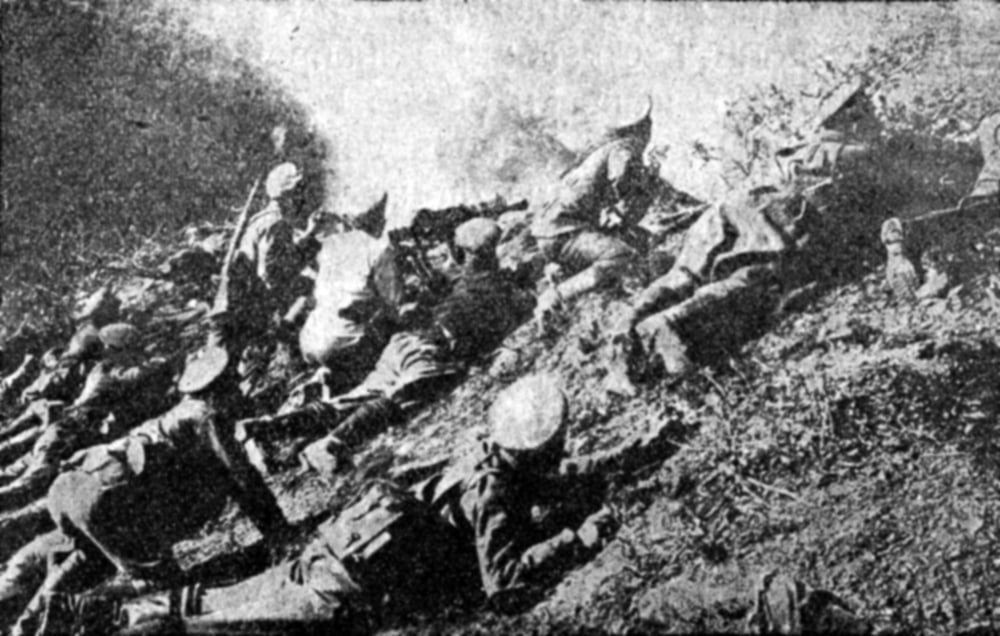
War in the trenches of the First World War of 1914-18

There are few passages within The Lord of the Rings that have the feel of the war literature of the 20th century as this one. Here we are reminded, if we need it, that Tolkien was writing a novel of his century and not a mere pastiche of medieval heroic literature. Tolkien was himself a veteran of the war in the trenches in France and took part in the Battle of the Somme that began on the 1st of July 1916 in northern France and during which a million men were either killed or wounded. The memory of that battle still casts a shadow over western Europe over a hundred years after it took place. My father gave us very little education in any deliberate sense; most of what I learned from him I did by observation rather than because he told it to me, but he was anxious to tell us of the horror of war and how a war in Europe should never be repeated. He himself was a veteran of the Normandy landings of June 1944 and his father of the naval Battle of Jutland of May 1916 and the memory of war played an important part in my education.

The capture of Frodo and Sam by Faramir and his men takes place just before the ambush begins and it is a measure of Faramir, the captain of war, that he does not treat his captives as mere irrelevances in the face of the serious matters of killing and being killed. In the few moments available to him he allows Frodo to tell his story before assigning two of his men to guard them. As they wait for battle to begin Mablung and Damrod speak of their leader and the respect in which they hold him. “He leads now in all perilous ventures,” they tell Frodo and Sam, and they are proud to follow him.

See ‘Faramir the Captain’ by Anke Eissman. Note how relaxed most of his men are. He is in charge and they don’t need to worry about what they have to do.

Tolkien gives us no overview of the battle that follows. We see it through Sam’s eyes, listening to the sound of steel against steel or metal cap, like the sound of “a hundred blacksmiths all smithying together”. We feel the terror as an oliphant charges straight towards them, veering away from them at the very last moment and we see a young warrior of Harad fall dead at their feet. Through all this their main ambition is to survive. Doubtless if battle had overtaken them they would have fought bravely but heroic deeds are not their first concern. This too is true to Tolkien’s memories of the trenches and of modern warfare.

The moment when Sam looks at the dead warrior is deeply moving. We are not shown war from the perspective of the war historian or the general in the staff room. We see it through the eyes of one man alongside other men. “It was Sam’s first view of a battle of Men against Men, and he did not like it much. He wondered what the man’s name was and where he came from; and if was really evil of heart, or what lies and threats had led him on the long march from his home; and if he would not really rather have stayed there in peace”.

Robert Runcie, Archbishop of Canterbury between 1980 and 1991, was a tank commander during the Second World War, winning the Military Cross, the second most important medal for valour that can be offered to the British Armed Forces for rescuing one of his wounded men from a crippled tank while under heavy enemy fire. He was greatly criticised by politicians for expressing sympathy and compassion for Argentine soldiers after the Falklands War of 1982. What moved him to speak of his pity was his memory of an incident in which his tank took out a German tank in battle and how, as was required of him, he checked to see if there were any survivors. He remembered looking into the tank and the dead young men within it and thinking of their mothers, wives and girlfriends who would never see them again. It was a Sam Gamgee moment and it remained with him for the rest of his life.

I haven’t found a photograph of Robert Runcie from the Second World War. You can tell that this is a photo of a British tank on show for the “top brass”, senior British officers, not one in the heat of battle.