“Faramir’s Face… Was Stern and Commanding, and a Keen Wit Lay Behind His Searching Glance.” Meeting Tolkien’s Faramir and Not Peter Jackson’s.

The Two Towers by J.R.R Tolkien (Harper Collins 1991, 2007) pp.866-871

When I think of Peter Jackson’s version of Faramir I think of the speech that Elrond makes to Gandalf in Rivendell before the Council.

“Men are weak. The race of Men is failing. The blood of Númenor is all but spent, its pride and dignity forgotten. It is because of Men the Ring survives.”

And then I think of the scene in which Faramir takes Frodo, Sam and the Ring towards Minas Tirith in an almost trance like state, seemingly overcome by the Ring’s malignant power.

What a contrast all this is to the man that we meet for the first time within the pages of The Two Towers.

I have been enjoying using this image of Faramir as created by Anke Eissman in the last few weeks. Compare it to David Wenham’s characterisation as illustrated below.

Sam awakes from sleep to find Frodo standing before Faramir and a company of about three hundred men. Faramir interrogating him and it feels as if a trial is taking place. We are told that Sam “could see Faramir’s face, which was now unmasked; it was stern and commanding, and a keen wit lay behind his searching glance.” Later on we hear Frodo’s assessment of the man before he stands, that he was very much like Boromir in looks but “a man less self-regarding, both sterner and wiser.” And later still we read Éowyn’s first assessment of Faramir that she could see “the grave tenderness in his eyes, and yet knew, for she was bred among men of war, that here was one whom no Rider of the Mark would outmatch in battle.” This does not put Éowyn off.

I do not blame David Wenham for the way in which he plays the part of Faramir in Peter Jackson’s films. He does it as was asked of him, as an embodiment of the weakness that Jackson’s Elrond speaks of. In Jackson’s films, rightly celebrated as a cinematic masterpiece even after twenty years, one of the major themes, alongside that of friendship, is power and weakness. The Ring is all-powerful and constantly exerts that power in its immediate and utterly malignant influence over any, Frodo for the most part excepted, who see it. In the scene in which Elrond speaks of human weakness we see Isildur fall immediately under its spell and refusing to destroy it in the fires of Orodruin. “It is because of Men that the Ring survives.”

David Wenham as Faramir and Elijah Wood as Frodo. I can’t quite believe that Wenham’s character is one that a woman like Éowyn would fall in love with. Now Viggo Mortensen’s Aragorn is a different matter entirely!

Contrast this characterisation of Men with the one that Tolkien gives us. Pride and dignity are not spent. Aragorn is not in exile in the North by choice but because it is the land of his birth. Although he is Isildur’s heir he will need to prove that claim in Minas Tirith and there is considerable doubt that his claim will be accepted. Denethor, the Lord of Gondor, is both proud and dignified, and although we will find him cast down by grief over the loss of Boromir, he is not self-indulgent as Jackson portrays him, eating a hearty meal as Faramir risks all in battle, but austere and self-possessed until the end when overcome with despair.

And Faramir is far better portrayed in the work of Anke Eissman than by David Wenham’s and Peter Jackson’s characterisation. When I look at Eissman’s Faramir, sitting before Frodo, in complete command of the situation, I can see the man that Éowyn will first of all respect and later on fall in love with.

St Paul has a word that describes Faramir perfectly and thar is prautes, a word that he uses in speaking of the fruit of the Holy Spirit in his letter to the Galatians (5.22,23). In most translations this is usually rendered as gentleness but this is only a part of the story. Gentleness is all too often mistaken for weakness, a mistake that Êowyn does not fall prey to when she perceives Faramir’s “grave tenderness” but realises that he is one who few could outmatch in battle. In fact Éowyn understands prautes perfectly. It is a subtle mingling of strength and gentleness and Faramir is a fine, even exemplary expression of the word. He was one of Tolkien’s favourite creations and the weeks that we will spend in his company will refresh both the hobbits and I hope, my readers as well.
“It Was Sam’s First View of a Battle of Men Against Men and He Did Not Like It Much.” Tolkien Brings His Memories of War to His Great Tale.

The Two Towers by J.R.R Tolkien (Harper Collins 1991, 2007) pp.858-865

Sam is already battle hardened standing by Frodo at the attack of the Nazgûl at Weathertop, at the attack of wargs near the doors of Moria and again within Moria at the Chamber of Mazarbul when orcs and trolls assailed the Fellowship. It is not battle itself that affects him so deeply, that realisation that someone is your enemy and wishes you harm, wishes even to kill you, it is, as the English poet Wilfred Owen put it, “the pity of war” that touches his heart when the Rangers of Ithilien ambush the Men of Harad as they march northwards to the Black Gate of Mordor.

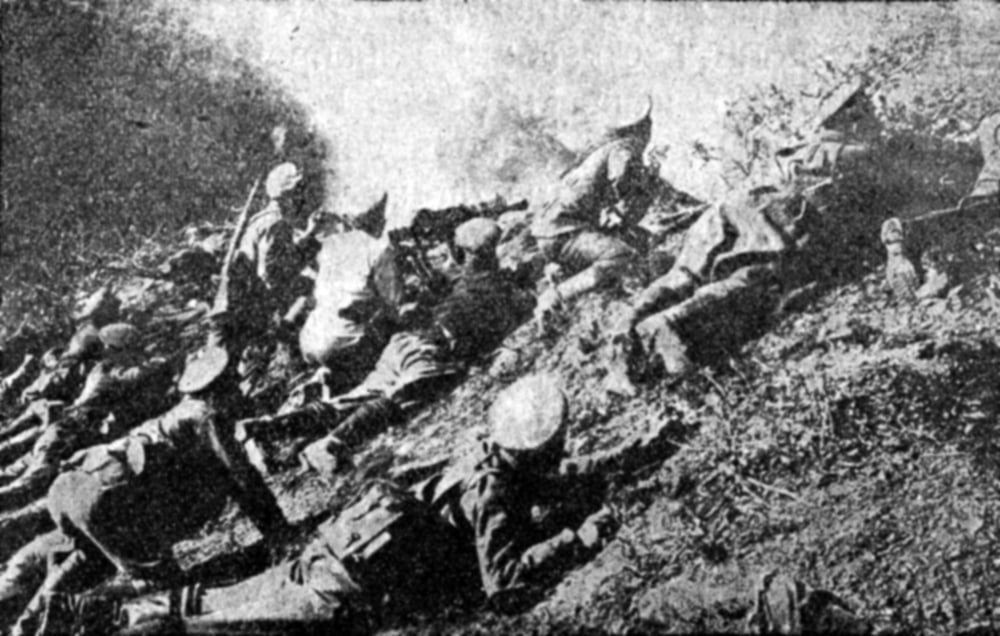
War in the trenches of the First World War of 1914-18

There are few passages within The Lord of the Rings that have the feel of the war literature of the 20th century as this one. Here we are reminded, if we need it, that Tolkien was writing a novel of his century and not a mere pastiche of medieval heroic literature. Tolkien was himself a veteran of the war in the trenches in France and took part in the Battle of the Somme that began on the 1st of July 1916 in northern France and during which a million men were either killed or wounded. The memory of that battle still casts a shadow over western Europe over a hundred years after it took place. My father gave us very little education in any deliberate sense; most of what I learned from him I did by observation rather than because he told it to me, but he was anxious to tell us of the horror of war and how a war in Europe should never be repeated. He himself was a veteran of the Normandy landings of June 1944 and his father of the naval Battle of Jutland of May 1916 and the memory of war played an important part in my education.

The capture of Frodo and Sam by Faramir and his men takes place just before the ambush begins and it is a measure of Faramir, the captain of war, that he does not treat his captives as mere irrelevances in the face of the serious matters of killing and being killed. In the few moments available to him he allows Frodo to tell his story before assigning two of his men to guard them. As they wait for battle to begin Mablung and Damrod speak of their leader and the respect in which they hold him. “He leads now in all perilous ventures,” they tell Frodo and Sam, and they are proud to follow him.

See ‘Faramir the Captain’ by Anke Eissman. Note how relaxed most of his men are. He is in charge and they don’t need to worry about what they have to do.

Tolkien gives us no overview of the battle that follows. We see it through Sam’s eyes, listening to the sound of steel against steel or metal cap, like the sound of “a hundred blacksmiths all smithying together”. We feel the terror as an oliphant charges straight towards them, veering away from them at the very last moment and we see a young warrior of Harad fall dead at their feet. Through all this their main ambition is to survive. Doubtless if battle had overtaken them they would have fought bravely but heroic deeds are not their first concern. This too is true to Tolkien’s memories of the trenches and of modern warfare.

The moment when Sam looks at the dead warrior is deeply moving. We are not shown war from the perspective of the war historian or the general in the staff room. We see it through the eyes of one man alongside other men. “It was Sam’s first view of a battle of Men against Men, and he did not like it much. He wondered what the man’s name was and where he came from; and if was really evil of heart, or what lies and threats had led him on the long march from his home; and if he would not really rather have stayed there in peace”.

Robert Runcie, Archbishop of Canterbury between 1980 and 1991, was a tank commander during the Second World War, winning the Military Cross, the second most important medal for valour that can be offered to the British Armed Forces for rescuing one of his wounded men from a crippled tank while under heavy enemy fire. He was greatly criticised by politicians for expressing sympathy and compassion for Argentine soldiers after the Falklands War of 1982. What moved him to speak of his pity was his memory of an incident in which his tank took out a German tank in battle and how, as was required of him, he checked to see if there were any survivors. He remembered looking into the tank and the dead young men within it and thinking of their mothers, wives and girlfriends who would never see them again. It was a Sam Gamgee moment and it remained with him for the rest of his life.

I haven’t found a photograph of Robert Runcie from the Second World War. You can tell that this is a photo of a British tank on show for the “top brass”, senior British officers, not one in the heat of battle.

“Now if I’ve Gone and Brought Trouble, I’ll Never Forgive Myself.” What Kind of Trouble Does Sam Gamgee’s Fire Bring to The Hobbits in Ithilien?

The Two Towers by J.R.R Tolkien (Harper Collins 1991, 2007) pp. 851-861

I am glad that Frodo and Sam were able to eat the rabbits that Gollum caught before they were caught by the men of Gondor in the woodlands of Ithilien and I am glad that they were able to rest upon a bed of fern that must have felt like the greatest luxury. To be well fed and well rested is of great help when you need to keep your wits about you. I am only sorry that they were not able to smoke a pipe as well but then perhaps they did not have their pipes or pipeweed with them.

Frodo and Sam are in Ithilien, the garden of Gondor, Although it bears the unmistakable signs of Mordor upon it after a few years of occupation it remains a place of beauty and of plenty too. They are surrounded by herbs that grow in profusion and perfume the air, and there are game creatures about that Sam can cook.

The hobbits have eaten nothing more than lembas for about a week now and although it is wonderfully sustaining and even more so when it isn’t mingled with any other kind of food lembas cannot satisfy them in the particular way that a well cooked meal could and Sam, in particular, desires that particular satisfaction.

Perhaps it was always unwise to light a fire in a place where enemies might be lurking, certainly Gollum thinks so, but a fire is necessary if you are going to cook, and maybe if Sam hadn’t relaxed a little too much after eating a good meal then he would not have committed the cardinal error that all children are warned against when learning to make a campfire. Never leave it unattended.

But Sam did make this mistake and a small brand from the fire did start a blaze in a pile of fern lying nearby and the smoke from the fire was spotted by the Rangers of Ithilien, and the hobbits were caught.

These Rangers are a company of men from Gondor who are operating behind enemy lines in the woodlands of Ithilien. Their mission is to make sure that the forces of Gondor can never feel completely at ease in this land. They harry and harass their foes and on this day it is their intention to ambush a force that is travelling northwards from Harad to enter Mordor through the Black Gate, just the kind of force that the hobbits saw on the day when Frodo decided to trust Gollum as his guide into the dark land.

The Rangers are commanded by Faramir, son of Denethor, Steward of Gondor, and the brother of Boromir, who had travelled as part of the Fellowship from Rivendell until he fell at Parth Galen as he sought to defend Merry and Pippin from capture by the Uruk-hai of Isengard. And it was this same Boromir that tried to take the Ring from Frodo and so made him take the decision to go on alone to Mordor. As far as Frodo and Sam are concerned Boromir is still alive and Frodo’s last memory of him is of the madness that overcame him and led him to try to seize the Ring by force.

I have long appreciated the depictions of Faramir by the artist, Anke Eissman. Note how he sits on the ground before his captive and does not seek to dominate him by standing, but his authority is still unmistakable.

So at the moment of their capture Frodo and Sam do not know what kind of trouble they are in and Sam does not know whether he will ever be able to forgive himself or whether he will ever get the opportunity to do so. He cannot know that he has fallen into the hands of one of the noblest of all Tolkien’s creations and that much good will come of this encounter.

We might say that the “chance” meeting between the hobbits and Faramir is mere coincidence, if any circumstance in our lives can ever be described with the word, mere. It was the great Swiss psychologist, Carl Jung, who first coined the word, synchronicity, to describe a series of unrelated events that are connected through their meaning and the meeting of the hobbits and Faramir is a profound expression of this. Later, before they parted, Frodo says to Faramir that Elrond had told him that he would find unexpected friendship upon his journey and we will think more of this on another occasion but it is sufficient to say on this occasion that Sam can forgive himself for his “mistake”, if mistake it truly is.

“Forth Eorlingas!” Tolkien and The Restoration of The Heroic in Warfare.

The Two Towers by J.R.R Tolkien (Harper Collins 1991, 2007) pp. 682-691

It is important at the outset of these thoughts on warfare in The Lord of the Rings to note that from the arraying of Aragorn, Legolas and Gimli in gear of warfare before the gates of Edoras to the final victory over the hosts of Isengard before Helm’s Deep there are only twenty-seven pages in the Harper Collins edition of The Two Towers. Compare that to the amount of time devoted to the battle in Peter Jackson’s film of the same name and even before we think about the battle at all we see that this Hollywood action movie treats warfare very differently to the way in which Tolkien does.

Tolkien’s personal experience of warfare was very different to that of the armies who fight in his great story. Harold MacMillan, who was the British Prime Minister in the late 1950s and early 1960s was a fellow officer to Tolkien at the Battle of the Somme in 1916 on whose first day the British army lost 60,000 men killed and wounded. MacMillan was himself one of the wounded and spent several hours hiding in a shell hole and reading Aeschylus in Greek to distract himself from the pain before before being found by British soldiers. In a letter of the time he wrote that “perhaps the most extraordinary thing about a modern battlefield is the desolation and emptiness of it all… One can look for miles and see no human being. But in those miles of country lurk (like moles or rats, it seems) thousands, even hundreds of thousands of men, planning against each other perpetually some new device of death. Never showing themselves, they launch at each other bullet, bomb, aerial torpedo, and shell.

It was a shell that hit and wounded MacMillan as he led an advance of his men towards the German lines. I quote these lines in a reflection upon Tolkien because they describe with dreadful eloquence the experience of warfare shared by soldiers of both sides in that dreadful conflict and contrast so starkly with the language that Tolkien uses to describe the ride of the Rohirrim to Helm’s Deep. Not that Tolkien ignores the horror of war. Théoden describes the hosts of Isengard as they advance “burning as they come, rick, cot and tree”. But he also writes of the beauty of a host of men about to ride out in defence of their homes and families.

“At the gate they found a great host of men, old and young, all ready in the saddle. More than a thousand were there mustered. Their spears were like a springing wood. Loudly and joyously they shouted as Théoden came forth.”

Tolkien profoundly understood the contrast between the desolate horror that MacMillan described and the heroic language that he used in his own descriptions of battle. Indeed he expressed that contrast in his distinction between the orcs of Mordor and Isengard and, for example, the Riders of Rohan. While the armies of Saruman and of Sauron use all the devices available to them of industrial warfare, the Rohirrim ride into battle carrying spear and sword; and Tolkien’s account is full of acts of individual heroism on the part of the defenders of Helm’s Deep while their enemies are faceless.

What Tolkien achieved in The Lord of the Rings was a restoration of humanity in the brutal and faceless experience of warfare that he knew and which MacMillan described. This means that he is a genuinely modern writer whose war literature can be included alongside A Farewell to Arms by Ernest Hemingway or Robert Graves Goodbye to All That. But whereas Hemingway and Graves seek, with great success, to express the experience that MacMillan describes, Tolkien does something quite different. He attempts a kind of redemption of the brutal experience of warfare by restoring the heroic to it. While he understood the experience that Wilfred Owen described in speaking of “these who die as cattle” he restores to those who die a human face and personal heroism.

But I must end where I began. Tolkien never sought to glorify war in his writings. This is perhaps best and most explicitly expressed by Faramir who is a warrior by necessity and not by choice and, of all the characters in The Lord of the Rings speaks most in Tolkien’s own voice.

“War must be, while we defend our lives against a destroyer who would devour all, but I do not love the bright sword for its sharpness, nor the arrow for its swiftness, nor the warrior for his glory. I love only that which they defend.”

“Seek for the Sword That Was Broken: In Imladris It Dwells.” Boromir Speaks of His Mission to Rivendell.

The Fellowship of the Ring by J.R.R Tolkien (Harper Collins 1991) pp.239-240

Boromir is in Rivendell because he has been called there by a dream. This is no dream that begins and ends in doubt but one that is crystal clear in its content and it has been repeated over and over again. We are left in no doubt that Boromir is supposed to be here except it was not supposed to be Boromir but his brother, Faramir.

“A dream came to my brother in a troubled sleep; and afterwards a like dream came oft to him again, and once to me.”

That Boromir is at the Council and not his brother is because of Boromir’s masterful nature. Everything about the dream has something of the heroic quest about it. The hero must go upon a perilous journey “over many dangerous leagues” and must bring back a gift to his people. In this case it is the gift of counsel. What does the dream mean?

Seek for the Sword that was broken:
   In Imladris it dwells;
There shall be counsels taken 
   Stronger than Morgul-spells.
There shall be shown a token 
    That Doom is near at hand,
For Isildur's Bane shall waken, 
    And the Halfling forth shall stand. 


The first thing that we notice is that the dream is intended to hit the dreamer right between the eyes. Compare it with the dreams that Frodo has at Crickhollow or in the House of Tom Bombadil. We know where these dreams will eventually take Frodo but Frodo himself has absolutely no idea. He just has to keep on walking toward his destiny one step at a time. Even as we ponder Boromir and Faramir’s dream we know that Frodo sits silently among the company even as that destiny unfolds. We know how the Council will end but Frodo sits in a cloud of unknowing.

Boromir’s dream is completely different. Every line in the verse has an explicit interpretation and yet, as far as we can tell from Boromir’s telling of the story, no-one in Gondor seems to be able to say what the verse means. The only guidance that Denethor offers is that Imladris is the home of Elrond Half-elven and that it lies in the north. Is this why the guidance that the dream offers is so explicit? Compared to Frodo’s dreams this is guidance for children and yet it has such an air of mystery about it.

Within minutes of Boromir’s telling of his story much of its meaning will have been revealed. Aragorn will show Boromir the shards of Narsil, the Sword that was broken. Elrond will command Frodo, the Halfling, to bring forth Isildur’s Bane, the One Ring, to display it to the Council. All this is clear. But there is subtlety contained within the verse as well. Boromir is told that in Imladris, in Rivendell, counsels will be taken “stronger than Morgul spells”. These words ought to make it clear to Boromir that what is decided at the Council is more powerful than the danger posed by the enemies of Gondor and yet all that he says about Elrond’s wisdom is a somewhat dismissive comment about the relative importance of Rivendell’s wisdom as against its military strength. We are left in little doubt which of the two Boromir considers more important. It reminds us of Stalin’s famous dismissal of the importance of the Vatican and the Papacy when he asked about how many divisions the Pope had.

A broken sword? A Halfling? Counsels that are taken? All these somewhat beyond our brave warrior. There is only one thing that really catches his attention and that is the Ring, Isildur’s Bane. We know this tragic tale will play out. And so why was this divine guidance given at all? Would it not have been better if Boromir had never come to Imladris? Has the divine guide not simply made a big mistake here? Or would it not have been better if the voice who spoke these words had ended by saying, “And I want Faramir to go to Rivendell?” But it is necessary that all the free peoples of Middle-earth should be represented in Rivendell on that day, that all should be drawn into the Quest of the Ring and the decision that is to be made. Gondor must be at the Council because Gondor will be at the heart of the events that are going to unfold.

Faramir Remembers “Númenor that was”

I am on a holiday with my wife in the county of Pembrokeshire in west Wales, the county in which my father in law was born and grew up. I am sitting in a pub with a glass of ale at my hand. I do not wish to write something new this week and so I decided to republish an old post in the hope that I would get some new readers for it. Do let me know what you think. When I first wrote this it was the first of three posts on “Númenor that was”, “Elvenhome that is” and “That which is beyond Elvenhome and will ever be.” Why don’t you read all three.

“We look towards Númenor that was, and beyond to Elvenhome that is, and to that which is beyond Elvenhome and will ever be.”

So says Faramir to Frodo and Sam motioning to them to stand with himself and his men facing westwards into the setting sun at the refuge of Henneth Annûn before they sit to eat. And in this simple action the people of Gondor recollect both their history and their identity day by day.

They remember the peril that Eärendil “ventured for love of the Two Kindreds” at the end of the First Age of the Earth. For when the forces of Morgoth had all but overthrown the kingdoms of the Elves and Men in Beleriand Eärendil had journeyed to Valinor to plea for the mercy of the Valar in their uttermost need, and mercy was granted to them. They remember how Morgoth was overthrown and in punishment was “thrust through the Door of Night beyond the Walls of the World into the Timeless Void”. They remember how Elros and Elrond, the sons of Eärendil, were granted a choice that none had ever been offered either before nor since. The Valar offered to them either to live as one of the deathless that was the destiny of the Elves upon the Earth or to choose mortality that was the destiny of Humankind. And they remember how Elrond chose the destiny of the Elvenkind and so came to live in Rivendell in Middle-earth and how Elros chose mortality and was granted as gift for himself and his people the great isle of Númenor in the Western Seas just within sight of Valinor.

They remember how at first their ancestors lived in contentment with the choice that Elros had made and the land that had been granted as gift; but how, even as their power grew, they grew envious of those that were deathless, coming to see their own mortality as a punishment laid upon them by the Valar who they now regarded as tyrants. This discontent and envy grew and festered over many years even as their might grew. Indeed, we might say, unease and power seemed to grow in equal measure. Eventually so great was that power that they were able to overthrow and make prisoner Sauron even after he had forged the One Ring and had made Barad-dûr in Mordor the heart of his dominions within Middle-earth. But their victory over Sauron was achieved, not as a rejection of his darkness but in envy of his power and so, even as a prisoner, Sauron was able to make that envy grow directing it now against the Valar. Eventually with Sauron’s encouragement they assaulted Elvenhome itself believing that if they could conquer it they would achieve the immortality that they desired, that it was the land itself that somehow granted to its people their deathlessness. But a great wave arose that destroyed the fleets and even the Isle of Númenor and so it is that when Faramir and his men stand in silence they remember “Númenor that was”.

But even as the faithlessness of the kings of Númenor and those that followed them comes to mind every time the people of Gondor stand before they eat so too does the memory of those who were faithful at great cost to themselves. For among the people of Númenor there were those known as Elf-friends who still loved the Valar and were content with the choice of Elros. When the fleets of Númenor sailed in assault upon Valinor they refused to go with them and the great wave that destroyed Númenor carried Elendil, his sons, Isildur and Anárion and all their peoples, in nine great ships to the shores of Middle-earth where they founded the kingdoms of Gondor and Arnor.

All this is called to mind as the peoples of Gondor remember “Númenor that was”, and it is a memory of gift, of choice, of growing discontent and envy that led to unfaithfulness and also to the faithfulness of Elendil and his people, the Elf-friends. And each time they do this they know that they themselves are the fruit of this story and how they too must live.

In this week’s reflection we have remembered  “Númenor that was” and perhaps it has caused us to think of our own discontents with our lives and what has been given to us and what it might mean for us to be faithful even as were the Elf-friends. Next week we shall think with Faramir and his men of “Elvenhome that is” and all that comes to mind as they gaze towards it.

The Return of the King

Last week we read about the failure of Númenor and the line of Stewards in Gondor that at its best kept the memory of Númenor and the faithfulness of the House of Elendil alive but eventually came to believe more in the memory than the reality. Memories are safer than realities. You can make of them what you will and your remembering can allow you to keep things as they are and not to change. So it is that we are reminded of Denethor’s words to Gandalf, “I would have things as they were”.

What capacity we all have for self deception! “Things as they were” in Gondor meant a dying land even without the invasion of Mordor. Legolas saw it and said, “The houses are dead, and there is too little here that grows and is glad”. When Denethor wished for things as they were all he really meant was that he would remain in power. What he really mourned was his own loss of control or prestige.

Faramir believes in the reality and so welcomes the king when he returns. At the moment when Gandalf crowns Aragorn, thus fulfilling the mission given to him by the Valar, Faramir cries out, “Behold the King!” He tells his people that the true king stands before them in flesh and blood with wisdom upon his brow, strength and healing in his hands, and a light about him. If any still long for the past then they are commanded to change. This is the kind of change that is meant in the word metanoia in the bible, the word that is usually translated as repentance. A new reality has come and we must change.

Tolkien goes on to tell us how everything does change.

“In his time the City was made more fair than it had ever been, even in the days of its first glory… and all was healed and made good”.

You would think that everyone would be glad to see this change, and I believe that thanks to Faramir’s leadership most people did, but I suspect that some longed for “the good old days” of the ruling Stewards.

When the true king rules everything is healed and becomes fruitful. This is a fundamental principle. In Gondor this means that gardens grew again and children were born and flourished. When King Energy is at work within us then our lives become ordered without being rigid, fruitful without being overgrown and we live and work in a kind of flow, of blessing, both for ourselves and for others.

Moore and Gillette put it this way in their seminal study of the masculine archetypes and psyche, King, Warrior, Magician, Lover.

This is the energy that expresses itself through a man when he takes the necessary financial and psychological steps to ensure that his wife and children prosper. This is the energy that encourages his wife when she decides to go back to school to become a lawyer… This is the energy that expresses itself through you when you are able to keep your cool when everyone else in the meeting is losing theirs… This is the energy that seeks peace and stability, orderly growth and nurturing for all people- and not only for all people but for the environment, the natural world. The King cares for the whole realm and is the steward of nature as well as of human society.”

This is what Aragorn is. It is what Faramir is too. You don’t have to be the boss in order to display King Energy. You can display it in service of another. I have a favourite movie, The Intern, in which a character played by Robert de Niro displays King Energy in lavish quantity as an enabler of others in a very humble role. Try and watch it and you will see what I mean. Actually the one in true authority is always aware of being a servant. In the prayers for the Queen in the Church of England we say this, “that she, knowing whose minister she is, may seek thy honour and glory”. It is only those who know that they are a servant who are able to be trusted with authority over others who can bring life-giving order, fruitfulness and blessing to them.

Aragorn Commands The Steward of Gondor, “Do now thy office!”

It was in the year 2050 of the Third Age that Eärnur, the last king of Gondor, rode to Minas Morgul in answer to the challenge of the Witch-King, the Lord of the Nazgûl. No tale was ever told of a battle between them but Eärnur was never seen again. He had no heir but the people of Gondor chose not to make a member of another family their king but to wait for the king’s return. They chose a Steward to govern them “to hold rod and rule in the name of the king, until he shall return”.

A thousand years passed before the War of the Ring and the downfall of Sauron during which the Stewards of the line of Mardil did their office. In all but name they were kings of Gondor but they never sat upon the throne or wore the crown. Tolkien remarks that although “some remembered the ancient line of the north”, the descendants of Elendil and Isildur of the kingdom of Arnor, the Ruling Stewards “hardened their hearts” against a true return of the king. Denethor may have told Boromir that only in places of “less royalty” could a steward have claimed the throne but as we saw in his last days he regarded Aragorn as an upstart. At the end of his life he cried out to Gandalf, “I will not bow down to such a one, last of a ragged house long bereft of lordship and dignity”.

Faramir saw things differently. It was one of the many ways in which he was divided from his father. Faramir may have been tutored by Gandalf, just as Aragorn was, but Gandalf could only teach him because he was already captured by the story of Númenor. There were effectively two stories of Númenor. Perhaps there are always these stories in every human enterprise. One was the story of the desire for power and a growing bitterness about everything that constrained them. At last all the bitterness about these constraints was concentrated upon anger about mortality and about the divinities, the Valar, who seemed to hold life unjustly as a private possession. The Valar, the governors or stewards of Earth on behalf of Illuvatar, the One, became through this belief as no more in the eyes of the kings of Númenor than rivals for power. Sadly this was the story that Denethor nourished in his heart and why he ended his life in despair and denial.

The other story, the story to which both Faramir and Aragorn gave their loyalty, was to Númenor as a gift. The first families of Men who wandered across the mountains into Beleriand in the First Age were befriended by and allied themselves to the Elves in the wars against Morgoth and the darkness. It was because of their faithfulness in those wars that they were given Númenor as a gift. So friendship and faithfulness lay at the heart of this other story and a submission also to the mystery of mortality. While the later kings of Númenor became embittered by this mystery, Elendil the Elf-friend and his followers chose to accept the mystery of mortality as a gift just as Númenor’s separation from the Undying Lands was also a gift.

We live in times in which the limitation of mortality is resented even as it was by Ar-Pharazôn, the last king of Númenor. Recently Elon Musk, the CEO of Tesla, argued that humans can only remain “economically viable” as cyborgs while Ray Kurzweil, the director of engineering at Google, argues for human immortality by digital means believing that it will be a possibility by the 2030s. The philosopher, John Gray, describes these immortalizers as “the God-builders”.

Who is faithful to the true story of Númenor, the mystery of mortality, as a gift, as Aragorn and Faramir are? Who awaits the coming of the true king? It is because Faramir nourished his longing for the return of the king in his heart that on the great day when Aragorn comes to Minas Tirith to claim the crown that he is willing to be a true steward and to lay his ruling authority down. It is because of his faithfulness that renewal comes to Gondor.

“Do now thy office!”

Éowyn and Faramir Declare Their Love as Éowyn Understands her Heart at Last

Éowyn receives her brother’s invitation to join the triumph at the Field of Cormallen after the fall of Sauron but she does not go. Once more the Warden of the Houses of Healing becomes anxious about her unhappiness and bids Faramir take time from his duties as Steward of Gondor to speak with her.

Faramir is a man of wise insight and he has learned much from the day he spent with Merry and so he says to her plainly:

“You do not go because only your brother called for you, and to look on the Lord Aragorn, Elendil’s heir, in his triumph would now bring you no joy. Or because I do not go, and you desire still to be near me. And maybe for both these reasons, and you yourself cannot choose between them. Éowyn, do you not love me, or will you not?”

In March 1941 Tolkien wrote a remarkable letter to his son, Michael, on the subject of marriage and relations between men and women. It is remarkable partly because it displays a closeness between father and son that is sadly very rare. Also because of its depth of insight. I think that most men on reading this letter would would wish they had enjoyed this closeness with their own father or that they could achieve it with their sons. Richard Rohr describes the general poverty of relations between fathers and sons as “The Father Wound”. Faramir has known this wound deeply but Tolkien, who never knew his own father shows that it need not be passed on to the next generation .

In the letter Tolkien writes about the Western romantic idea of courtly love in which a great lady would enjoy the devotion and admiration of young men, often expressed through poetry or deeds that would prove their love. A physical expression of the love was considered unacceptable although the two great Arthurian love stories of Guinevere and Lancelot and of Tristan and Isolde show that such relationships could move disastrously from the idealised form to the physical form. In his letter Tolkien also notes that to idealise a woman, to grant her some kind of divinity, does her no good at all. Tolkien describes this as “false and at best make believe. The woman is another fallen human being with a soul in peril.”

I refer to this, partly because I believe it to be Éowyn’s temptation. She desired the adoration of the greatest knight of his age and, with it, the adoration of all men and women. I also wonder if Faramir was tempted to idealise Éowyn. “Were you the blissful Queen of Gondor, still I would love you.” Perhaps not, perhaps Faramir simply feels that he has to declare his love with as much passion as he can to make Éowyn see it. Thankfully for his own sake he never has to know what it would be like to love the Queen of Gondor without hope! Éowyn sees reality at last or, as Tolkien puts it so beautifully, “the heart of Éowyn changed, or else at last she understood it”.

It is only possible to love flesh and blood although such love always points us beyond itself towards divine love which we glimpse in the temptation to idealise. Tolkien puts this powerfully in his letter. Every marriage, in a certain sense he writes, is a mistake. We could all find “more suitable mates”. It is possible to spend a whole lifetime either looking for the perfect mate or saying, “if only”. And we will never know. Even the best of marriages requires self-denial, perseverance and forgiveness. They require the decision to say the greatest, Yes, to reality, to the real person in front of us. I know that it has become popular to create our own wedding vows, as if by doing so we give the wedding ceremony more authenticity, but I become more deeply impressed by the vows of the old English Sarum Rite which is over five hundred years old and in which each person promises to “love and to cherish” for better for worse, for richer for poorer, in sickness and in health, till death us do part”. Both Éowyn and Faramir have to renounce some kind of idealised form of romantic love and commit themselves to the real person in front of them.

Faramir Gazes at the Overwhelming Wave and Thinks of Númenor as He Takes Éowyn in his Arms.

The moment when the Ring goes to the Fire and the reign of Sauron is ended is told in three separate places in The Lord of the Rings and from three different perspectives. The first is at Orodruin itself as Sam carries Frodo from the Cracks of Doom and sees a brief vision of Sauron’s overwhelming power before “all passed… Towers fell and mountains slid; walls crumbled and melted, crashing down; vast spires of smoke and spouting steams went billowing up, up, until they toppled like an overwhelming wave, and its wild crest curled and came foaming down the land”. The second telling is at the Black Gate of Mordor as the embattled host of the West stand at bay against their enemies and Gandalf cries out, “‘The realm of Sauron is ended!.. The Ring-bearer has fulfilled his Quest.’ And as the Captains gazed south to the Land of Mordor, it seemed to them that, black against the pall of cloud, there rose a huge shape of shadow, impenetrable, lightning crowned, filling all the sky. Enormous it reared above the world, and stretched out towards them a vast threatening hand, terrible but impotent: for even as it leaned over them, a great wind took it, and it was all blown away, and passed; and then a hush fell.”

The third and last telling takes place in the gardens of the Houses Houses of Healing as a young man and a woman stand, hand in hand (although they do not know it) as they gaze northward towards the Morannon as all the earth holds its breath and “Time halted”.

“Then presently it seemed to them that above the ridges of the distant mountains another vast mountain of darkness rose, towering up like a wave that should engulf the world, and about it lightnings flickered; and then a tremor ran through the earth, and they felt the walls of the City quiver. A sound like a sigh went up from all the lands about them; and their hearts beat suúddenly again.”

At last Faramir speaks.

“It reminds me of Númenor,” he says, and he tells Éowyn of his dream of the great wave that rises above the fields and the hills to drown it and a “darkness unescapable”. Éowyn draws closer to him. Is the Darkness Unescapable coming? But no, Faramir’s limbs are light and he feels a hope and a joy that no reason can deny. And then he kisses Éowyn upon the brow.

Tolkien too had a recurring dream of an overwhelming wave that he associated with the fall of Atlantis and of Númenor. In his legendarium Tolkien tells of the great hubris of the king of Númenor, Ar-Pharazôn, who was seduced by Sauron to defy the Valar and make an assault upon the Undying Lands. Because of this attempt to break the  bounds of human mortality Eru, the One, intervenes and destroys Númenor with a great wave, saving only Elendil, the Elf-friend, his family and followers.

Tolkien and his wonderful creation, Faramir, both dream about the catastrophe and Faramir carries the sorrow of the failure of his great ancestors and the gradual decline of Gondor in his heart. He longs for the restoration of his people and yet fears their destruction. The sudden and terrifying appearance of the great wave above him tells him that the end has come and yet his heart says, no! His heart is pierced with hope and joy!

This is the eucatastrophe, a word coined by Tolkien himself and one that runs counter both to the hubris of our own times and to our own fear of catastrophe. Tolkien said that eucatastrophe is “the sudden happy turn in a story which pierces you with a joy that brings tears”. He said that this was the highest function of a fairy-story, something that he declared The Lord of the Rings to be and which was in no sense meant to be a disparagement of his work. The happy turn for Tolkien was never meant to reduce his readers to the kind of children who cannot bear unhappiness and must forever remain in an enchanted world in which no harm can come. Just as with Julian of Norwich’s great declaration that “All shall be well and all shall be well and all manner of things shall be well” the eucatastrophe, the sudden and entirely unexpected surprise of joy can only come to those who have stared the darkness straight in the face.

No wonder Faramir kisses Éowyn at this moment; and no wonder Éowyn allows him to do so. But more on that next week.