“My Business is With Isengard Tonight, With Rock and Stone.” How The Ents Destroyed Saruman”s Fortress

The Two Towers by J.R.R Tolkien (Harper Collins 1991, 2007) pp. 734-744

The smoking of pipes at the ruined gates of Isengard had created a quiet mood in which nothing is said but Legolas is anxious to know more about the story of the hobbits after their capture by orcs nine days before. Merry and Pippin spoke of their experience with the Uruk-hai and how they were able to escape amidst the confusion of battle when Éomer’s company attacked. As Gimli said about how Pippin was able to cut his bonds with an orc knife at an earlier point in the story the hobbits were lucky but they were able to seize their luck “with both hands”.

Merry and Pippin went on to speak of their meeting with Treebeard and of Entmoot when the Ents discussed what action they should take against Saruman. Then they spoke of how, at the end of their debate, the Ents “suddenly blew up”, of how they marched upon Isengard, and of how they were followed by huorns who came out of the forest behind them.

They spoke of how, as they reached Nan Curunir, the vale of the wizard, they were met by a tremendous sound of trumpets blaring and thought that they had been discovered by their enemies. But then they had realised that the noise was of the emptying of Isengard as Saruman sent his army to war against Rohan and how for an hour they watched them marching southward towards Helm’s Deep.

Treebeard watched them go and then said to Merry and Pippin, “My business is with Isengard tonight, with rock and stone”.

Tolkien describes how the Ents launched their assault upon the fortress, wonderfully showing how the slow, deliberate action of tree roots over a hundred years, an action about which all householders must be aware, was concentrated into a single night’s furious work.

“They pushed, pulled, tore, shook and hammered; and clang-bang, crash-crack, in five minutes they had these huge gates just lying in ruin; and some were already beginning to eat into the walls, like rabbits in a sand-pit.”

Merry and Pippin go on to describe how the destruction continues, how Saruman tried to respond by means of fire from within his impregnable fastness of Orthanc at the heart of Isengard; and how the Ents diverted the waters of the Isen from its natural course and flooded the fortress, turning Orthanc into an island in the centre of a lake, an island in which Saruman was now a prisoner.

I have already spoken of how, in this powerful piece of description, Tolkien shows how the action of a forest upon a house over many years is concentrated within a single night. We know that if any building is neglected for a period of time nature soon reclaims it, drawing it back into itself as what once seemed to be permanent is shown to be merely temporary. Tolkien did not know of James Lovelock’s Gaia hypothesis, in which Lovelock suggested that the earth is a complex self-regulating system within which that which is organic and non-organic interacts in order to maintain the system as a whole but I suspect that he may have been inclined to like it if he did. Many scientists have criticised the hypothesis on the basis that it is teleological, in other words that it is descriptive of a set of conditions that will lead to a particular end, in this case about the survival of planet earth as a place for organic life, but Tolkien was a Christian, and Christians believe that everything is moving towards a conclusion, of a new heaven and a new earth.

In his Music of the Ainur Tolkien places the whole history of the earth within the framework of a single piece of music in which all creatures, both earthly and heavenly are active participants. Only Eru Ilúvatar, only God, knows how the music will end but it will be a beautiful resolution of all that has preceded that end. As the 14th century English mystic, Julian of Norwich put it, “All shall be well”. There may be a time in which figures like Saruman may triumph but as the Ents show, through their business with the rock and stone of Isengard, they cannot triumph forever.

“The Land Had Changed.” Fangorn Forest Comes to Helm’s Deep. The Revenge of the Trees.

The Two Towers by J.R.R Tolkien (Harper Collins 1991, 2007) pp. 705-707

It was Gandalf who understood what was happening first. As the host of Rohan rode from Edoras to Helm’s Deep he saw a “darkness brooding about the feet of the Misty Mountains” and asked Legolas to describe what he could see.

“I can see a darkness. There are shapes moving in it, great shapes far away upon the banks of the river; but what they are I cannot tell. It is not mist or cloud that defeats my eyes: there is a veiling shadow that some power lays upon the land, and it marches slowly down stream. It is as if the twilight under endless trees were flowing downwards from the hills.”

At first Gandalf mistook one form of darkness for another, seeing them all as one kind and that kind the darkness of Mordor but as he pondered more he began to realise what he was seeing and so rode towards Isengard. There he asked Treebeard for the help of his Huorns and with them rode back to Helm’s Deep.

Later on Merry spoke of the Huorns to other members of the Fellowship.

“I think they are Ents that have become almost like trees” he said… “There is great power in them, and they seem to be able to wrap themselves in shadow: it is difficult to see them moving. But they do. They can move very quickly if they are angry. You stand still looking at the weather maybe, or listening to the rustling of the wind, and then suddenly you find that you are in the middle of a wood with great groping trees all around you.”

And it is these trees, or perhaps we should call them Ent-trees, that Legolas described to Gandalf and that are now in the Deeping-coomb, the valley below the Hornburg. The hosts of Isengard stand at bay before foes on every side. Théoden and his riders drive them towards the Huorns who block their retreat and Erkenbrand and a thousand men upon foot march towards them, the remnants of a once defeated army that had stood at bay at the Fords of the Isen now victorious once more as they drive their foes before them. And Gandalf rides down upon them revealed for a moment in power and his enemies fall upon their faces in terror. For if there is one thing that orcs understand, perhaps the only thing, it is power. Just an hour before they had been a proud army serving a mighty wizard and about to storm a fortress that had never fallen when defended. Now they are surrounded by power on every side. At last they flee into the mysterious forest and are never seen again.

When Treebeard described Saruman as having a mind of “metal and wheels” who “does not care for living things” he was not merely expressing a difference in taste between himself and the wizard but something much more fundamental. When Saruman emptied Isengard of its defenders in order to conquer Rohan he had no idea of the threat that lay on his doorstep and the reason for this was that he did not care for living things. There are two senses of meaning in the word care that Treebeard used. One is the sense of care as responsibility and it is certainly true that Saruman has no sense of responsibility for living things. But the other sense is that he simply did not think about them very much at all. He assumed that his technology was more potent and effective than any living creature that he had encountered with the exception maybe of Sauron himself and in this he utterly underestimated the forest and its power.

It is one of the greatest feats of Tolkien’s imagination to have thought about how a forest might behave if it were to be able to perform its essential actions not as a plant but as an animal. And what might happen if the growing resentment that a forest might feel about its abuse and mistreatment by others suddenly spilled over. This forest has been abused by a wizard and by orcs for a long time and now, roused by two young hobbits, it takes revenge upon its enemies. Tolkien concentrates the revenge of the living world into a brief period of time. We know that our living planet may move much more slowly than this but if we choose to behave like orcs or fallen wizards in our relationship with life itself our planet will defend itself against us and will eventually win albeit after a conflict with terrible losses. Maybe one day we, like the hosts of Isengard, will be cowering before its latent power.

“Their Coming Was Like The Falling of Small Stones That Starts an Avalanche in The Mountains”. Gandalf Speaks of the Awakening of the Ents.

The Two Towers by J.R.R Tolkien (Harper Collins 1991, 2007) pp. 646-649

What a gift gentleness is to a world grown weary with the mere exercise of power. And so Merry and Pippin awoke a kindliness within the heart of Boromir the warrior, inflated as he was by fantasies of his own greatness, who sought to gain what he desired by abuse of his strength in the attempt to steal the Ring from Frodo. When Aragorn ordered Boromir to stay with the young hobbits and to protect them as best he could he was simply trying to find some order amidst the chaos of battle and to give himself space to do what he felt that he must do, to find the Ringbearer; but what he gave to Boromir in the giving of that order was the opportunity to find redemption for his failure in the laying down of his life.

This alone would have been sufficient reason for the contested decision to include Merry and Pippin within the Fellowship but Gandalf speaks of more.

“But that is not the only part they have to play. They were brought to Fangorn, and their coming was like the falling of small stones that starts an avalanche in the mountains. Even as we talk here, I hear the first rumblings. Saruman had best not be caught away from home when the dam bursts!”

There are three occasions in which hobbits are captured by orcs in The Lord of the Rings. No other character has to suffer this indignity although Éowyn is threatened with imprisonment by the Witch King of Angmar, the Lord of the Nazgûl. The capture of Merry and Pippin in the breaking of the Fellowship is the first; the second is the capture of Frodo by Shagrat and Gorbag near Shelob’s Lair; and the third the capture of Frodo and Sam by the road to the Black Gate in Mordor. And on each occasion the capture serves only to carry the hobbits nearer to their goal. In the case of Frodo and Sam the goal is known to them. Somehow they must take the Ring to the Fire at Orodruin and they need a road to follow in order to get there. In the case of Merry and Pippin the Uruk-hai of Isengard carry them across the plains of Rohan in order to deliver them at the feet of Treebeard.

There is a delicious irony in this, of course. Gandalf speaks of this to Aragorn, Legolas and Gimli. “Saruman also had a mind to capture the Ring, for himself, or at least to snare some hobbits for his evil purposes. So between them our enemies have contrived only to bring Merry and Pippin with marvellous speed, and in the nick of time, to Fangorn, where otherwise they would never have come at all.”

But there is something further to say in regards to Merry and Pippin. Gandalf again speaks of this to his companions when he tells them that Sauron, as well as Saruman, had tried to capture hobbits and to take them to Barad-dûr, either to retake the Ring or to keep them as hostages. Thankfully Sauron, as well as Saruman, failed to achieve their purpose and Gandalf adds: “Let us not darken our hearts by imagining the trial of their gentle loyalty in the Dark Tower.”

It is the gentleness of the hobbits that proves essential here. On the one hand it is a quality that is entirely disregarded by both Sauron and by Saruman. To them gentleness is merely an expression of weakness. But in delivering this quality to Fangorn the orcs of Isengard awaken the hearts of Treebeard and the Ents to their own destruction. It is gentleness of the young hobbits that delights the Ents, which reawakens them and reconnects them to their essential vocation, that of being shepherds.

The good shepherd lays down his life for the sheep and in their reawakening the Ents are recalled to that duty. Sacrifice is something that the powers of darkness are incapable of doing or even imagining. By this we don’t mean that they are incapable of sacrificing others for their own ends. They do this constantly without giving it a second thought. But they have rendered themselves incapable of any action that even remotely approaches self-sacrifice and so Frodo’s choice to take the Ring to the Fire, Sam’s choice to go with him, Gandalf’s sacrifice of himself in the conflict with the Balrog at the Bridge of Khazad-dûm, Boromir’s sacrifice for the sake of Merry and Pippin, and the sacrifice that Aragorn, Legolas and Gimli make in their hopeless pursuit of the orcs who captured Merry and Pippin, all of these are simply incomprehensible to the dark powers and all of are essential to the ultimate victory of good over evil.

“It is Old, Very Old,” Said The Elf. Legolas In The Forest of Fangorn.

The Two Towers by J.R.R Tolkien (Harper Collins 1991, 2007) pp. 639, 640

A few years ago I was taking the road through the Savernake Forest on a regular basis as I drove down to Salisbury in the county of Wiltshire in England to see my mother in the last days of her life. In England, when you see the name, Forest, attached to a particular place it will often mean an area of land set apart for hunting by the Norman conquerors of this land nearly a thousand years ago and so, for example, the New Forest in the south of England was new when the Normans first came in the 11th century but it is old now. Savernake Forest is of a similar age and standing by the side of the road is a an ancient oak tree that first took root around the time that William the Conqueror first established his realm here.

The Big Belly Oak in Savernake Forest. I like the fact that passing vehicles have to take a little extra care as they pass it by.

As Legolas enters the Forest of Fangorn with his companions, Aragorn and Gimli, in search of Merry and Pippin, it is the oldness of the forest that he feels.

‘”It is old, very old,” said the Elf. “So old that I almost feel young again, as I have not felt since I journeyed with you children. It is old and full of memory. I could have been happy here, if I had come in days of peace.”‘

It is this quality of oldness that can cause us to reassess our place in the scheme of things. I have sometimes seen this in the relationship between an old man and a young boy, a grandfather and grandson, noting the particular quality of attentiveness that they give to one another. Perhaps my favourite literary relationships are between old men and young boys, Dumbledore and Harry Potter, Merlin and the young Arthur, Gandalf and Frodo, teachers and eager pupils. And it is possible to make a relationship with a particular tree as well. I remember once taking shelter in woodland on a stormy day and finding great comfort in the presence of an ancient tree that stood so confidently as its branches swayed in the wind. I still go to seek out that tree from time to time just to feel its strength and feel the need to do so, once again, even as I write this.

And then there are certain places that have the capacity, somehow, to hold you because of their age. Old churches can have such a capacity. A memory that still holds me is of walking with my father through spring woodland on our way to church when I was a small boy. It is the memory of the presence of my father, a rare treat, the bluebell covered woodland floor, and the particular beauty of the church, at least as I saw it then, that has this quality of holding. I picked bluebells to give to my mother on my way home. No one had ever told me not to pick wild flowers and so I did so in complete innocence. The day was perfect.

Early memories of old churches also mean singing Evensong according to the 1662 Book of Common Prayer of the Church of England. I will join a congregation in an ancient country parish church this Sunday evening for the same service and anticipate happily the same quality of inner quiet that I found back then as a small boy with my treble voice. My personal copy of the Prayerbook was given me by my grandmother, who was born in reign of Queen Victoria, and who held my elder daughter on her lap in the last year of her life. If my daughter lives to a similar age that will mean almost two centuries of the life of our family connected in that moment by just two lives. That thought too has the capability of holding me if I pay attention to it

.

It is this quality of being held, of being young again in the presence of great age, of the feeling of safety, of rootedness in something much greater than oneself that Legolas feels as he enters the Forest of Fangorn even amid the seeming impossibility of finding Merry and Pippin and so Gimli is comforted too.

“O Rowan Dead, Upon Your Head Your Hair is Dry and Grey.” Quickbeam the Ent Teaches Us the Power of Lamentation.

The Two Towers by J.R.R Tolkien (Harper Collins 1991,2007) pp. 628-631

I have never known any fully mature rowan-trees and so sadly have never encountered in my own experience the description that Bregalad, or Quickbeam as he is called in the Common Tongue, gives of the mighty trees of his youth.

“And these trees grew and grew, till the shadow of each was like a green hall, and their red berries in the autumn were a burden, and a beauty and a wonder.”

A rowan-tree crowned in glory.

I may not have met a fully mature rowan-tree but I do share Bregalad’s love of the rowan and its beauty and I have enjoyed watching birds flock to them later in autumn as other sources of food begin to run scarce. It is a tree that sustains them well into winter and itt is a good tree to plant and grow in a town garden or to see upon a woodland walk in the country.

Merry and Pippin are introduced to Bregalad by Treebeard towards the ending of the first day of Entmoot.

“Are you getting weary, or feeling impatient, hmm, eh?” Treebeard asks. “Well I am afraid that you must not get impatient yet?” This is still only the first day of deliberations that will take three days to conclude. Bregalad has already made up his mind about what to do and needs no more debate and so he is given the task of looking after the young hobbits until all is done.

“I am Bregalad, that is Quickbeam in your language. But it is only a nickname, of course. They have called me that ever since I said yes to an elder Ent before he had finished his question. Also I drink quickly, and go out while some are still wetting their beards.”

The quickness that Merry and Pippin experience in Quickbeam, and which they delight in, is a quickness to sing and to laugh. The very last time we see the friends at the end of The Lord of the Rings as they bid farewell to Sam is as they go off together singing. Bregalad is of the same spirit and so he laughs when the sun comes out from behind a cloud and he laughs whenever he meets a spring or a stream but his singing is subtly different whenever he meets a rowan-tree. He halts a while “with his arms stretched out” and he sings and sways as he sings.

Bregalad is a lover in the sense that he delights in life, and he delights in the life of the forest in particular, and especially in rowan-trees amidst the life of the forest. He takes pleasure in the being-ness of rowan-trees, in the simple fact that they are, and he expresses his delight in his singing. He sings his joy in the beauty of these trees.

O rowan fair, upon your hair how white the blossom lay!
O rowan mine, I saw you shine upon a summer's day,
Your rind so bright, your leaves so light, your voice so cool and soft:
Upon your head how golden-red the crown you bore aloft!

This is a song of praise for the glory of a fellow creature but his song does not end with praise but with lamentation. If, in Derndingle where the Entmoot meets, the mood is of growing anger which will eventually spill forth in songs of war, songs in which Bregalad will join, the mood of the song that he sings to Merry and Pippin is one of the deepest sadness.

O rowan dead, upon your head your hair is dry and grey;
Your crown is spilled, your voice is stilled for ever and a day.

It is not only anger that rouses the Ents against the wanton destruction of Saruman and of the orcs of Isengard but sadness also. And the sadness goes deeper than the anger. With their anger the Ents will “split Isengard into splinters and crack its walls into rubble” but with the sadness that they sing in songs of lament they will labour to heal the land, to renew Fangorn and also to rebuild Isengard making it a place of beauty once again, a place in which earth, air, fire and water can live together in harmony with one another and in which living things that grow and which sustain life can thrive. Bregalad teaches us that we need more than anger if we are to transform the earth. There are other songs to sing than songs of war.

“It is Likely Enough… That We are Going to Our Doom: The Last March of The Ents.” The Ents Go to War at Isengard.

The Two Towers by J.R.R Tolkien (Harper Collins 1991, 2007) pp.623-635

The night that Merry and Pippin spend in Wellinghall is the first since they escaped from the Orcs and the first that they have had in a home, a place of safety, since leaving Lothlórien, and so they sleep long and refreshingly.

Treebeard takes them to Entmoot, the council in which the Ents will deliberate what course of action they must take.

“Deciding what to do does not take Ents as long as going over all the facts and events that they have to make up their minds about”, Treebeard says to the hobbits, and he estimates that this will take a couple of days or so. He sends Merry and Pippin off with a younger Ent called Bregalad or Quickbeam who has already made up his mind about what should be done and the hobbits spend those days in his company as the Moot continues.

It is on the third day, a bleak and windy day, in the afternoon, that all falls silent and then with a great crash and the quivering and bending of the trees that the Ents march towards them.

We come, we come with roll of drum: ta-runda runda runda rom!”

The Ents are marching to Isengard and to war.

It is through Merry that we learn something about Isengard. Merry is the organiser of the four hobbits, the original company of the Ring that left the Shire some months before these events. He organised the purchase of Crickhollow in Buckland, and, as the real reason why Frodo is leaving Hobbiton became clear it is Merry who made secret preparation for leaving the Shire. He is rather proud that while Pippin spent his days in Rivendell idling away the time he tried to find out as much as he could about what might lay ahead.

“Isengard is a sort of ring of rocks or hills, I think, with a flat space inside and an island or pillar of rock in the middle, called Orthanc. Saruman has a tower on it. There is a gate, perhaps more than one, in the encircling wall, and I believe there is a stream running through it; it comes out of the mountains, and flows on across the Gap of Rohan.”

Orthanc is not Saruman’s work but much older having been built by the Númenorians in the days of Elendil. It was a sign of their decline that during the first part of the Third Age it became a lawless place far from the authority of Minas Tirith and a thorn in the side of the new kingdom of the Rohirrim who had settled in the plains of Calenardhon that lay between the southern end of the Misty Mountains to the north and the mountains of Gondor to the south. So it was that when Saruman took possession of Isengard in 2759 of the Third Age both the Steward of Gondor and the King of Rohan welcomed him gladly seeing him as a valuable ally who would watch over the strategically vital Gap of Rohan.

It would seem that Saruman was able to keep his true intentions secret right until the moment he took Gandalf prisoner during the time in which Frodo was making preparations to leave first Hobbiton and then the Shire, although Treebeard seems to have been aware of these intentions for some time and the presence of orcs in Isengard. Even after going to war with Rohan Saruman was able to keep Théoden from making a strong response through the efforts of Grima Wormtongue his chief counsellor who was able to convince Théoden that Saruman’s true wish was for peace.

It is with the arrival of Merry and Pippin in their pure, gentle and artless simplicity that the dam finally bursts and the slowly simmering anger of the Ents finally comes pouring out of Fangorn and down to Isengard. It is as if Nature herself finally rises up against the powers that would destroy her. But even as the Ents march upon Isengard and upon Saruman Treebeard is aware that Nature may fail, that it is “likely enough that we are going to our doom: the last march of the Ents”. But, he adds, “if we stayed at home and did nothing, doom would find us anyway, sooner or later”. The possibility that disenchanted Nature could yet reawaken and rise against a world of “metal and wheels” was something that the Inklings pondered both through the character of Merlin in C.S Lewis’s That Hideous Strength and through Treebeard in The Lord of the Rings. Tolkien allows such a revolt to take place but recognises the heartbreaking fragility of Nature that may yet fall before the walls of Isengard and before technology.

“I Am Not Altogether on Anyone’s Side, Because Nobody is Altogether on My Side.” Treebeard, the Ents and Forests in The World of Middle-earth

The Two Towers by J.R.R Tolkien (Harper Collins 1991, 2007) pp. 611-617

The homes in which people live tell you much about them. Of course, many people have little choice in the kind of home in which they live, but even when that choice is limited for people they will still seek to do something to tell a story about themselves. I remember when as a young man I taught in an African school in Zambia I would sometimes go to visit a student’s family in one of the villages nearby. One thing always stood out to me on these visits and that was that the family I visited may have possessed very little but everything was presented with great care and the simple hut was clean and life lived with great dignity. Those who know the descriptions of the simple homes of early settlers travelling west among the American continent will recognise this need for dignity. I came across great poverty in African villages but I did not encounter squalor until I worked as a parish priest in some run down neighbourhoods of Birmingham, England.

Treebeard’s home is an expression of his dignity as the oldest of the Ents and of a carefully crafted balance between earth, the flowing of water over the earth, that which grows in the earth, and light. It is the play of light upon stone, water and tree that gives Wellinghall its particular character. The name in its English form and therefore in the Common Tongue of Tolkien’s Middle-earth comes from the idea of a spring welling up from the earth beneath it and the hall that was built there.

“A little stream escaped from the the springs above, and leaving the main water, fell tinkling down the sheer face of the wall, pouring in silver drops, like a fine curtain in front of the arched bay.”

The “arched bay” had been shaped out of the lower slopes of Methedras, the last of the Misty Mountains and so we are brought into a home in which the worlds outside and inside flow together in a carefully crafted manner. If in a typical western home a great effort is made to create something which keeps the interior quite separate from that which lies outside this is most certainly not the case with Wellinghall.

Treebeard’s home is, as far as he can achieve it, an adaptation to the world of earth, water, tree and light in which he has lived since time immemorial. There is no agriculture or industry within his world. Even his food is derived from the welling waters of the young Entwash that flow through his home although there is clearly some kind of intoxicant that occurs within them, or has been added to them. But it is an intoxicant that energises rather than enervates. We remember that when Merry and Pippin first drank from the waters of the Entwash as they escaped into the forest from the orcs they did not notice that “the cuts and sores of their captivity had healed and their vigour had returned”.

Perhaps what we see in the ecology of Fangorn Forest is what can happen when a very particular set of relationships are able to develop over a long period of time. It is important to note that Fangorn is never presented as a kind of paradise in a way in which Lothlórien appears to be. Treebeard himself speaks of the impact of darkness upon it and his work as the shepherd of the trees is both to protect the forest from external forces that seek to harm it and from the darkness that might destroy it from within.

Even as he speaks with Merry and Pippin we seem to see Treebeard become increasingly aware that he has failed to protect his forest. The depredations that first came with the return of the Númenorians in the Second Age and whose activities led to the large scale destruction of the forest that once had lain right across Eriador and of which the Forest of Fangorn was only its eastern end seem to have been something with which Treebeard had to learned to live with, albeit reluctantly. But now the deliberate destruction of the forest by Saruman is something that he cannot tolerate. It may be that a world in which no-one has really been on the side of the trees and their shepherds is one that has led Treebeard to stay out of the struggles for power and for freedom in the wider world about him. He has not been “altogether on anyone’s side” because “nobody is altogether” on his side but now he realises that unless he chooses a side his forest will be destroyed completely. He has to take action.

No-one is “altogether” on Treebeard’s side but some seek to destroy his world completely.

“We Are Tree-herds, We Old Ents.” Treebeard Teaches Merry and Pippin About His People.

The Two Towers by J.R.R Tolkien (Harper Collins 1991, 2007) pp. 607-611

Ents are shepherds of trees, tree-herds as Treebeard puts it, and it is in the nature of shepherds to live so closely to the creatures they care for that they can anticipate any action that those creatures might perform. Of course, sometimes a sheep, or perhaps a tree, might do something that takes the shepherd by surprise and if that happens then they will do all that they can to put things right. As that ancient source of wisdom, the Bible, puts it, “the shepherd lays down his life for the sheep”. This does not just mean that the shepherd will die for the sheep although they are always prepared to do so if required but that they give their lives for their welfare from day to day and Treebeard has been doing this for a very long time indeed.

His long life of service to the trees began with a prayer of Yavanna, the member of the Valar for whom the care of things that live and grow upon the earth was most dear. She prayed to Eru to provide for the care of trees. Her main concern then was with Dwarves and their axes, which rather puts into context the advice that Aragorn gave to Gimli about being careful how he used his. Indeed the only other recorded occasion apart from these events at the end of the Third Age in which Ents became involved in the affairs of the wider world was when the Dwarves of Nogrod went to war with the Elves of Doriath and sacked their stronghold of Menegroth.

Menegroth lay at the heart of Doriath, a forest kingdom ruled over for long years by Thingol and by his wife, Melian the Maiar. It was Melian who through her magic arts made Doriath a secret place and it was in that land that Luthien was born and nurtured and where Galadriel learned much from Melian so that the land of Lothlórien in many ways resembled Doriath. It was through the tragic greed of Thingol that led to his death and war with the Dwarves of Nogrod and led to so much destruction of that which had been so beautiful. The Ents fought alongside the Elves in this war and it is quite possible that Treebeard was one of those who fought. His motto of “Do not be hasty” may have been made in those unhappy days and he has kept it. He has not gone to war for thousands of years until the arrival of two young hobbits who come among the Ents as they seek to escape from orcs.

Like trees themselves Ents are patient creatures. Treebeard is able to look back to a time when “there was all one wood… from here to the Mountains of Lune, and this was just the East End.” He ponders the sense of spaciousness that he enjoyed in former days. “Broad days,” he calls them when there was room and time just for breathing. “The woods were like the woods of Lothlórien, only thicker, stronger, younger. And the smell of the air! I used to spend a week just breathing.”

Although he regards the decline of the forests of Middle-earth with sadness we do not get the sense that he does so with resentment or bitterness. As Gandalf will say to him later on he has not plotted to cover the lands with his trees. But at the last he will become angry at the wanton destruction of trees by Saruman who does so simply for the sake of his own self-aggrandizement. His choice not to act hastily has guided him for many long years. He has not been passive in the face of evil but has devoted himself to the care of his Forest of Dark Night, his tauremornalómë, protecting unwary travellers from the worst of that dark and teaching those parts of the forest that have embraced darkness in hatred of the light to rest in darkness as a part of the natural rhythm of things, a time in which the forest can breathe in before exhaling once more in glad welcome of every dawn.

There are almost too many examples of the wanton destruction of trees in the world to name just one.

“Why Did Celeborn Warn Us Against Your Forest?” Treebeard Tells the Hobbits Something of The Story of Forests and Ents.

The Two Towers by J.R.R Tolkien (Harper Collins 1991, 2007) pp. 607-611

Carefully but firmly holding Merry and Pippin in the crooks of his arms Treebeard makes his way through the Forest of Fangorn. The hobbits have had plenty of experience of being carried in the past few days but the last one was by orcs, “seized like a sack” and crushed into their necks. Their arms were gripped like iron with orcs’ fingernails biting into their flesh. This is very different, soon Merry and Pippin begin to feel “safe and comfortable”, hobbit curiosity gets the better of Pippin and there is something he wants to know.

“Please, Treebeard,” he said, “could I ask you about something? Why did Celeborn warn us against your forest? He told us not to risk getting entangled in it.”

It is a theme that runs through The Lord of the Rings that its free peoples have become divided from one another so that there is a sense of hiddeness and wariness about each land in which strangers are treated with suspicion. So normal has this become that when Gandalf, who has worked harder than any to break down barriers between peoples, is confronted with the words pedo mellon a minna on the western doors of Moria he assumes that a secret password is required of him. In fact all he needs to do is to say the word, friend, mellon, and the doors open. This is a fact that I note was completely ignored in the recent Amazon dramatisation, The Rings of Power. We live in suspicious times once more and, like Gandalf, assume that doors will be closed against us. Even the stories that we tell tend to be of suspicion and wariness rather than friendship and openness.

Treebeard speaks of this as he ponders Celeborn’s own land, the Golden Wood, turning over Elven words as one might allow a fine wine to linger upon the tongue before swallowing it. Lothlórien too is a dangerous place, “and not for anyone just to enter in”. We might note that when Gandalf took Gollum prisoner it was to the realm of Thranduil that he took him and not Lothlórien. The secretness of that land needed to be preserved.

It is darkness that has divided the peoples of Middle-earth, darkness not as a welcome pause between periods of daylight in which rest can be taken and moonlight and starlight enjoyed for their own sake but as a thing of threat in which enemies might be hiding ready to do harm. Treebeard speaks of “the Great Darkness”, presumably referring to the time that followed the destruction of the Trees of Light in Valinor by Morgoth in the First Age, a time in which darkness did not merely mean an absence of light but had a quality of its own, the kind of hopelessness to which Dante refers in the motto that stands above the Gates of Hell in his Divine Comedy. It is this kind of darkness that entered parts of the realm of Fangorn just as it did in parts of The Old Forest near the Shire. Treebeard speaks of some trees in the forest especially in the valleys under the mountains that are “sound as a bell, and bad right through.”

The Ents have watched over the forest since time immemorial and they have tried to teach the trees about light, opening their hearts to it, softening those hearts. And they have tried to keep unwary folk away from danger. And it must surely be a fruit of their work that at the end of The Lord of the Rings Legolas takes Gimli upon a voyage of discovery through Fangorn that is a source of delight and wonder and not one of danger and threat. It is not just because of Sauron’s fall that the darkness has been lifted, the time for that has been much too brief, it is because through the work of the Ents that the forest is full of light. But perhaps Legolas and Gimli had the services of an Ent to guide them through the forest. We are not told. A guide such as Treebeard could take a guest into secret places safely, unfolding them to those who wish to take time to enjoy them. This would be a different way of getting to know a forest than to take a truck along a highway that has been driven through its heart like a sword thrust.

Hill Is a Hasty Word for a “Thing That Has Stood Here Since This Part of The World Was Shaped.” Treebeard Calls Us to Learn to Speak With Less Haste.

The Two Towers by J.R.R Tolkien (Harper Collins 1991, 2007) pp. 603-607

Merry and Pippin begin to tell their story to Treebeard but soon Merry suggests that Treebeard put them down.

“You must be getting tired of holding us up,” he says.

Treebeard replies by saying that he doesn’t tire easily but that perhaps it is time to go, to leave the place on which they are standing. And then he ponders the name of this thing.

“Hill?” suggested Pippin. “Shelf? Step?” suggested Merry.

Treebeard repeated the words thoughtfully. “Hill. Yes, that was it. But it is a hasty word for a thing that has stood here ever since this part of the world was shaped. Never mind. Let us go.”

And so Treebeard, in just a few words, challenges us to examine the ways in which we use language, a way is usually unexamined, we might even say, thoughtless. We first learn the names of things from our parents and other adults; a code that we share in common with all who speak our mother tongue. Hobbits, in Tolkien’s world, abandoned their own original language and adopted the Common Tongue, or Westron, that enabled the peoples of Middle-earth, such as Ents and Hobbits, to speak with one another. It is another way in which Hobbits are able to be a kind of Everyman in The Lord of the Rings. Tolkien did some work on the Westron language but unlike the languages of the Elves that emerged from a first principle of language, from the mythology that was the Elves first and essential experience of reality, Westron was a translation from English back into an invented language.

Merry and Pippin, like most hobbits, have very little understanding of the ancient languages of Middle-earth. They are modern people for whom language has lost its ancient connection to an experience of its world that is rooted in myth and mystery. Those who still speak Gaelic in Scotland are able, if they so choose, to walk about a Hebridean island and through the names of each place they come to, tell the story of their island. Tolkien, through his knowledge of Old English, could do something similar with the place names of England, particularly in the ancient shires of Worcester and Oxford. The name of the town near which I live in Worcestershire is Droitwich, from the Old English wic or village and dright which might be dirt (drit). English, unlike Gaelic which tells stories, has always been a practical language. We might say that it is a hasty language. It encourages you to get on with things. Gaelic encourages you to stop and ponder the stories of things.

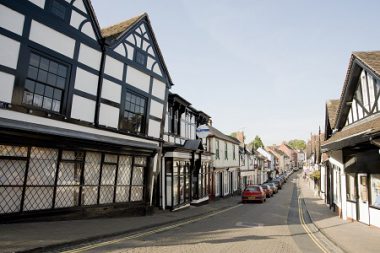
The old High Street in Droitwich

Treebeard is not particularly interested in getting on with things. He has no gardens to tend or food to grow. As he says to the young hobbits his food is a drink “that will keep you green and growing for a long, long while” and unlike ale or beer this drink involves no manufacturing process. His task is to be a shepherd to the trees of the forest and like shepherds, or herdsmen, throughout the world for much of the time, the work requires a close attention to all that is going on and Treebeard has been paying attention for thousands of years. His language, perhaps more like Gaelic, invites you to stop and ponder.

His attentiveness and his long memory is expressed in the telling of stories and the hill on which he has been standing that day has a very long story indeed. Treebeard’s life is lived in long practiced harmony with the forest in which he has lived for long ages and his language is contemplative, an expression of that harmony.

The French Orthodox scholar, Olivier Clément, speaks of this kind of contemplation thus:

“Here is a little spiritual exercise by means of the humblest of sensations- of breathing, of rejoicing under the blue sky, of touching a stone, or the bark of a tree, of gazing… at the majesty of a tree- I try to reach the transcendence of a thing. The object is visible and at the same time invisible; I must seek its inner self, let myself be led by it”

Treebeard has been led by the “inner self” of his forest for a very long time.