“Nay, Nay, Whatever May Now Betide in War, My Line Too is Ending, Even The House of The Stewards Has Failed.” Some Thoughts on Hope and Expectation in The Lord of the Rings.

The Return of the King by J.R.R Tolkien (Harper Collins 1991) pp. 799-806

I am grateful to one of my regular correspondents, Kate Splieth, for thoughts that have led to this reflection as we continue to think about the siege of Minas Tirith before the arrival of the Riders of Rohan, one of the darkest moments in The Lord of the Rings. In a comment on my last reflection upon eucatastrophe, she writes this,
“Is there a difference between hope and expectation?”

It is in the tragic character of Denethor that we see that difference most clearly expressed. From the moment that Denethor first receives the sign that his son, Boromir, has been killed, he begins his fall into despair. When Gandalf and Pippin first meet him, seated upon the Steward’s chair in the throne room of Gondor, they see this sign in his hand. He holds aloft the horn of Boromir that was cloven in two as he made the brave defence of Merry and Pippin at Parth Galen that led to his death.

From that time onwards Denethor’s spirit is broken even though he continues to direct the defence of the city against the Morgul host. But at the last the Prince of Dol Amroth carries the body of Faramir from the failed defence of the fords of Osgiliath to his father, and whatever strength Denethor had to continue resistance is lost.

“I sent my son forth, unthanked, unblessed, out into needless peril, and here he lies with poison in his veins. Nay, nay, whatever may now betide in war, my line is ending, even the House of Stewards has failed. Mean folk shall rule the last remnant of the Kings of Men, lurking in the hills until all are hounded out.”

We may note here that Denethor has reduced the story of his people to the story of his family, of his line. He is convinced, wrongly as we shall see, that Faramir is dying, and unlike Sam Gamgee, kneeling beside what he believed to be the corpse of Frodo in Shelob’s Lair, Denethor sees no reason to carry on, “whatever now may betide in war.” To him there is no future, even if victory should ultimately be achieved over the forces of Mordor. His line is ending, just as the line of the Kings of Gondor failed.

Here we see the difference between hope and expectation, or at least expectation as it has become. In the Latin text of the Nicene Creed we read et exspecto resurrectionem mortuorum, and I await the resurrection of the dead. The word, exspecto, that has become expect in modern English is associated with specto, to look out for, to wait for, to hope for. This kind of expectation is to Denethor, a fool’s hope, and when men call for guidance from their lord, Denethor answers, “Follow whom you will, even the Grey Fool, though his hope has failed.”

Denethor has given in to despair which is the ultimate consequence of his expectation. All his gathering of intelligence has convinced him of the overwhelming power of his enemy and the utter inadequacy of his own resources. His one hope, if we can call it that, was to gain control of the Ring of Power and so have a weapon that he could use of sufficient power to stand against that enemy. In this manner he resembles Saruman who also hoped to gain control of the Ring, although unlike Saruman, Denethor never considered the possibility of becoming an ally of Sauron. Saruman’s intention was to ally himself to Sauron while seeking either to gain control of the Ring or to create his own ring of power. Denethor was never a traitor unlike Saruman.

But neither Denethor, nor Saruman, had hope. Both gave way to despair. Saruman did so cynically, choosing to ally himself with darkness believing that darkness would have the last word in everything. Denethor also came to believe in the final victory of darkness but refused to ally himself with that darkness. In that sense there is still a heroism in Denethor, a heroism that he shows in the breastplate that he wears under his robes.

And what of hope? Gandalf chooses hope, the decision to believe that at the end the good, the true and the beautiful will prevail even though all that can be seen is darkness and the power of evil. In the Council of Elrond the choice was made to send the Ring to the Fire, not because it was felt to be a good idea but because it was the right thing to do, the only thing that could be done without giving way to the ultimate power of all the Ring represented which is the power of power itself.
“Though the Darkness Had Reached Its Full and Grew No Deeper, It Weighed Heavier on Men’s Hearts, And a Great Dread Was On Them.” Tolkien Describes The Darkest Moments of The Siege of Minas Tirith.

The Return of the King by J.R.R Tolkien (Harper Collins 1991) pp. 799-803

There are many dark moments in The Lord of the Rings, and I do not wish to take part in one of those polls that seem to be popular in social media. You know the kind that I mean; what are the ten darkest moments in this story? Is it Sam Gamgee kneeling beside the body of Frodo after his friend has received what seems to be a deadly sting from Shelob, or is it this moment when it seems that Minas Tirith will fall to the assault of the Morgul Host under their deadly captain, the Witch-King of Angmar? I do not wish to compare them. At the very least it would be a terrible slight upon the anguish that Sam feels as he looks upon Frodo and feels that the whole world has come to an end. But although Gandalf has been right to call Denethor to think of more than Gondor, Denethor has also been right to say that if Gondor falls the fall of the rest of Middle-earth will inevitably follow.

There is a word that serious readers of Tolkien’s work eventually come to know and that is the word, eucatastrophe. In his famous essay On Fairy Stories, Tolkien defined this word as “the sudden happy turn in a story which pierces you with a joy that brings tears (which I argue is the highest function of fairy-stories to produce)”. And so he thinks of the moment when the prince awakens the Sleeping Beauty from her hundred years sleep, or, in the Christian story, the moment of the incarnation, the birth of Christ in Bethlehem, the moment that is heralded in Isaiah 9.2 by the words, “The people that walked in darkness have seen a great light: they that dwell in the land of the shadow of death, upon them hath the light shined.” The essential contrast here is between darkness, the shadow of death and the great light that suddenly and entirely unexpectedly breaks in upon them in their utter hopelessness.

We will, of course, come back to the eucatastrophic moments in the telling of the story of the breaking of the siege of Minas Tirith later in this series of reflections, and we will see that not one of these moments is able to lift Denethor, the Steward of Gondor, from his deep despair. But what I wish to reflect upon here is that the essential feature of a true eucatastrophe is that it is entirely unlooked for. If we were to expect the “sudden happy turn” in our stories, then what such an expectation would create in us would be complacency. Unlike Pippin, who stands “alone and sleepless” on the walls of Minas Tirith looking eastward through the night we would sleep comfortably in our beds even through the greatest disaster. Don’t worry, we would say to one another, something will turn up, it always does.

And not all the sudden happy turns that have happened either in our own experience or in the telling of stories that we love the most are able to assure us that this time, in this present darkness, there will be an inbreaking of light. Like Pippin we wait, robbed of sleep, and asking, as we thought of a few weeks ago, “Is there any hope?”

And therein we see the action that we can take. There is the anxious waiting that Pippin shows us. There is the courageous if hopeless action of Faramir going out to the fords of Osgiliath even though he knows that he will not be able to hold them. Or there is the steady and indomitable spirit of Gandalf who remains in the darkest places so that those who are lost in them will not be utterly abandoned.

None of these actions can bring about the eucatastrophic events that will deliver Minas Tirith from the siege of the Morgul host, but without them, without the faithful perseverance that each of these actions represents, there can be no “joy that brings tears”, the tears that will later fall at the Field of Cormallen when Sam will cry out, “Is everything sad going to come untrue?”

“Opposing The Fire That Devours and Wastes With The Fire That Kindles.” Gandalf Kindles a Flame in The Hearts of The Free Peoples of Middle-earth.

The Return of the King by J.R.R Tolkien (Harper Collins 1991) pp. 741-743

Readers of my blog will know that it is my custom to make the heading of each post a quotation taken from the passage in The Lord of the Rings that I am thinking about. In this post, the last in this short series on Gandalf in which I have been thinking about the question that Pippin asked of himself as he stood between Gandalf and Denethor, “What was Gandalf?”, I have taken my quotation from a different source.

To help me in my reflections I have been using an essay that Tolkien wrote but never published, and that his son, Christopher, included in Unfinished Tales. The title of the essay is The Istari, and can be found between pp. 502-520 in that volume. In that essay Tolkien wrote this of Gandalf:

“Warm and eager was his spirit (and it was enhanced by the ring Narya) for he was the Enemy of Sauron, opposing the fire that devours and wastes with the fire that kindles, and succours in wanhope and distress; but his joy, and his swift wrath, were veiled in garments grey as ash, so that only those who knew him well glimpsed the flame that was within.” (Unfinished Tales p.505 Harper Collins 1998)

I hope that you, like me, will have found your heart warmed by this description of Gandalf, and that thoughts about many passages in The Lord of the Rings will have been evoked as you read it. Indeed, so much was fire associated with Gandalf that when he kindled fire with a word of command in the snows of the Misty Mountains to save the company from freezing to death he declared to them:

“If there are any to see, then I at least am revealed to them… I have written Gandalf is here in signs that all can read from Rivendell to the mouths of Anduin.” (The Fellowship of the Ring p. 283)

Perhaps it was this spirit that Círdan of the Grey Havens recognised when Gandalf first arrived in Middle-earth around the year 1,000 in the Third Age, for it was Círdan who gave him Narya, the ring of fire, that was at that time in his possession. Círdan had received Narya from Celebrimbor in order to keep it safe from Sauron but he never used it, knowing that he had no particular affinity to the ring, that there was nothing in his spirit that would mean that he could use the ring’s fiery capabilities. He knew that this quality of the ring would be needed in the struggle against Sauron and in recognising Gandalf’s “joy and swift wrath”, hidden though these qualities were beneath his “garments grey as ash”, he knew that he had found the true keeper of the ring of fire.

Gandalf opposed Sauron in two ways. On occasion, when necessity demanded it, he would literally fight fire with fire, opposing the power of darkness with light. In The Lord of the Rings the occasion in which we see this most clearly is in the battle against the Balrog of Moria, the “the flame of Udûn”, when Gandalf declares himself as a “servant of the Secret Fire, wielder of the flame of Anor”. (Fellowship p.322). The Balrog knows what he means by these words and we read that the fire in it seems to die as it hears them. After a long struggle the Balrog meets its end at Gandalf’s hands and although Gandalf gives up his life in this battle it is the flame of Anor that prevails and Gandalf receives his life again from Iluvatar.

Gandalf can wield fire in battle when necessary but for much of his time in Middle-earth it is the second way in which he opposes Sauron that is most prevalent. He opposes the fire that destroys, not in open conflict but “with the fire that kindles and succours”. Gandalf warms the hearts of the peoples of Middle-earth.

Tolkien uses a word that is rarely used in the English language to describe the condition of so many that seek to oppose the Dark Lord. It is the word, wanhope. We still use the word, wan, to speak of something that is a poor version of the best, but wanhope is a stronger word yet. In Chaucer’s Parson’s Tale (c.1400), we read:”now comes wanhope that is despair of the mercy of God that comes sometimes of too much outrageous sorrow and sometimes of too much dread” (my translation of Chaucer’s Middle English). I am sure that Tolkien had the good parson’s words in mind in using this word in Unfinished Tales and in describing the state of mind of many who despair of prevailing in the struggle against Sauron. Gandalf was able to save Théoden from wanhope but failed to do so in Denethor. Théoden renounces his despair while Denethor gives into his. Eventually it is the unexpected and unlooked for good fortune found in the person of Gollum in the Cracks of Doom that will save Middle-earth from destruction but it is Gandalf’s tireless work that means that there is a world worth saving.

“I Must Find The Mountain of Fire and Cast The Thing Into The Gulf of Doom. Gandalf Said So. I Do Not Think I Shall Ever Get There.” Frodo Speaks of His Task to Faramir and of Its Impossibility.

The Two Towers by J.R.R Tolkien (Harper Collins 1991, 2007) p.891

The shock and fear that followed the revelation of the true identity of Frodo’s burden is at an end but what follows is sheer exhaustion. With the last of his strength Frodo tells Faramir of his mission.

“I was going to find a way into Mordor… I was going to Gorgoroth. I must find the Mountain of Fire and cast the thing into the gulf of Doom. Gandalf said so. I do not think I shall ever get there.”

Faramir stares at Frodo with “grave astonishment”, and rightly so. Alongside Frodo’s declaration at the Council of Elrond that he would take the Ring though he did not know the way this is the only time that Frodo actually speaks of his task in plain speech. There is no attempt at heroic language. No boasting. Merely a quiet statement of what has to be done.

“Gandalf said so.”

Frodo claims nothing for himself. He has been given his orders and now he must carry them out. There is nothing more to be said and Frodo says nothing more. Except, as Faramir knows, that Frodo is attempting something that no-one has ever before tried to do. Later in the story Ioreth of the Houses of Healing will tell her friend that Frodo “went with only his esquire into the Black Country and fought with the Dark Lord all by himself, and set fire to his Tower, if you can believe it.” Of course we know that this is not quite what happened but what Frodo achieved is almost as impossible and Faramir recognises this. His grave astonishment is entirely justified. He knows that he stands in the presence of greatness even as Elrond recognised at Frodo’s first quiet declaration, comparing him to Beren and the great heroes of the First Age.

Only Frodo, as we have seen, does not recognise this, nor ever does. He only thinks in terms of what must be done and of its impossibility.

Hope and hopelessness are themes that Tolkien returns to again and again throughout The Lord of the Rings. Aragorn is given the name, Estel, secretly by his mother as she gives herself up to her own death and he spends his life struggling with this destiny, hoping against hope, not with Sam’s cheerful optimism, but a grim determination just to carry on. Frodo is of a similar spirit. There is a job to be done and that is all needs to be said.

What Frodo, and Aragorn, both do, is to give themselves up to something that is greater than themselves. Although Tolkien was himself man of deep Christian faith he never allows the characters in his story the comfort or strength that such faith would bring. Julian of Norwich’s famous declaration that “All shall be well, and all shall be well, and all manner of things shall be well” is something about which they know nothing. They must simply do their jobs because they are both necessary and right. Whether they will be rewarded with success is not something that they can know. So Elrond told Gimli’s father, Glòin, on learning of Sauron’s threats against the dwarves of Erebor that there is naught that the dwarves can do “other than to resist, with hope or without it”.

The heroic figures of The Lord of the Rings are denied faith in God in an explicit sense but the goodness, truth and beauty that they both love and fight for sustain them throughout their struggles. Galadriel may speak of “the long defeat” but this does not weaken her resolve. Tolkien did not believe in an arc of history that tends towards justice but in his belief in the resurrection of Christ, “the greatest ‘eucatastrophe’ possible in the greatest fairy story”, as he put it in a letter, he placed his hope in a final victory that would be one achieved by God alone.

In this sense Tolkien felt closer to the spiritual world of his heroes who had to resist “with hope or without it” than to some general kind of Christian optimism. And so he gives us Frodo, walking step by step towards Mordor even though he does not think that he will ever get there, as a model for our own lives and even as we stare with Faramir’s grave astonishment at him so too do we do the good that we have been called to do both this and every day.

The Tale of Beren and Lúthien Tinúviel. Aragorn Brings Aid at a Moment of Deadly Peril from the Unseen World.

The Fellowship of the Ring by J.R.R Tolkien (Harper Collins 1991) pp. 184-191

Aragorn’s telling of the Tale of Tinúviel is a thing of beauty and draws us in so near that we want to lose ourselves in it as, for a brief moment, are its teller and its four hearers.

“As Strider was speaking they watched his strange eager face, dimly lit in the red glow of the wood fire. His eyes shone and his voice was rich and deep. Above him was a black starry sky.”

The travellers are sheltering in a dell below Weathertop and, as well as the shining of Aragorn’s eyes and the sky, aflame with starlight, the moon rises above the hilltop. Three shinings on a night of ever present danger. For close at hand, five of the Nazgûl, led by their lord, are stealthily approaching the camp. Soon they will attack and a Morgul blade will pierce Frodo’s shoulder yet, as we readers of the tale listen to Aragorn, even if we have read it many times, we are as glad to be lost in it for a moment.

In Verlyn Flieger’s wonderful study, The Splintered Light, she begins by reflecting upon two apparently contradictory elements within Tolkien’s mind and in his work. One is the eucatastrophe of the fairy tale. The entirely unexpected and yet longed for happy ending that transforms all the suffering that has gone before. The other is the dyscatastrophe, the final defeat suffered by even the greatest hero. In his wonderful lecture, The Monsters and the Critics, Tolkien expresses this with heartbreaking poignancy.

“The great earth, ringed with… the shoreless sea, beneath the sky’s inaccessible roof, whereon, as a little circle of light about their halls, men with courage as their stay went forward to that battle with the hostile world and the offspring of the dark which ends for all, even the kings and champions, in defeat.”

“A little circle of light.” Was Tolkien alluding to this when he drew our attention to the shinings in that most fragile of “halls” in the dell below Weathertop? Perhaps, and so we might ask if the ending of the chapter that is so menacingly entitled, A Knife in the Dark, is the dyscatastrophe, the inevitable defeat suffered by all heroes. Frodo himself cries out in despair when he first learns that the Ring itself draws the Nazgûl towards him, “Is there no escape then?… If I move I shall be seen and hunted! If I shall stay, I shall draw them to me!”

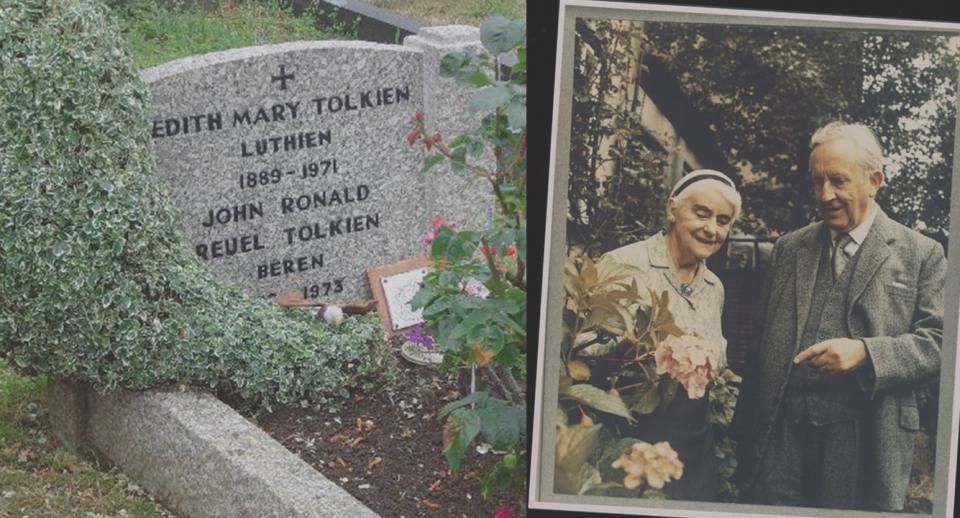
But the tale itself is an inbreaking of light, so bright, into the darkness, that shining eyes, stars and moon are at most a pale reflection of it. For it is the tale of Beren and Lùthien, the greatest of all Tolkien’s love stories, one so precious to him that he wanted those names to be inscribed beneath his and his wife’s names upon their gravestone. Aragorn, whose eyes shine with strange eagerness in the telling of it, perceives his own story as a kind of retelling of the tale.

Edith and John Tolkien. Lúthien and Beren.

“Beren was a mortal man, but Lúthien was the daughter of Thingol, a King of Elves upon Middle-earth when the world was young; and she was the fairest maiden that has ever been among all the children of this world. As the stars above the mists of the Northern lands was her loveliness and in her face was a shining light.”

A theme that recurs throughout the tale is one of the power of word and music. Lúthien is enchanted by hearing the sound of her own name upon the lips of Beren while, first Sauron and then Morgoth himself, of whom Sauron was but a servant, are overcome by Lúthien’s song. Does the chanting of the Lay that tells their tale invoke them at a moment in which “the offspring of the dark” make their attack or, perhaps more importantly even than this, invoke the same powers that aided them in their hopeless struggle with the dark? As Aragorn says to Sam after the attack, “More deadly to him [the Witch-king] was the name of Elbereth.”

The finest minds are those that are able to live with the greatest paradox. Surely at this pivotal moment in The Lord of the Rings the invasion of the desperately fragile “circle of light” and the telling of the tale that invokes a hope that is not broken even by the greatest evil is the coming together of Tolkien’s antitheses of eucatastrophe and dyscatastrophe, of heavenly light and the darkness of hell.

Faramir Gazes at the Overwhelming Wave and Thinks of Númenor as He Takes Éowyn in his Arms.

The moment when the Ring goes to the Fire and the reign of Sauron is ended is told in three separate places in The Lord of the Rings and from three different perspectives. The first is at Orodruin itself as Sam carries Frodo from the Cracks of Doom and sees a brief vision of Sauron’s overwhelming power before “all passed… Towers fell and mountains slid; walls crumbled and melted, crashing down; vast spires of smoke and spouting steams went billowing up, up, until they toppled like an overwhelming wave, and its wild crest curled and came foaming down the land”. The second telling is at the Black Gate of Mordor as the embattled host of the West stand at bay against their enemies and Gandalf cries out, “‘The realm of Sauron is ended!.. The Ring-bearer has fulfilled his Quest.’ And as the Captains gazed south to the Land of Mordor, it seemed to them that, black against the pall of cloud, there rose a huge shape of shadow, impenetrable, lightning crowned, filling all the sky. Enormous it reared above the world, and stretched out towards them a vast threatening hand, terrible but impotent: for even as it leaned over them, a great wind took it, and it was all blown away, and passed; and then a hush fell.”

The third and last telling takes place in the gardens of the Houses Houses of Healing as a young man and a woman stand, hand in hand (although they do not know it) as they gaze northward towards the Morannon as all the earth holds its breath and “Time halted”.

“Then presently it seemed to them that above the ridges of the distant mountains another vast mountain of darkness rose, towering up like a wave that should engulf the world, and about it lightnings flickered; and then a tremor ran through the earth, and they felt the walls of the City quiver. A sound like a sigh went up from all the lands about them; and their hearts beat suúddenly again.”

At last Faramir speaks.

“It reminds me of Númenor,” he says, and he tells Éowyn of his dream of the great wave that rises above the fields and the hills to drown it and a “darkness unescapable”. Éowyn draws closer to him. Is the Darkness Unescapable coming? But no, Faramir’s limbs are light and he feels a hope and a joy that no reason can deny. And then he kisses Éowyn upon the brow.

Tolkien too had a recurring dream of an overwhelming wave that he associated with the fall of Atlantis and of Númenor. In his legendarium Tolkien tells of the great hubris of the king of Númenor, Ar-Pharazôn, who was seduced by Sauron to defy the Valar and make an assault upon the Undying Lands. Because of this attempt to break the  bounds of human mortality Eru, the One, intervenes and destroys Númenor with a great wave, saving only Elendil, the Elf-friend, his family and followers.

Tolkien and his wonderful creation, Faramir, both dream about the catastrophe and Faramir carries the sorrow of the failure of his great ancestors and the gradual decline of Gondor in his heart. He longs for the restoration of his people and yet fears their destruction. The sudden and terrifying appearance of the great wave above him tells him that the end has come and yet his heart says, no! His heart is pierced with hope and joy!

This is the eucatastrophe, a word coined by Tolkien himself and one that runs counter both to the hubris of our own times and to our own fear of catastrophe. Tolkien said that eucatastrophe is “the sudden happy turn in a story which pierces you with a joy that brings tears”. He said that this was the highest function of a fairy-story, something that he declared The Lord of the Rings to be and which was in no sense meant to be a disparagement of his work. The happy turn for Tolkien was never meant to reduce his readers to the kind of children who cannot bear unhappiness and must forever remain in an enchanted world in which no harm can come. Just as with Julian of Norwich’s great declaration that “All shall be well and all shall be well and all manner of things shall be well” the eucatastrophe, the sudden and entirely unexpected surprise of joy can only come to those who have stared the darkness straight in the face.

No wonder Faramir kisses Éowyn at this moment; and no wonder Éowyn allows him to do so. But more on that next week.

The Battle Before the Black Gate. Do the Best Stories have Happy Endings?

I had intended to return to Frodo and Sam at the Tower of Cirith Ungol this week but I felt that I needed to offer one last meditation on the “hopeless” battle before the Black Gate of Mordor before I leave it for a while. At the very least I felt that I owe it to Pippin who is lying under the body of a Troll chieftain that he has just valiantly slain in defence of Beregond of the Guard, his friend. I can’t just leave him there without hope!

When I first read The Return of the King as a teenager it was a volume that I had borrowed from my school library. After eating my evening meal I disappeared to my room and read and read and read…

I wonder how long it took me to read the section from the end of Book 5 and the battle before the Black Gate to the moment when Gandalf calls upon the armies of the West to “stand and wait!” I was reading as fast as I could but even so it must have been a good hour or so before I got there. Tolkien’s happy ending, his eucatastrophe, as he termed it, was something for which I was made to wait. I had to endure the endless journey through the horror of Mordor that Frodo and Sam had to make in order to reach Mount Doom and once there I had to watch helplessly with Sam as Frodo failed in his mission and all was saved only by the unlooked for intervention of Gollum.

But still the happy ending came. Did it come because of the courage of the Armies of the West and their brave captains? Did it come because of the faithful witness to the Good that Gandalf had born through the long centuries of his sojourn in Middle-earth? Did it come because of the friendship of the nine companions who set out from Rivendell just three months before? Did it come because Frodo staggered, step by weary step, supported and, at the last, carried by Sam up the slopes of Mount Doom?

After we have given due praise to all of the characters that we have come to know and love in Tolkien’s great work, and each of them deserves great praise, we have to say that none of these things actually brings about the happy ending. That comes through grace alone, from something that lies beyond the endless repetition of cause and effect.

This is one of Tolkien’s greatest contributions to the culture of our time and one which has brought the greatest anger from literary critics. Most of all Tolkien has been accused of being an escapist. Life, real life, the critics say, is not like that. Tolkien is treating us as if we are children. This is mere fairy tale and it is time for us to grow up and embrace reality.

Tolkien faced this criticism head on in an essay first printed in 1947 entitled, On Fairy-Stories. In it he wrote, “I coined the word ‘eucatastrophe’: the sudden happy turn in a story which pierces you with a joy that brings tears  (which I argued it is the highest function of fairy-stories to produce). And I was there led to the view that it produces its peculiar effect because it is a sudden glimpse of Truth, your whole nature chained in material cause and effect, the chain of death, feels a sudden relief as if a major limb out of joint had suddenly snapped back”.

It is this “sudden glimpse of Truth” that is so subversive to the “chain of death” that is held to be the only reality by the so-called modernists. And it is precisely from that prison, surrounded by the chain of death, from which Tolkien calls us to escape. Is it a coward who cannot face up to reality who tries to escape from this prison? Surely it is the ones who tell us that the prison is the only reality and that there is no freedom beyond it who lack courage. The courageous life is the one that refuses to submit to the tyranny of the “chain of death” as do Tolkien’s heroes.


Christmas! A Good Time to Start a Venture that will Save the World From Evil.

“Go now with good hearts! Farewell, and may the blessing of Elves and Men and all Free Folk go with you. May the stars shine on your faces!”

So says the Lord Elrond at dusk on the 25th December in the year 3018 in the Third Age of the Earth as the Fellowship of the Ring sets out upon the quest to take the Ring of Power to the fires in which it was created upon Orodruin, Mt Doom, in the land of Mordor.

Within the story the date upon which the Fellowship sets out is determined by events such as Frodo’s decision to leave Bag End upon his birthday, the 23rd of September. This means that it is in the dead of winter that the great quest will leave Rivendell. But for Tolkien there is another reason why the 25th of December is chosen and that, of course, is because of the place of that date within the church’s calendar. It is Christmas, the Feast of the Nativity, of the birth of the Saviour to Mary and Joseph in a stable in Bethlehem. It is the day upon which the great adventure begins, “a light for revelation to the Gentiles and for glory to your people Israel.”

In Tolkien’s legendarium, unlike C. S Lewis’s Chronicles of Narnia, there is no incarnation. There is no figure like Aslan, around whom the whole story turns, who will die and rise again for the world. But the whole story is a preparation for the Incarnation. All of Tolkien’s great work prepares us to hear the great words that are proclaimed in the Christmas gospel, that “the Word became flesh and lived among us, and we have seen his glory, the glory as of a father’s only son, full of grace and truth.”

The destruction of the Ring of Power and the Fall of Sauron is not the end of the story. Tolkien goes to great lengths to show that. It is the point of the heartrending chapter near the end of The Lord of the Rings that he entitles, The Scouring of the Shire. The Ring may have gone to the Fire but a small band of brigands under a malicious leader can still do serious harm. It is the point of the departure from Middle-earth of Galadriel, Elrond and Gandalf and the ending of the great works that they were able to do with the three Elven Rings whose power fades with the destruction of the One Ring to which they were inextricably linked. For with the end of Sauron comes also the fading of Lothlórien and of Rivendell.

Christmas is yet to come in Middle-earth. We sense that when it does come it will do so as Tolkien’s great eucatastrophe, “the sudden happy turn in a story that pierces you with a joy that brings tears.” The long slow defeat of Tolkien’s story and our own experience of the world will end, not with the going out of the light for ever, but with the dawning of endless day that grows ever brighter. To this Great Day the Fall of Sauron and the Coronation of Aragorn as the returning King of Gondor and of Arnor is but a signpost. The reality that the sign points to has not yet come.

But for now we get ahead of ourselves in the story. It is the 25th of December and a small company without much gear of war goes south with the Ringbearer.

“There was no laughter, and no song or music. At last they turned away and faded silently into the dusk.”