“Frodo Wouldn’t Have Got Far Without Sam, Would He Dad?” Frodo Thinks About the Place of Sam Gamgee in His Story and About Both of Them in The Great Tale.

The Two Towers by J.R.R Tolkien (Harper Collins 1991, 2007) pp. 931-935

Frodo and Sam have come a long way since Gandalf unceremoniously pulled Sam by the ear through the study window at Bag End. And they have travelled far since Frodo’s attempt to escape from all his friends across the Anduin to the Emyn Muil after Boromir’s betrayal and his attempt to take the Ring from Frodo by force. At that point in the story Frodo greeted Sam’s heroic effort to catch up with him, risking his life in the waters of the mighty river, with the words:

“Of all the confounded nuisances you are the worst, Sam!”

The road from the breaking of the Fellowship to the place just below the tunnel into Mordor in the pass of Cirith Ungol has only been a few days but during that time the bonds of friendship between Frodo and Sam have begun to grow deep. Frodo takes the opportunity using the gentle game that he and Sam are playing as Sam imagines Frodo as a character in the kind of story that he loved to hear when he was a child to express something of how he has come to feel about him.

“Why, Sam,” he said, “to hear you somehow makes me as merry as if the story was already written. But you’ve left out one of the chief characters: Samwise the stouthearted. ‘I want to hear more about Sam, dad. Why don’t they put in more of his talk, dad? That’s what I like. it makes me laugh. And Frodo wouldn’t have got far without Sam, would he, dad?'”

This short speech displays much of the struggle that men have to say what they really feel. It is the last sentence that gets closest to this for Frodo. “I wouldn’t have got very far without you, Sam.” But this shy expression of feeling is wrapped up in teasing and in all the careful formality of relationships between classes that typified the early twentieth century world that Frodo and Sam live in and which they carry into the pre-modern heroic world of the central narrative of The Lord of the Rings. And in passing we might note here how seemingly effortless this travel between worlds is. We hardly notice that that all this conversation about heroic literature takes place in a lighthearted conversation between an officer and his batman (a servant to an officer in the British military) on the front line during the Great War of 1914-18. Are we in the trenches of that terrible conflict or are we in the story of Beren and Lúthien from the First Age of Arda? In fact we are in both stories but most importantly of all, the heroic tale recounted in The Silmarilion is legitimately brought into the twentieth century conversation and re-enchants it.

Sam is the first to point this out, speaking of the tale of Beren and Lúthien.

“But that’s a long tale, of course, and goes on past the happiness and into grief and beyond it- and the Silmaril went on and came to Eärendil. And why sir, I never thought of it before! We’ve got some of the light of it in that star-glass that the Lady gave you! Why, to think of it, we’re in the same tale still! Its going on. Don’t the great tales never end?”

Some may recall that Bilbo used words very much like this in his despairing cry of, “Don’t adventures ever have an end?” in the hall of fire in Rivendell when he met Frodo there. Both the tragedy and comedy of life come down to each of us from the ancient stories and we must inherit them both. The point is, and Tolkien vividly brings this to life here, is that our lives in modernity are not hermetically sealed against the heroic tales of the past. They still live in us and we in them.
“I Wonder What Sort of a Tale We’ve Fallen Into?” Sam Gamgee Continues to Think About His and Frodo’s Experience.

The Two Towers by J.R.R Tolkien (Harper Collins 1991, 2007) pp. 930-935

When I first read Sam’s thoughts about the ancient tales that were to be recorded in The Silmarilion, tales such as that of Beren and Lúthien and their journey to Thangorodrim to wrest a Silmaril from Morgoth’s iron crown they meant nothing to me beyond the lines that I had read of The Lay of Beren and Lúthien in the first book of The Lord of the Rings when Aragorn recounted the story to the hobbits in the camp below Weathertop. I had no idea that these words related to a work upon which Tolkien had spent most of his adult life, the creation of a legendarium within which The Lord of the Rings played just a part.

I did not know these stories but Sam did; and so did Frodo. These characters that Tolkien created came to the early readers of The Lord of the Rings with inner lives that had been formed in a way that no others ever had been in an imaginary work. So as Sam spoke of the story of Beren and Lúthien to Frodo both of them could picture the characters in their mind’s eye and both of them knew what had led those characters to make the journey to Thangorodrim and to achieve the impossible task that lay before them.

See Alan Lee’s wonderful evocation of the journey of Beren and Lúthien to Thangorodrim that is on the front cover of Christopher Tolkien’s edited version of his father’s writings of that story.

It is not possible within this limited space to recount the whole of this story. You will need to read it either within The Silmarilion or in Beren and Lúthien, both of which were lovingly and masterfully prepared for publication from his father’s writings by Christopher Tolkien. There you will read the story that holds such an important place within the imagination that Frodo and Sam both share.

If you do decide to do this then you might come to the conclusion that Sam has become a little too full of himself. Who does he think that he is to compare himself to such an heroic figure such as Beren? Of course the point is that he is not comparing himself with the great hero of old. It is Frodo of whom he is speaking.

“I wonder if we shall ever be put into songs or tales. We’re in one, of course; but I mean: put into words, you know, told by the fireside, or read out of a great big book with red and black letters, years and years afterwards. And people will say: ‘Let’s hear about Frodo and the Ring!”

As far as Sam is concerned, his part in the story is not particularly important. He is a kind of Sancho Panza to Don Quixote as his master travels about Spain engaged in adventures of medieval chivalry. His task is simply to look after his master and not to do anything that is particularly heroic himself.

Now the adventures of Don Quixote, and his faithful servant, Sancho Panza, in Miguel de Cervantes’ tale, bare some similarity to Frodo and Sam’s. If Sam knew Cervantes’ story he would almost certainly think of himself as a figure like Sancho Panza. But Frodo is no Don Quixote. His adventures are not illusory. He does not tilt at windmills imagining them to be knights at a medieval joust. His task is deadly serious. He has been given an impossible journey to undertake. One upon which the whole world depends. The likelihood is that neither he nor Sam will survive, either to tell the tale or to hear it told.

And there is one thing more. Sancho Panza’s role in his story was to keep his master from getting into too much trouble and to patch things up after they got a little too out of hand. Sam is a hero in his own right and Frodo recognises this, even if he speaks of it here in humorous tones.

“To hear you somehow makes me as merry as if the story was already written. But you’ve left out one of the chief characters: Samwise the stouthearted.”

Frodo speaks in this way because he wants to deflect attention from himself. In fact from both of them. As far as he is concerned he is no hero. Just as Sam puts it he has fallen into a story in which he has no right to be and he wishes that it could simply be done with. But his heart has been cheered by Sam and by the story to which Sam has referred. He is ready to go on and to walk into the darkness with some sense that his journey has meaning.

“I Must Find The Mountain of Fire and Cast The Thing Into The Gulf of Doom. Gandalf Said So. I Do Not Think I Shall Ever Get There.” Frodo Speaks of His Task to Faramir and of Its Impossibility.

The Two Towers by J.R.R Tolkien (Harper Collins 1991, 2007) p.891

The shock and fear that followed the revelation of the true identity of Frodo’s burden is at an end but what follows is sheer exhaustion. With the last of his strength Frodo tells Faramir of his mission.

“I was going to find a way into Mordor… I was going to Gorgoroth. I must find the Mountain of Fire and cast the thing into the gulf of Doom. Gandalf said so. I do not think I shall ever get there.”

Faramir stares at Frodo with “grave astonishment”, and rightly so. Alongside Frodo’s declaration at the Council of Elrond that he would take the Ring though he did not know the way this is the only time that Frodo actually speaks of his task in plain speech. There is no attempt at heroic language. No boasting. Merely a quiet statement of what has to be done.

“Gandalf said so.”

Frodo claims nothing for himself. He has been given his orders and now he must carry them out. There is nothing more to be said and Frodo says nothing more. Except, as Faramir knows, that Frodo is attempting something that no-one has ever before tried to do. Later in the story Ioreth of the Houses of Healing will tell her friend that Frodo “went with only his esquire into the Black Country and fought with the Dark Lord all by himself, and set fire to his Tower, if you can believe it.” Of course we know that this is not quite what happened but what Frodo achieved is almost as impossible and Faramir recognises this. His grave astonishment is entirely justified. He knows that he stands in the presence of greatness even as Elrond recognised at Frodo’s first quiet declaration, comparing him to Beren and the great heroes of the First Age.

Only Frodo, as we have seen, does not recognise this, nor ever does. He only thinks in terms of what must be done and of its impossibility.

Hope and hopelessness are themes that Tolkien returns to again and again throughout The Lord of the Rings. Aragorn is given the name, Estel, secretly by his mother as she gives herself up to her own death and he spends his life struggling with this destiny, hoping against hope, not with Sam’s cheerful optimism, but a grim determination just to carry on. Frodo is of a similar spirit. There is a job to be done and that is all needs to be said.

What Frodo, and Aragorn, both do, is to give themselves up to something that is greater than themselves. Although Tolkien was himself man of deep Christian faith he never allows the characters in his story the comfort or strength that such faith would bring. Julian of Norwich’s famous declaration that “All shall be well, and all shall be well, and all manner of things shall be well” is something about which they know nothing. They must simply do their jobs because they are both necessary and right. Whether they will be rewarded with success is not something that they can know. So Elrond told Gimli’s father, Glòin, on learning of Sauron’s threats against the dwarves of Erebor that there is naught that the dwarves can do “other than to resist, with hope or without it”.

The heroic figures of The Lord of the Rings are denied faith in God in an explicit sense but the goodness, truth and beauty that they both love and fight for sustain them throughout their struggles. Galadriel may speak of “the long defeat” but this does not weaken her resolve. Tolkien did not believe in an arc of history that tends towards justice but in his belief in the resurrection of Christ, “the greatest ‘eucatastrophe’ possible in the greatest fairy story”, as he put it in a letter, he placed his hope in a final victory that would be one achieved by God alone.

In this sense Tolkien felt closer to the spiritual world of his heroes who had to resist “with hope or without it” than to some general kind of Christian optimism. And so he gives us Frodo, walking step by step towards Mordor even though he does not think that he will ever get there, as a model for our own lives and even as we stare with Faramir’s grave astonishment at him so too do we do the good that we have been called to do both this and every day.

“Well, Sméagol, The Third Turn May Turn the Best. I Will Come With You.” Frodo Decides to Put His Faith in Gollum.

The Two Towers by J.R.R Tolkien (Harper Collins 1991, 2007) pp. 833-846

The journey to Mordor and to Mount Doom was always an impossible task. While there were other things to think about and problems to solve it was possible to avoid confronting that reality. There was the descent of the Emyn Muil, the passage of the Marshes and the question of what to do about Gollum. All this gave Frodo and Sam something to think about other than the really big thing. But now, as they see the impossibility of entering Mordor through the Black Gate without death or capture the reality hits home.

What would Gandalf have done if he had been with them? Which way would he have gone? Frodo wonders if Gandalf had ever been this way. He knew that Gandalf had once entered the fortress of Dol Guldur in Mirkwood, Sauron’s lesser stronghold, but he doubted if Gandalf had ever been to Mordor. Indeed no-one had ever entered Mordor and lived to tell the tale. No-one except Gollum, and he had been freed in order to search for the Ring.

So it is at this terrible moment just some few yards from the Morranon that the impossibility of the task and his utter inadequacy to undertake it becomes clear to Frodo. Gollum has spoken of another way but for some time they all sit in the hollow where they are hiding in silence.

Elrond had said to Frodo that the task was appointed for him and that Frodo could not find a way then no-one could. As Frodo heard these words that “no-one” probably held little meaning for him and when Elrond had gone on to speak of Hador and Húrin and Túrin and even Beren himself, it probably meant very little to him, except as a cause of some embarrassment, but now Frodo understands what Elrond meant. The task really is for him alone, not for Gandalf or Aragorn or any other of the great, and the task is impossible.

Something has to break into the sheer immensity of this realisation or the story might have ended here. In silence. But something does. It always does. Life goes on around even the most significant events and does not even notice them. First they become aware that, far off, Nazgûl are in the air, and this terrifies them; then they hear more forces arrive from Harad to swell the growing army within Mordor.

Gollum describes what he can see to Frodo and Sam and this leads Sam to think of oliphaunts and he recites a verse that he remembers from his childhood, standing with his hands behind his back just as he would have done as a small child. And just as happened when Sam had recited the tale of the trolls on the journey to Rivendell as the Morgul-blade drew Frodo deeper and deeper into darkness so too now Sam’s simple cheerfulness breaks the spell and Frodo laughs.

It is laughter that enables Frodo to make a choice. Impossibility becomes possibility once again. I do not mean that suddenly Frodo believes that he can achieve his mission, that, as we might now say, he believes in himself again. Frodo never entertained that particular illusion that has become so important in our own time. We may have seen Boromir believing in himself but Frodo just gets on with the job that has been given to him.

But faith does play a vital part in what Frodo decides to do. He decides to trust Gollum. This is not mere naivety on his part. He is well aware of Gollum’s malice and untrustworthiness. But in the face of impossibility, at the moment when this has moved from some abstract form of which he has always been aware to a reality that almost crushed him when he realised it, Gollum offers a way forward.

Gollum’s way is a terrible one and full of treachery. Gandalf would have warned Frodo against it. But Frodo is now aware that there may not be any way into Mordor and that, as Sam grimly puts it, they might as well walk up to the Black Gate and save themselves “a long tramp”. And it is in the light of this realisation that he becomes free to choose. He chooses to go with Gollum and he laughs. The whole thing is ridiculous, impossible, anyway. The whole thing is a joke. And this realisation reawakens hope in Frodo’s heart. At least hope to take the next step.

And then the step after that.

“Down Into The Land of Shadow.” Tolkien’s Ending of The Fellowship of the Ring.

The Fellowship of the Ring by J.R.R Tolkien (Harper Collins 1991) pp.397-398

Those who came to know The Lord of the Rings through the films that were made some twenty years ago by Peter Jackson will have been surprised when they first read Tolkien’s own ending to the first volume of his trilogy, The Fellowship of the Ring. Tolkien gives us no battles, no brave self-sacrifice from Merry and Pippin offering themselves to the orcs so that Frodo can escape, no farewell by Aragorn to Frodo, and no heroic death of Boromir. That last will take place off stage at the beginning of The Two Towers. Instead he gives us this…

“So Frodo and Sam set off on the last stage of the Quest together. Frodo paddled away from the shore and the River bore them swiftly away, down the western arm, and past the frowning cliffs of Tol Brandir”

Frodo and Sam struggle to get past the current of the river that seeks to drag them over the mighty falls and so at last make their way to the east bank, and then…

“At length they came to land again upon the southern slopes of Amon Lhaw. There they found a shelving shore, and they drew the boat out high above the water, and hid it as well as they could behind a great boulder. Then shouldering their burdens, they set off, seeking a path that would bring them over the grey hills of the Emyn Muil, and down into the Land of Shadow.”

We can understand why Peter Jackson decided to end his first film differently and I, alongside the packed theatre audience who witnessed the film, was glad to stand and applaud it. It was a masterpiece in its own right and I could not wait for the release of The Two Towers which is what Jackson had intended.

But Tolkien had his reasons for ending this first part of his great story in this way and if I were to try to create the scene as I think Tolkien intended us to see it I would slowly draw the camera back from Frodo and Sam as they set off on their journey until all we could see was two small figures set against a vast and empty wasteland.

There is an old and deeply poignant prayer of the Breton people of France whose ancient language is related to Welsh, a tongue that Tolkien loved. It simply states that “O God, thy sea is so great and my boat is so small.” I have known it for some time through a collection of prayers from the Celtic tradition of which the Breton tongue is a part but discovered while preparing this blog post that an American admiral gave a small plaque to President John Kennedy, a fellow sailor, with this prayer inscribed upon it. The point of the prayer, as President Kennedy received it, was to remind us of our smallness against the vastness of the universe in which we are set. Kennedy kept the plaque on his desk in the Oval Office throughout his term of office to teach him humility. Presidents need such reminders in a way that Breton fisher folk do not. For them, and for all the “little” people of the earth, it is enough that they must set out each day into a world that is so much bigger than they are, and Tolkien intends us to see Frodo and Sam among such people. Their journey is not heroic in the sense that it is a conquest of the world although Elrond was right to compare Frodo to the great heroic figures of the First Age like Hurin and Beren, it is heroic in the sense that ordinary life is heroic. Ordinary folk shoulder their burdens and set out, seeking a path through a life that is so much bigger than they are. Frodo and Sam know that what they seek to do is far too big a task for people like them but they do it anyway because it is a task that they have been given to do.

Surely Tolkien drew here upon his memories of the ordinary soldiers on the Western Front in the First World War who did their job against overwhelming odds and did not see their lives as wasted because doing their job was what life was all about. It reminds me of a conversation I once had with a woman whose husband had worked all his life in a job that he hated in order to feed his family and did it with pride so that the high point of his week was to cook breakfast on a Sunday morning and to share it with them all. That is the kind of heroism that Frodo and Sam represent.

“May It Be a Light to You in Dark Places, When All Other Lights Go Out.” Galadriel Gives a Phial of Light to Frodo.

The Fellowship of the Ring by J.R.R Tolkien (Harper Collins 1991) pp.365-367

After Galadriel has given a gift of three of her golden hairs to Gimli there remains one last gift to be given, to Frodo, the Ring-bearer who is not last in her thoughts. She gives to him “a small crystal phial” that glitters as she moves it and “rays of white light” spring from her hand.

“In this phial,” she said, “is caught the light of Eärendil’s star, set amid the waters of my fountain. It will shine still brighter when night is about you. May it be a light to you in dark places, when all other lights go out.”

Frodo remembers the verses that Bilbo chanted about Eärendil in the Hall of Fire in Rivendell, the verses that seemed to Frodo “to fit somehow” into something about which he was dreaming, about “an endless river of swelling gold and silver” flowing over him. This is Frodo’s immersion into the history of light of which he is a vital part and of which Galadriel’s phial is now a living symbol.

A ship then new they built for him 
of mithril and of elven-glass
with shining prow; no shaven oar
nor sail she bore on silver mast:
the Silmaril as lantern light
and banner bright with living flame
to gleam thereon by Elbereth
herself was set, who thither came
and wings immortal made for him,
and laid on him immortal doom,
to sail the shoreless skies and come
behind the Sun and light of Moon.

Galadriel herself has been intimately involved in this history from the beginning. It is the story of how Fëanor made three exquisite jewels in which was captured the light of the two trees in Valinor, of Telperion and of Laurelin. Eventually the trees are destroyed by Morgoth with the aid of Ungoliant, the terrible spider-like monster and ancestor of Shelob, who Frodo and Sam will encounter in the tunnels of Cirith Ungol and who Sam will vanquish with the aid of Galadriel’s phial after Frodo is poisoned. After the theft of the Silmarils Fëanor will pursue Morgoth, defying the Valar who forbid him to leave Valinor. Along with his people, the Noldor, he steals ships from the Teleri, slaying them when they try to resist him, and so begins the tragic history of Middle-earth that reaches a climax in The Lord of the Rings.

There is a sense in which the whole of this history is contained in Galadriel’s phial, both in its beauty and its sorrow. The light of the Silmaril that is captured in the phial is a sign of hope to which all the peoples of Middle-earth can look each morning and evening in the star that shines brightly above them. Eärendil brought hope to Middle-earth when it lay prostrate before the power of Morgoth and his star continues to do so today. In the terrible lair of Shelob, in a place where all other lights have gone out, Frodo cries out, “Aiya Eärendil elenion ancalima!” “Hail Eärendil, brightest of stars!” And at this moment when all hope is gone the light of the Silmaril blazes forth and the memory of the fall of Morgoth is rekindled.

But I mentioned sorrow too. For the story of the Silmarils is a story of trust betrayed. I mentioned the kinslaying of Alqulondë when the Noldor stole the ships of the Teleri but I could mention many other sorrows too. In fact one of the great themes of the story of the First Age as recounted in The Silmarillion is the telling of the sorrows of Middle-earth to the Valar. After the death of Beren Lúthien follows him to the underworld and sings to Mandos the most beautiful song in the world, a weaving together of the griefs of the Two Kindreds of Elves and Humankind that reduces the Lord of Death to tears of pity. Indeed we could add to this story that of Eärendil himself whose journey to Valinor is itself a plea to the Valar to take pity upon these kindreds.

Galadriel has been a part of both the sorrow and the beauty. She was a part of the rebellion of Fëanor and the Noldor, albeit reluctantly, but in her rejection of the Ring when it was offered to her by Frodo she displays her adamantine character and so wins a victory over evil that is vital for the success of the task of the Ring-bearer. Her gift to him is a symbol of that victory.

“When Evening in The Shire Was Grey”. Frodo and Sam Sing Songs of Gandalf in Lothlórien.

The Fellowship of the Ring by J.R.R Tolkien (Harper Collins 1991) pp. 349-351

Galadriel and Celeborn wisely leave the Fellowship to themselves after the encounter in Caras Galadhon and Galadriel’s silent interrogation of their hearts and minds. What the Fellowship needs now is rest and healing of weary bodies. Even though at its borders Lothlórien is alert to possible threat at its heart it remains at rest and so it seems that the Company does “little but eat and drink and rest, and walk among the trees”; and it is enough.

At first, as Aragorn put it, there is a desire simply to rest and to forget grief, grief at the loss of Gandalf at the Bridge of Khazad-dûm, but inevitably after a while their thoughts turn to their loss and their grief becomes keen.

It is Frodo and Sam who choose poetry in which to try to put that grief into some kind of form. Perhaps it is as they hear songs of Mithrandir, the Grey Pilgrim, in the Sindarin tongue of their Elven hosts, that they begin to find their own thoughts move in the same direction. Perhaps it is, as Sam has already put it, that in Lothlórien they feel themselves to be “inside a song” that enables them to create their own.

When evening in the Shire was grey
his footsteps on the Hill were heard;
before the dawn he went away 
on journey long without a word. 

The words are beautiful and full of longing for what has been lost. The aching realisation that Frodo will never hear the sound of those footsteps coming along the path to his door again, a sound that always meant that something deep and rich, old and wise, was about to enter his life once again. But Tolkien is quick to introduce a disclaimer here. These words “feel faded as a handful of withered leaves”. Tolkien uses this sad image to describe Frodo’s feelings of inadequacy as he tries to put the person of Gandalf into words but we cannot help but feel that it is Tolkien’s own feelings of inadequacy as a poet that are on show here. Gandalf is far too great a figure to reduce to a few lines upon a page, or committed to memory in Frodo’s mind.

But a good poem is not a reduction of anything. Each line in Frodo’s evocation of Gandalf points us towards his greatness but also his simplicity. They speak of his mighty journeys; of his skill in languages; of his “deadly sword”, his “healing hand”.

“A lord of wisdom throned he sat, swift in anger, quick to laugh, an old man in a battered hat who leaned upon a thorny staff.”

All through the poem Frodo gives us on the one hand, his greatness, and on the other, his vulnerability and all the time he is doing something that from their earliest encounters with one another, C.S Lewis admired in Tolkien’s work. It was after an evening reading The Lay of Leithian Tolkien’s verse telling of the story of Beren and Lúthien that Lewis wrote of myth making that it is the essence of a myth “that it should have no taint of allegory to the maker and yet should suggest incipient allegories to the reader”. And surely here in Frodo’s lament for Gandalf the incipient allegory that is suggested to us is the connection between Gandalf, the mighty maiar clothed in the form of “a weary pilgrim on the road”, and what first Tolkien and then Lewis described as the true myth of the incarnation in which, in Christ, God is clothed in our humanity, not in its semblance but in all its reality. There is no incarnation in any part of Tolkien’s legendarium. He deliberately chose to set his story in a world that knows nothing of it but again and again, in the story of Gandalf, in the story of the true king hidden within the weather stained Ranger of the North who goes by the name of Strider, and in other characters, the true myth is suggested to us in many ways. Might this be why our hearts are drawn towards them?

“Do Not Repent of Your Welcome To The Dwarf.” The Fellowship Tell the Story of Gandalf’s Fall to Galadriel and Celeborn.

The Fellowship of the Ring by J.R.R Tolkien (Harper Collins 1991) pp. 344-347

With the arrival of the Fellowship to the halls of Galadriel and Celeborn in Caras Galadhon at the heart of the realm of Lothlórien the tale of Gandalf’s fall into the abyss at the Bridge of Khazad-dûm must at last be told. So too has the manner of his fall at the hands of the Balrog of Moria, “of all elf-banes the most deadly, save the One who sits in the Dark Tower.”

If news of the fall of Gandalf has been the cause of great grief in the Elves of Lothlórien so news of the Balrog of Moria is the cause of great anger and most especially in Celeborn.

“Had I known that the Dwarves had stirred up this evil in Moria again, I would have forbidden you to pass the northern borders, you and all that went with you. And if it were possible, one would say that at the last Gandalf fell from wisdom into folly, going needlessly into the net of Moria.”

Readers will note that even though Celeborn is angry with the whole company, even with Gandalf himself, it is Gimli who he singles out for his particular wrath. It is Dwarves who have stirred up the evil that has lain hidden long years in the depths of Moria.

Celeborn’s anger against the Dwarves has a long history. It began in the First Age of Arda when his kinsman, the Lord Thingol of Doriath gained possession of a Silmaril through the mighty deeds of Luthien and Beren who took it from the very crown of Morgoth himself. The Silmaril was the price that Thingol had demanded of Beren so that he could have the hand of Luthien in marriage. Thingol asked Dwarf craftsmen to put the Silmaril into the Nauglamir, greatest and most beautiful of the works of the Dwarves in that age. The Dwarves were overcome by desire for the Silmaril and demanded that Thingol give it to them in payment for their labour. When Thingol refused this they killed him and a war broke out between Dwarves and Elves with terrible slaughter upon both sides. Although Celeborn’s role in that war is never mentioned there can be no doubt that he played his part in it and that he carried both anger and distrust towards Dwarves in his heart thereafter.

That the telling of the tale of the events at the Bridge of Khazad-dûm does not end with a swift expulsion of the Fellowship from Lothlórien and disaster for their mission is thanks to the intervention of Galadriel. If Celeborn is the keeper of the memory of a perception of treachery upon the part of dwarves and of a bitter war in which his homeland was destroyed by them then Galadriel is the keeper of a very different one. In her heart she cherishes the memory of Melian, the wife of Thingol, who became like a mother to her. Melian was known for her great wisdom and through all the story of Thingol and his avaricious heart she tried to warn him that such a spirit could lead to no good. Thingol became a grasper after things, even treating his own daughter, Luthien, as if she were a possession and not a free person. Galadriel, after the spirit of Melian, is a giver of hospitality, even though, like Melian too, she has put a girdle around Lothlórien to keep all evil at bay. She made Aragorn and Arwen welcome, both separately and in giving space for their love for each other to grow. And now she extends a loving welcome to Gimli the Dwarf.

“She looked upon Gimli, who sat glowering and sad, and she smiled. And the Dwarf… looked up and met her eyes; and it seemed to him that he looked suddenly into the heart of an enemy and saw there love and understanding.”

For Gimli this moment is a turning point in his story. His looking up, away from his anger and sadness and into the face of Galadriel turns him into a lover of beauty. He offers her his heart in worship and this is no idolatry because idolatry is in essence the worship of things for the sake of a small, mean self, the kind of worship that led to the fall and mutual destruction of Thingol, his realm, and the Dwarves, long ago. Gimli becomes a servant of all that is beautiful for its own sake. He “kisses the joy as it flies”, as William Blake puts it and so comes to live in “eternity’s sunrise”.

“Aragorn Insisted on My Putting in a Green Stone.” The Importance of Hope in The Lord of the Rings.

The Fellowship of the Ring by J.R.R Tolkien (Harper Collins 1991) pp.227-231

Bilbo’s verses, chanted in the Hall of Fire in Rivendell, the house of Elrond have gone remarkably well. Remarkably well because Elrond is the son of Eärendi, the hero about whom Bilbo has sung. A number of commentators have remarked upon the ambiguous reception that the Elves give to Bilbo’s efforts and the way in which they seem to dismiss mortals comparing them to sheep. They ignore the fact that Eärendil was himself a mortal, a mortal who married an elven princess, Elwing the daughter of Dior and grandchild of Beren and Lúthien, and great-grandchild of Thingol and Melian of Doriath. They ignore the fact that the history of mortals and elves are so closely woven together and that Aragorn, like Elrond, is a descendant of Eärendil and Elwing.

Aragorn himself clearly feels this tension, chiding Bilbo for treading upon a subject that is well above his head but he makes one suggestion concerning Bilbo’s verses and that is that he should put in “a green stone”, seeming “to think it important”.

And it is important. For this stone is the Elessar, the Elfstone. In the history of Galadriel and Celeborn, recorded in the Unfinished Tales we read this:

“There was in Gondolin a jewel smith named Enerdhil, the greatest of that craft among the Noldor after the death of Fëanor. Enerdhil loved all green things that grew, and his greatest joy was to see the sunlight through the leaves of trees. And it came into his heart to make a jewel within which the clear light of the sun should be imprisoned, but the jewel should be green as leaves.”

This stone was given by Enerdhil to Idril, the daughter of Turgon, king of Gondolin and she in her turn gave it to her son, Eärendil. And even in these few words we discern a lineage for the Elessar that is entirely different to that of the Silmarils of Fëanor or, for that matter of the Ring of Power. For from the moment of its making the story of the Elessar is one of gift. Enerdhil gives it to Idril and gives it without condition. He does not seek to possess the one who receives his gift. By contrast the story of the Silmarils is one of theft and power. Morgoth steals the jewels from Fëanor and when Beren and Lúthien take one of the jewels from Morgoth’s crown the heirs of Fëanor never cease from their efforts to regain it no matter what the cost, either to themselves or others.

Thus the Elessar is always a sign of hope. “It is said,” so we read in Unfinished Tales, “that those who looked through this stone saw things that were withered or burned healed again or as they were in the grace of their youth, and that the hands of all who held it brought to all that they touched healing from hurt.” And so it passes from Idril to Eärendil, her son, who takes it with him into the west in his quest to seek aid for Middle-earth from the Valar. At last, and Tolkien spoke of two ways in which this might have happened, it passes to Galadriel, either through Gandalf who brought the stone with him from Valinor or through Celebrimbor, the maker of rings who was deceived by Sauron into giving him the means by which the Ring of Power was forged at the Cracks of Doom. Whichever tale you choose the Elfstone remains a gift and so at last Aragorn comes to Lothlórien with the Fellowship fleeing from Moria and Galadriel gives the stone to him as they part.

“She lifted from her lap a great stone of a clear green, set in a silver brooch that was wrought in the likeness of an eagle with outspread wings; and as she held it up the gem flashed like the sun shining through the leaves of spring.”

We do not read of the influence of the stone upon Aragorn in the rest of the story. We know that Galadriel had given the stone to Celebrian, her daughter and that through her it passed to Arwen. Did Aragorn know that Arwen had possessed the stone, the very stone that Eärendil had once worn? Was it this connection that caused him to insist that Bilbo included the Elfstone in his verses? Was Aragorn, in his own way, reminding the son of Eärendil that he too was intimately linked to this story? Aragorn will be crowned the King Elessar and he will bring healing to Middle-earth just as the prayer of Eärendil did so at the end of the First Age. At this point of the story on the eve of the Council of Elrond all there is is hope but it is enough.

The Tale of Beren and Lúthien Tinúviel. Aragorn Brings Aid at a Moment of Deadly Peril from the Unseen World.

The Fellowship of the Ring by J.R.R Tolkien (Harper Collins 1991) pp. 184-191

Aragorn’s telling of the Tale of Tinúviel is a thing of beauty and draws us in so near that we want to lose ourselves in it as, for a brief moment, are its teller and its four hearers.

“As Strider was speaking they watched his strange eager face, dimly lit in the red glow of the wood fire. His eyes shone and his voice was rich and deep. Above him was a black starry sky.”

The travellers are sheltering in a dell below Weathertop and, as well as the shining of Aragorn’s eyes and the sky, aflame with starlight, the moon rises above the hilltop. Three shinings on a night of ever present danger. For close at hand, five of the Nazgûl, led by their lord, are stealthily approaching the camp. Soon they will attack and a Morgul blade will pierce Frodo’s shoulder yet, as we readers of the tale listen to Aragorn, even if we have read it many times, we are as glad to be lost in it for a moment.

In Verlyn Flieger’s wonderful study, The Splintered Light, she begins by reflecting upon two apparently contradictory elements within Tolkien’s mind and in his work. One is the eucatastrophe of the fairy tale. The entirely unexpected and yet longed for happy ending that transforms all the suffering that has gone before. The other is the dyscatastrophe, the final defeat suffered by even the greatest hero. In his wonderful lecture, The Monsters and the Critics, Tolkien expresses this with heartbreaking poignancy.

“The great earth, ringed with… the shoreless sea, beneath the sky’s inaccessible roof, whereon, as a little circle of light about their halls, men with courage as their stay went forward to that battle with the hostile world and the offspring of the dark which ends for all, even the kings and champions, in defeat.”

“A little circle of light.” Was Tolkien alluding to this when he drew our attention to the shinings in that most fragile of “halls” in the dell below Weathertop? Perhaps, and so we might ask if the ending of the chapter that is so menacingly entitled, A Knife in the Dark, is the dyscatastrophe, the inevitable defeat suffered by all heroes. Frodo himself cries out in despair when he first learns that the Ring itself draws the Nazgûl towards him, “Is there no escape then?… If I move I shall be seen and hunted! If I shall stay, I shall draw them to me!”

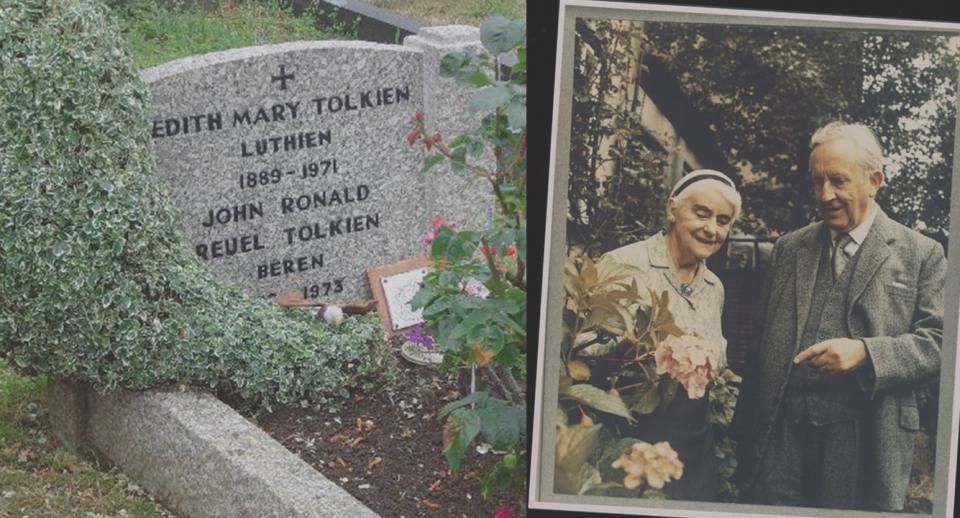
But the tale itself is an inbreaking of light, so bright, into the darkness, that shining eyes, stars and moon are at most a pale reflection of it. For it is the tale of Beren and Lùthien, the greatest of all Tolkien’s love stories, one so precious to him that he wanted those names to be inscribed beneath his and his wife’s names upon their gravestone. Aragorn, whose eyes shine with strange eagerness in the telling of it, perceives his own story as a kind of retelling of the tale.

Edith and John Tolkien. Lúthien and Beren.

“Beren was a mortal man, but Lúthien was the daughter of Thingol, a King of Elves upon Middle-earth when the world was young; and she was the fairest maiden that has ever been among all the children of this world. As the stars above the mists of the Northern lands was her loveliness and in her face was a shining light.”

A theme that recurs throughout the tale is one of the power of word and music. Lúthien is enchanted by hearing the sound of her own name upon the lips of Beren while, first Sauron and then Morgoth himself, of whom Sauron was but a servant, are overcome by Lúthien’s song. Does the chanting of the Lay that tells their tale invoke them at a moment in which “the offspring of the dark” make their attack or, perhaps more importantly even than this, invoke the same powers that aided them in their hopeless struggle with the dark? As Aragorn says to Sam after the attack, “More deadly to him [the Witch-king] was the name of Elbereth.”

The finest minds are those that are able to live with the greatest paradox. Surely at this pivotal moment in The Lord of the Rings the invasion of the desperately fragile “circle of light” and the telling of the tale that invokes a hope that is not broken even by the greatest evil is the coming together of Tolkien’s antitheses of eucatastrophe and dyscatastrophe, of heavenly light and the darkness of hell.