“To The Stone of Erech! I Seek The Paths of The Dead. Come With Me Who Will.” Aragorn Acts Swiftly as Time Runs Out.

The Return of the King by J.R.R Tolkien (Harper Collins 1991) 762-765

It is in the very nature of things of great importance that however long we spend in thinking about them or in making preparation for them there will always come a point when action has to be taken and that when that time comes it will feel as if there is not sufficient time to do what we need to do. Nor are there sufficient resources. As my friends in North America put it, we will always feel like we are a dollar short and a minute late.

As to the questions of time and resources Gimli puts it well. When Aragorn, the Heir of Isildur, succeeds in taking control of the Stone of Orthanc from Sauron’s control, he learns that a great peril is approaching Minas Tirith from the south. These are the Corsairs of Umbar, ancient enemies of Gondor who have allied themselves with Sauron to put a final end to their foes. Aragorn knows that if help does not come then Minas Tirith will fall in ten days time.

“Then lost it must be,” said Gimli. “For what help is there to send thither, and how could it come in time?”

There is no help and there is no time.

But messages have come to Aragorn from Elrond and now he knows that perhaps there is help and there is time. But the way is dark and full of doubt. Perhaps that too is the way with decisions that we must take that are of great importance. We can never be entirely sure that what we are doing is the right thing. For Aragorn the message bids him remember the words of the Seer, spoken long ago in the days of his ancestor, the last king of the northern kingdom who fell in battle against the Witch-king of Angmar.

From the North shall he come, need shall drive him:
he shall pass the Door to the Paths of the Dead.

But how can Aragorn know that he is the one of whom the Seer spoke long ago. Have there not been many times since those days in which there has been great need? The answer is that Aragorn cannot be certain, not completely certain. It may be that this is not the final climax even though everything seems to point to the fact that it is.

And what of the help?

Aragorn tells the story of a people who lived long before the days of Malbeth the Seer, a people who lived in the mountains that divide Rohan and Gondor. He tells of how in the days of the Last Alliance when Elves and Men fought together against Sauron Isildur called upon this people to fulfil their oaths to serve him and his heirs in time of need, but how they refused to come because they had once worshipped Sauron and they feared him. And Aragorn spoke of how Isildur had cursed them, telling them that they would “rest never until your oath is fulfilled.” And how they lived still as unquiet spirits, the “Sleepless Dead”, around the hill of Erech in Gondor, waiting until they might receive the call from the Heir of Isildur to fulfil their oath to him.

“I hope that the forgotten people will not have forgotten how to fight,” said Gimli; “for otherwise I see not why we should trouble them.”

They cannot know whether the help of the oath-breakers will be enough. They cannot know if they will obey the Heir of Isildur even though his need is great, and even if they go with him to face the threat from the south, whether their help will mean anything. All they can do is to take the Paths of the Dead, to go to the Stone of Erech, to call the Dead to fulfil their oaths to Isildur and his heirs, and then to go with them into battle. It is only then that they will find out what power the oath-breakers possess. It is only then that they will know that they have the resources needed to do what is required.

A dollar short and a minute late. That is how it always is with the big things; with those decisions that truly shape our lives. We must take action, and only then will we learn whether we are too late and do not have enough. Or perhaps, that we arrived in time and have enough to do what we need to do.

“I Have Looked in The Stone of Orthanc, My Friends.” Why Does Aragorn Choose This Moment to Reveal Himself to Sauron.

The Return of the King by J.R.R Tolkien (Harper Collins 1991) pp. 761-765

in the last post on this blog we saw how Aragorn emerged from the disguise of Strider the Ranger that he has kept for many years to become Elessar the King. And when we heard him declare to Gimli, “You forget to whom you speak”, we felt the shock that his friends felt, friends who had become used to the disguise even though they knew deep in their hearts that he was more than the disguise. Perhaps it is worth reminding ourselves that when Pippin approached the throne room of Gondor with Gandalf in order to meet with Denethor that Pippin had to be warned not to speak about Aragorn to which Pippin replied, “What’s wrong with Strider?”. The disguise has been effective enough for Pippin to share in the surprise that Gimli and Legolas felt when Aragorn addressed them as the king.

But why has Aragorn chosen this moment to reveal himself to Sauron as king? Why has he done so even though Gandalf warned him not to be too hasty in using the Stone of Orthanc even though he is its rightful master?

I am going to offer my own understanding of this and would be delighted to read your thoughts about this in the comments section. I want to take you back a few pages from the passage that we are considering here because I think that in them we will find something that brings Aragorn out from his long crafted disguise. We read how the Dúnedain of the North overtook Théoden and his party as they rode from Isengard across Rohan to the fortress at Helm’s Deep, and how they brought messages from Rivendell to give to Aragorn, their captain. One message that we will think more about was from Elrond.

“The days now are short. If thou art in haste, remember the Paths of the Dead.”

And the other message, the message that I think brings Aragorn out from his disguise, comes from Arwen. It begins with a question that Aragorn asks of Halbarad.

“What is that you bear, kinsman?”

For Halbarad bears a “tall staff, as it were a standard, but it was close-furled in a black cloth bound about with many thongs.” And Halbarad answers his kinsman.

“It is a gift that I bring you from the Lady of Rivendell… She wrought it in secret, and long was the making. But she also sends word to you: The days now are short. Either our hope cometh, or all hopes end. Therefore I send thee what I have made for thee. Fare well, Elfstone.”

Note the way in which Arwen divides the word, farewell. Halbarad has done his duty as her messenger well in conveying her meaning exactly as she intended it. I cannot help but feel that she made it clear that he was to say, Fare Well. And think back to the moment in Lothlórien when Frodo heard Aragorn say to himself, Arwen, vanimelda, namarië.

Namarië. The word in the High-Elven tongue that means farewell. Here the word is not divided. Aragorn in Lothlórien has lost all hope after the fall of Gandalf in Moria. Here he is indeed bidding his beloved, his vanimelda, a last adieu “unless there be a light beyond the dark roads that we must still tread, you and I.” (The Fellowship of the Ring pp. 341-343)

But not so Arwen. In secret and alone she has woven a banner for the man that she has chosen against the wishes of the father that she loves. She knows the words of her father: “She shall not be the bride of any Man less than the King of both Gondor and Arnor” (The Return of the King p. 1036). And so she has made for Aragorn the standard of the King.

“Fare well, Elfstone.”

Arwen knew of the stone, the Elessar, that Galadriel kept secretly in Lothlórien and together with Galadriel she held the secret of her hope that she would be united with Aragorn. It was the stone that Idril of Gondolin gave to Eärendil before he made his great journey into the west on behalf of the beleaguered peoples of Middle-earth who had fallen under the yoke of Morgoth. Eärendil was Arwen’s grandfather, the father of Elrond her father, and Elros, the distant ancestor of Aragorn. Eärendil was the keeper of the stone of hope and in Lothlórien Galadriel gives the same stone to Aragorn with the words, “In this hour take the name that was foretold for you, Elessar, the Elfstone of the House of Elendil.” (Fellowship pp. 364-367).

Galadriel may have given the name to Aragorn in Lothlórien but now it is clear that she shared this secret together with Arwen, that together they have given the name that was once given to Eärendil by Idril of Gondolin. And in Arwen’s message to her Elfstone, her Elessar, come the words, fare well. Not a goodbye, an adieu, but a call to action, and an expression of her hope that in all that he does Aragorn will indeed fare well, go well, do well. And it is as the Elessar, the heir of Isildur, Elendil and Eärendil, that Aragorn receives her gift, her standard, and so declares himself to Sauron, wresting control of the Stone of Orthanc from his grasp.

“I Must Go Down Also to Minas Tirith, But I Do Not Yet See The Road.” Aragorn Ponders His Way Ahead.

The Return of the King by J.R.R Tolkien (Harper Collins 1991) p. 756-758

In the last post I thought about Merry’s fear of being left behind and of being treated as if he were merely a piece of excess baggage and commented that Aragorn gives little attention to Merry’s plight because he is pondering his own way ahead. Readers of The Lord of the Rings will recall the anguish that Aragorn felt following the fall of Gandalf in Moria as he wrestled with the question of whether he should go with Frodo to Mordor or to keep the promise that he had made to Boromir to go with him to Minas Tirith. Eventually the events that took place at Parth Galen made the choice for him and so he went with Legolas and Gimli on the great chase across Rohan following Merry and Pippin and then into the Forest of Fangorn where he met Gandalf once again beyond all hope.

Now as Théoden makes his way with his men from the wreck of Isengard to Edoras while Gandalf rides upon Shadowfax with Pippin directly towards Minas Tirith Aragorn wrestles once again with a choice. It would appear that the obvious choice would be to go with Théoden and the Riders of Rohan on their way to join the battle in Gondor but now he ponders a new question.

“He will hear tidings of war, and the Riders of Rohan will go down to Minas Tirith. But for myself and any that will go with me…”

And here Legolas and Gimli declare that they will go with Aragorn before he has the opportunity to conclude this line of thought. As far as they are concerned it is a simple matter of “All for one and one for all!” But then Aragorn continues.

“Well for myself… it is dark before me. I must go down also to Minas Tirith, but I do not yet see the road. An hour long prepared approaches.”

Aragorn is thinking about words that Galadriel sent to him through Gandalf and which he received in Fangorn.

Where now are the Dúnedain, Elessar, Elessar, 
Where do thy kinsfolk wander afar?
Near is the hour when the Lost should come forth,
And the Grey Company ride from the North,
But dark is the path appointed for thee;
The Dead watch the Road that leads to the Sea.

Once again Aragorn’s decision will be made clear to him, not through his pondering but through events because suddenly a company of grey clad knights overtakes Théoden and his men and after the original anxiety that a battle will have to be fought is allayed by the discovery that these men are indeed the Dúnedain of the North, the Rangers of which Aragorn is the Captain, new words are given to him by Elrohir, the son of Elrond, confirming Galadriel’s words.

The days are short. If thou art in haste, remember the Paths of the Dead.

The story of those paths is told more fully later in the tale, of how the people of the mountains that lay between Rohan and Gondor were called by Isildur to fight with him and the forces of the last alliance between Elves and Men against Sauron at the end of the Second Age but how they had feared the Dark Lord and so refused to come. And the story goes that Isildur cursed them condemning them to a ghostly existence in the shadows of the mountains until the time came when his heir would call them to fulfil the oath that they had made to Isildur and then broken.

Words have come to Aragorn from the wisest of the Elven folk, each word confirming that which was spoken by the other. But still Aragorn hesitates.

“Great indeed will be my haste ere I take that road.”

One last thing will have to take place in order to make Aragorn’s decision clear to him. One last thing will move him from the long years of secrecy in which he has hidden his true identity, the reality that he is indeed the heir of Isildur and of Elendil, the King Elessar as Galadriel named him. Like Gandalf, who spent long years as the Grey Pilgrim before being renamed “the White”, and conferred by Iluvatar with an authority with which he could challenge the Dark Lord so too did Aragorn move from his grey years of secrecy and of hiding to a moment when he would claim his true identity as King and challenge his Enemy.

“The Darkness Has Begun. There Will Be No Dawn.” Pippin Has Nothing to Do But Wait for the Beginning of War.

The Return of the King by J.R.R Tolkien (Harper Collins 1991) pp. 750-755

I have always found these pages in The Return of the King difficult to read. Like everyone else in the story I am waiting for the battle to begin. Not that I love stories of battle. Actually the older I get the less I like them. It’s just that waiting is so very difficult. What do you do as you wait for something that is too big to put out of your mind but you know that it is going to happen whether you want it to or not.

Even Gandalf seems to be distracted and unable to concentrate his considerable mind. At the end of the chapter that we have been reading and thinking about Pippin very much does not want to be alone. He wants to see Gandalf again, a figure from the familiar world of the Fellowship that set out from Rivendell and which has shared so much together. But when Gandalf arrives in the dead of night and Pippin tells him that he is glad to see him back Gandalf’s grumpy response is to say: “I have come back here, for I must have a little peace, alone. You should sleep in a bed while you still may.” In other words, leave me alone, Pippin!

Poor Pippin. There is so much difference between a bed that is a place of profound rest after great struggle, as is the bed on the Field of Cormallen for Frodo and Sam after their terrible trials, and a bed, however comfortable, that is but a brief pause before a time of trial. As Gandalf puts it with brutal succinctness, “the night will be too short.”

For Pippin, indeed for Gandalf too, there is no escape from this time of waiting except to pass through it. Pippin may want some kind of company in order to distract himself from himself but so too does Gandalf.

“When will Faramir return?” he asks himself, searching in the darkness for some piece that is missing in the vain hope that it will make sense of everything. Gandalf might just have asked, when will Théoden, or Aragorn, arrive? He might even ask, when will Frodo and Sam complete their task? And for poor Pippin there is the nagging ache that lies deep within his soul that is the unanswered question, where is Merry?

And that is the problem when all is said and done. I might be able to ask the question, but that does not mean that my question can be answered. Or, at the very least, it does not mean that I have any power within myself to answer that question. Gandalf cannot make anything happen that can quieten his troubled mind. All that he can do is to wait.

Some well meaning guides might suggest a mindfulness technique at this point. If only Gandalf or Pippin could focus on a mantra of some kind or a sacred word, then all will be well. But all would not be well. The forces of Mordor would still be about to arrive and that can never be good whatever we might do to prepare to meet it. And Faramir, Théoden and Aragorn would still be somewhere unknown.

Pippin is going through an initiation. He has been ever since he passed his first uncomfortable night in the fields of the Shire after setting out with Frodo and Sam from Bag End. How that night, the night before the hobbits encountered the Nazgûl for the very first time, must seem like paradise as Pippin waits through a night after which there will be no dawn. But that is the point in an initiation. Its whole purpose is to teach you how to die before you die. It teaches you to live light to everything except for the things that really matter. It teaches you what those things really are. They aren’t the accumulation of wealth, not even of power. As Gildor Inglorien said to Frodo on the second night of the journey across the Shire, take those who you can trust. In other words, friendship matters far more than power.

On the night before the outbreak of war Pippin feels very much alone and afraid. He is forced to endure it by himself. But he will emerge from this experience as one who can be a source of great strength to others. Later, Faramir will have reason to be grateful for his friendship, so too will Merry who will not be left to die alone on the battlefield, and Aragorn who will not be killed by the troll on the field before the Black Gate of Mordor. This night may be desperately hard to endure but, along with all the other things that Pippin has to pass through, it will make him the “very valiant man” as he was introduced to Ingold and his men at the beginning of The Return of the King.

“What is Wrong With Strider?” Gandalf Gives Pippin a Rapid Briefing on Aragorn Just Before They Enter the Throne Room of Gondor.

The Return of the King by J.R.R Tolkien (Harper Collins 1991) pp. 736-737

You would have thought that Gandalf would have briefed Pippin about Aragorn and his true identity some time before they went into the throne room of Gondor to meet Denethor. After all it is four days since he had set out from the camp at Dol Baran with Pippin seated in front of him on Shadowfax so there has been plenty of time to do so, but he did not. In fact he tells Pippin that it was his responsibility to learn something of the history of Gondor. But I rather think that Gandalf knows that Pippin only learns something, really learns it, when it is absolutely necessary for him to do so. Before that time comes for him all that he is told will go in through one ear and out of the other.

So as they go down a passage to the throne room Gandalf tells Pippin not to tell Denethor any more than is necessary about the death of Boromir, nothing about Frodo’s errand, and nothing about Aragorn.

“Why not?” asks Pippin guilelessly. “What is wrong with Strider?”

It is worth noting that Pippin still refers here to Aragorn as Strider, to the name by which Aragorn introduced himself to Frodo and his companions in the Prancing Pony in Bree. This is not some slip of the tongue on Pippin’s part. He never really gets to know Aragorn by any other name. Readers may remember that in the chapter entitled Flotsam and Jetsam as Merry and Pippin tell their story to Aragorn, Legolas and Gimli, Aragorn settles down with his pipe to listen to them and Pippin cries out: “Strider the Ranger has come back!” (Two Towers p.734). There will also be a moment later in the story after the Battle of the Pelennor Fields when Pippin will see Aragorn for the first time since leaving the camp in Rohan and will cry out in surprise and joy: “Strider! How splendid!” and Pippin’s familiarity will be a cause of some irritation at that moment for those who are just beginning to get used to the possibility that the warrior who arrived in the battle at just the right time might possibly be their king.

So to Pippin Aragorn always remains the man who befriended him and his friends in the inn at Bree. Perhaps Gandalf recognises this and so decides not to overcomplicate things with his young companion. Perhaps too, Gandalf knows that the real value that Pippin brings to his task is not his intelligence or subtlety but his innocence. After all Pippin would have to be a completely different and much older character even to begin to match Denethor in subtlety, and if he tried to do so the effort would be perceived so quickly that more harm might be done in the attempt than any good. Much better that Pippin simply keeps his mouth shut and comes before Denethor as he is. What touches Denethor, getting momentarily beneath his defences, is not Pippin’s cleverness but the moment when he pledges his service to Denethor in gratitude for Boromir’s sacrifice. After all Pippin always revered Boromir remembering how Boromir had laid down his life for him when he was captured by the orcs of Isengard.

Aragorn will have to take care of himself, how he will arrive in Minas Tirith and under what name. And when he does so he will even use Pippin’s over familiarity to his advantage. When the Prince of Dol Amroth acidly asks: “Is it thus that we speak to our kings?” Aragorn replies:

“Verily, for in the high tongue of old I am Elessar, the Elfstone, and Envinyatur, the Renewer… But Strider shall be the name of my house, if that ever be established. In the high tongue it will not sound so ill, and Telcontar I will be and all the heirs of my body (Return p.845)

So Gandalf trusts Aragorn to be Aragorn and I think we can also say with some confidence that he trusts Pippin to be Pippin and does not expect Pippin to be anything other than he is.

“Well, Master, We’re in a Fix and No Mistake.” Some Thoughts on Hobbits and Heroes.

The Two Towers by J.R.R Tolkien (Harper Collins 1991, 2007) p. 787

I spent a pleasant evening with a friend in a pub recently (Thanks, Ben!) talking about The Lord of the Rings and we got to thinking about heroes and, more specifically, the kind of heroes that Tolkien’s hobbits are. We compared them to superheroes in, say, a Marvel comic or film. Now I was an avid reader of those comics as a boy and I am happy to say this with pride now with C.S Lewis’s thought in mind that he would rather see a boy reading a comic with pleasure than a classic novel because he thought he had to. I also fell in love with Narnia so I hope that would have pleased him too. I was fascinated by the characters of the heroes and their inner struggles just as much as their triumphs over evil. I was just starting to become aware of my own struggles and they gave me some comfort and the thought that I might be a hero too.

But we agreed that Tolkien created a different kind of hero in Frodo and Sam. In fact, as Tom Shippey has shown, he created the kind of hero that could only have been created in a 20th century story, the kind that would have experienced industrial warfare, as Tolkien and Lewis did on the Western Front of the First World War of 1914-18. And while in a Marvel story the hero comes to save the day while the rest of us run for cover or stand helplessly with our hands raised over our heads as the forces of evil destroy our city around us, Tolkien’s hobbits are more like us.

Yesterday I listened, deeply moved, to a news report that the French military attaché to the United Kingdom unexpectedly arrived at the hundredth birthday celebration of a veteran of the Normandy landings of June 1944 and presented him with France’s highest honour, the Legion d’honneur. I was moved by this because my father took part in those landings and, had he lived, would recently have celebrated his own hundredth birthday. I felt that my Dad was being honoured too. The old gentleman was interviewed on the radio and, speaking with admirable clarity, said that he did not feel that he deserved the award because, as he put it, “I was just there”. I think my father would have said the same thing. In fact the only story that he ever told us of the experience was that as he was going ashore on the Normandy beaches in his American built landing craft he noted that it had an ice-cream maker fitted and wondered what it was doing there. If any of my American readers know the answer please let me know in the comments below.

But that “I was just there” remark typifies Tom Shippey’s argument about the “heroes” of 20th century warfare. Whereas Lancelot, riding to rescue Guinevere from her captors, is a hero of romance, the veterans of the Normandy landings of 1944 were “just there”, doing their duty and trying to stay alive.

Tolkien gives us both kind of heroes in his story though he hardly ever used the word. In Aragorn, Legolas and Gimli, following the orcs of Isengard across the plains of Rohan in the hope of freeing Merry and Pippin from their captivity we have the kind of hero that Sir Thomas Malory would have recognised in his Morte D’Arthur. In Frodo and Sam trying to find a way down from the Emyn Muil to the livid marshes below we have something quite different. They are more like the men going ashore on the Normandy beaches in 1944. They just keep going. Or, at least, they try to.

But Frodo and Sam give a dignity to every person who has ever just kept on going, trying their best to do whatever good they can in their lives. I have had conversations with my daughters about this recently as they have looked in horror at evils in the world and have wondered what can be done. I have thought about it in reference to my own life as I have asked myself the question, “What use have I been?” And like Frodo and Sam, I won’t pretend that my story has been like Aragorn’s or Lancelot’s although there was a time when I wanted to be like that, but, whether I ever write it down or not, I will try to create my own Red Book in my head of what I have tried to do, of how I have tried to answer Gandalf’s principle that all any of us can do is “to decide what to do with the time that is given us”.

And not to give up.

Ten Years of Wisdom From The Lord of the Rings on WordPress.

It was on October 30th 2013 that I first posted on WordPress seeking Wisdom From The Lord of the Rings. On those first two days I was so excited that nine people around the world had read the introduction to my work. By the end of that year those nine had been added to by a further 390 and so my project had begun.

My daughter, Bethan took this photo of me outside the rooms where she taught Modern European History at Magdalen College, Oxford last year. Fans of the Inklings will know that it was on Addison’s Walk in the gardens of the College that Tolkien and Lewis went for the famous walk that ended with Lewis’s conversion to Christianity.

My first encounter with The Lord of the Rings came in the autumn of 1968. I was 13 years old and a pupil at the Royal Grammar School in High Wycombe, one of those schools originally founded in the middle of the 16th century in England. And while Tolkien attended a school originally founded in Birmingham by Edward VI, the only son of Henry VIII, mine was founded a few years later by his half-sister, Elizabeth I.

It is worth noting that in 1968 comparatively little of Tolkien’s work had been published and The Silmarillion was yet to come. So apart from The Lord of the Rings and The Hobbit little was known of the history of Middle-earth except what could be found in the appendices to The Return of the King. But I was a lover and not a scholar and so, in the years to come I returned to what I knew again and again, always with a sense of melancholy as Frodo’s ship went into the West but with the knowledge that I could return to the beginning on another occasion.

It was in the first decade of this century that I began to wonder if I might write about the book that I loved and as I read it once again I began to fill notebooks with my thoughts on the text and to find references to the ideas that I was gleaning from it. I thought that forty years of reading Tolkien might give me some kind of authority to write about his work. But nothing seemed to flow until one evening at home I watched a movie on TV with my wife and younger daughter, Rebecca, and a new idea came to mind.

The movie was called Julie and Julia and in it I was introduced to a thing called a blog. The movie told the story of a young New Yorker, Julie Powell, who decided to cook all 520 recipes in the book written by the legendary cook, Julia Childs in a single year and to tell the story in a blog. As well as enjoying the story itself I began to realise that while I could not construct whole chapters on my favourite book I could construct a short piece of 700 to 800 words. My mind seemed to think in arguments of that kind of length quite naturally. After all I was a church minister, a priest of the Church of England, and I constructed sermons that felt like that.

The first year was a bit of a struggle and in 2014 I published irregularly and my work was read by just a handful of people each day. In 2015 I began to write more regularly and my readership grew to a dozen a day. I would publish a piece once a week and that felt all right within my other commitments. In November 2016 my readership grew to over a thousand in that month for the first time and thereafter kept on steadily growing and by the time I was was appointed to my current post in December 2018 I was being read by about 2000 people each month.

At that point I felt that I could not write regularly and minister to seven busy parishes in rural Worcestershire close to where Tolkien grew up and where his mother’s family used to farm on a farm known locally as Bag End. There was a gap in my publishing of over a year but to my surprise my readership held up pretty well. People were still finding and reading my work.

Then came Covid in March 2020 and we were all locked away inside our homes. Suddenly I had time to write and people had time to read. During that spring and summer I got two mentions in Google News and suddenly my readership grew from a little over 2,000 a month to around 5,000. Even after I was able to return to more normal working practices I kept on writing, getting up at around 5 a.m on a Saturday morning and writing my 700 to 800 words. A further leap in my readership came in the autumn of 2022 with Amazon’s Rings of Power and in September and October of that year I got over 11,000 readers. The number fell back a little bit after the series ended but during this year I have had regularly had between 8,000 and 9,000 readers a month and by the end of 2023 I will have had over 100,000 readers during the year for the very first time. It is a long way from the handful that I was getting each day ten years ago. Over 50 pieces that I have written have been read over 1,000 times and my two most popular posts have been read over 20,000 times.

It has been a rich experience and I would like to say a special thank you to the people who have accompanied me along the way. Brenton Dickieson who writes the blog, A Pilgrim in Narnia, has been an important regular encourager and I will always remember the weekend that he stayed with us as he made his way from Prince Edward Island in Canada to Oxford to give a lecture to the C.S Lewis Society there. We went walking in the Malvern Hills above the town where Lewis went to school and found places to which Lewis made reference in his imaginative works. And I am still incredibly excited every time I see a comment and know that a new conversation might be about to begin with someone new. Just leave a comment and we can start to talk.

So thank you everyone for travelling with me along the way. And thank you to WordPress for being such enabling hosts. I wonder where the blog is going to take me next.

“Where Now The Horse and The Rider?” Aragorn Sings of The Brevity of Human Life.

The Two Towers by J.R.R Tolkien (Harper Collins 1991, 2007) pp. 660-665

After a hard and weary crossing of the plains of Rohan Gandalf and his three companions arrive at the feet of the White Mountains and to Meduseld, the hall of Théoden amidst the courts of Edoras. Legolas is the first to see them clearly and Gandalf asks him to describe what he can see.

“I see a white stream that comes from the snows,” he said. “Where it issues from the shadow of the vale a great hill rises upon the east. A dike and mighty wall and thorny fence encircle it. Within there rise the roofs of houses; and in the midst, set upon a green terrace, there stands aloft a great hall of Men. And it seems to my eyes that it is thatched with gold.”

As the road draws near to the gates of Edoras it passes under many grassy mounds covered with white flowers. These are the barrows in which the kings of Rohan lie. There are sixteen of them, “seven mounds upon the left, and nine upon the right”, and the first was raised 500 years before this time. To Legolas it is but a little while but to the Riders of the Mark this seems so long ago “that the raising of this house is but a memory in song, and the years before are lost in the mist of time.”

There are many barrows in England, none of which are made beautiful by Evermind. They are thousands of years old and “lost in the mist of time” and yet to Legolas this would still be but a little while.

This contrast between the immensity of time itself and the brevity of each human life within it is one of the major themes within Tolkien’s works. Elves and Men feel this contrast in different ways but both feel its sadness. Elves are immortal unless they suffer violent death and yet they live amidst change and decay. The three Rings that Celebrimbor forged in the Second Age and hid from Sauron were an effort to mitigate the effects of Time. They have done much good and Gandalf himself bears one of them, using it secretly to warm human hearts wherever he goes, but they are ultimately a futile effort to prevent what is inevitable. And for humankind, while they feel deeply the immensity of time they feel also how short each life within time is doomed to be.

Aragorn has been here before. In the days of his lonely wanderings in Middle-earth after learning from Elrond his true identity as the heir of Isildur and Elendil he served both the Steward of Gondor and the King of Rohan, preparing in hope for the day on which he would claim the throne. Thanks to the way in which he has inherited the longevity of the Númenorians he has already lived a long life by the time he returns to Edoras. He is older than Théoden and none of the people who now live in Rohan have any memory of him from the days of Thengel, Théoden’s father. In his time among the Rohirrim he mastered their language and now he begins to sing from the Lay of Eorl, words “laden with the sadness of Mortal Men”.

Where now the horse and the rider? Where  is the horn that was blowing?
Where is the helm and the hauberk, and the bright hair flowing?
Where is the hand on the harpstring, and the red fire glowing?
Where is the spring and the harvest and the tall corn growing?
They have passed like rain on the mountain, like a wind in the meadow;
The days have gone down in the West behind the hills into shadow. 
Who shall gather the smoke of the dead wood burning, 
Or behold the flowing years from the Sea returning?

Tolkien draws here from the poetry of the people who created kingdoms in England after the departure of the Romans in 410 A.D. Like the Rohirrim they felt the brevity of life deeply, the tragedy of what it is to be human, to be aware of the immensity of time and space, of the possibility of the eternal, and to know that life is too short to explore the potential of all this. He knew the story that St Bede recounted in his history of the English people, of Bishop Paulinus standing before the King of Northumbria and telling him of the Christian faith. And of how, after Paulinus had finished speaking that Coifi, the high priest replied and spoke of how to be human is to be like a bird in winter flying from the dark and storm outside the hall of the King and enjoying, for a brief moment, the light and warmth within before returning again to the cold and dark outside. “So man appears on earth for a little while,” Coifi concludes, “but of what went before this life, or what follows, we know nothing.”

And so the scene is set for the encounter between the travellers and Théoden in Meduseld, upon whom, with the malicious aid of Wormtongue, this tragic sense of life lies so heavily.

“I Have Spoken Words of Hope. But Only of Hope. Hope is Not Victory.” Gandalf Looks to The Future.

The Two Towers by J.R.R Tolkien (Harper Collins 1991, 2007) pp. 652,653

The moment is about to come when Gandalf will lead Aragorn, Legolas and Gimli to Edoras and to Meduseld, Théoden’s golden hall in the realm of Rohan. At that moment the story will leap forward once again even as Gandalf and the three companions leap forward borne by Shadowfax and the horses that ran from the camp on the night before Aragorn and his friends entered Fangorn. But just before this great leap there has been a pause, a drawing of breath, as Gandalf speaks of how things stand at this point in the story. And there is also the conclusion of a theme that has run through the story ever since he fell in Moria in the battle at the bridge of Khazad-dûm.

Aragorn speaks to his grief-stricken companions.

It was Aragorn who spoke then to his grief-stricken companions.

“Farewell, Gandalf!” he cried. “Did I not say to you: if you pass the doors of Moria, beware? Alas that I spoke true! What hope have we without you?”

And then he added words that would both drive him on yet hang around his neck like the mariner’s albatross in Coleridge’s great poem:

“We must do without hope,” he said. “At least we may be avenged. Let us gird ourselves and weep no more! Come! We have a long road, and much to do.”

To do without hope. To carry on without any sense that at the end of the long road there will be a completion of the taskdone. To carry on because that is what must be done and for no other reason.

And step by step, from the emergence of the Fellowship from the dark of Moria “beyond hope under the sky” until the reunion “beyond all hope” in the forest of Fangorn Aragorn has journeyed hopelessly.

Now hope is restored. Surely with Gandalf beside them once more there is hope they will triumph. But Gandalf speaks once again of their hope of victory.

“I have spoken words of hope. But only of hope. Hope is not victory. War is upon us and all our friends, a war in which only the use of the Ring could give us surety of victory. It fills me with great sorrow and great fear: for much shall be destroyed and all may be lost. I am Gandalf, Gandalf the White, but Black is mightier still.”

To follow a road hopelessly is a courageous act for it is to do what must be done simply because the deed is right and not for any sense that a reward of some kind might lie at the road’s ending. We might compare the way in which Aragorn and his companions journey onward from Moria to the journey that Thorin Oakenshield and his company make to the Lonely Mountain in Tolkien’s The Hobbit. There, we might say, a part of what sustains hope upon the journey is simply not to think too much about its end, upon the dragon that must be faced and overcome. The dwarves and their hobbit companion go from obstacle to obstacle thinking of nothing more than how to deal with each one as it comes until at the secret door into the mountain Thorin informs Bilbo that the time has come for him to do his job without any sense of how this is to be accomplished. Hope of treasure certainly drives them forward but in another sense they also travel without hope because hope of success lies too close to fear of failure and death in the flames of Smaug. It is best not to think either of success or failure.

Aragorn has also put aside all thoughts of triumph or disaster, only focusing on whether the deed is just or not. But now Gandalf is returned and his hope rekindled. Gandalf does not counsel that they should do without hope. Indeed he tells Legolas that he should go “where he must go and hope”. But he warns them that hope is not victory.

I am reminded of the grim and rather frightening deputy head at my school who, when he would lead prayers at the start of the day, would do so with these words of St Ignatius Loyola. They seem to have been written in very much the same spirit that Gandalf displays here.

“Lord Jesus, teach us to serve you as you deserve. To give and not to count the cost, to fight and not to heed the wounds, to labour and not to seek for rest, to give and not to seek for any reward save that of knowing that we do your will.”

“That at Least is Enough to Show That He Was a Hobbit.” Aragorn, Legolas and Gimli Search for News of Their Friends.

The Two Towers by J.R.R Tolkien (Harper Collins 1991, 2007) pp. 636-639

When Gimli awakes under the eaves of Fangorn, with his “very bones” chilled, after the night in which the strange visitor came to the camp and the horses loaned to the three hunters ran away, Merry and Pippin are spending the day together with Bregalad as Entmoot continues. The young hobbits are safe in the care of the Ents although Aragorn, Legolas and Gimli could not possibly know this. Indeed Gimli, at least, still regards Fangorn Forest as a place of threat and menace and not, as we have learned, as a place of refuge and kindly welcome to those who are fleeing from danger.

We know that there is little possibility that the hunters will find Merry and Pippin, at least at this point in the story, but they are resolved to continue the search until either they find them or fail, even perish, in the attempt.

The search for clues begins close to the site of the battle in which Éomer’s company first surrounded, and then wiped out, the orcs who were taking Merry and Pippin to Isengard, and it is Aragorn, the greatest tracker of the age, who makes the first find.

“‘Here at last we find news!’ said Aragorn. He lifted up a broken lead for them to see, a large pale leaf of golden hue, now fading and turning brown.”

It is one of the mallorn-leaves of Lórien in which the elves had carefully wrapped the gift of lembas, the waybread that proves so important in sustaining the travellers, especially Frodo and Sam, upon their journey. And there are other signs nearby. One is the presence of lembas crumbs, another the cut cords of the bonds that had held Merry and Pippin, and the other the orc blade that Pippin had used to cut Merry’s bonds.

Legolas is perplexed by the strange tale that these signs seem to tell but Aragorn is able to interpret their meaning. As we know Pippin had been able to free his hands earlier in the forced march across the plains of Rohan. We know too that Grishnákh had tried to escape the battle carrying Merry and Pippin one under each arm in the hope that he could take them to Mordor and claim a reward for bringing a prize to the Dark Lord that Saruman had clearly coveted so much. And we know that Grishnákh was discovered and then killed by the Rohirrim who were not able to discover the hobbits because they were wearing their elven cloaks.

And there is a further detail about which all the companions are able to agree. It is clear that before they continued their journey, one, or as Aragorn guesses and hopes, both of the hobbits sat down to eat a meal of lembas.

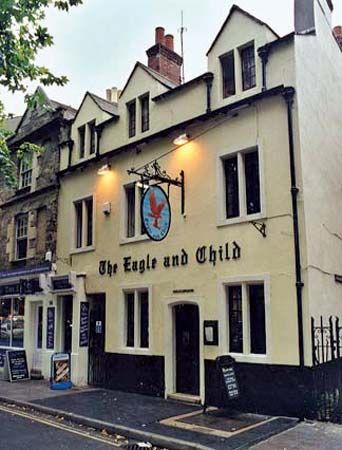
The first main scene of The Lord of the Rings is located in The Ivy Bush, a small inn on the Bywater Road that the Gaffer Gamgee, Sam’s father, likes to frequent. This is no random detail. Hobbit life is built around the enjoyment of food, drink and good company. Tolkien described himself as “a Hobbit (in all but size). I like gardens, trees and unmechanized farmlands; I smoke a pipe and like good plain food.” He might have added his liking for beer, ale and the company of friends. It is no mere accident that some of the finest literary work of the 20th century, work that was wonderfully imaginative, brilliantly critical and profoundly philosophical, arose from The Inklings who used to gather in The Eagle and Child on St Giles’ in Oxford.

The Eagle and Child on St Giles’s in Oxford. It is temporarily closed for a major refurbishment. We are assured that it will be sympathetic. When it reopens I look forward to enjoying its pleasures. Would anyone care to join me there? Perhaps as we enter we could call out, as C.S Lewis used to do, “Any pies today?”

It is no mistake that one of the main things that makes the four hobbits , and especially Merry and Pippin, who set out upon the impossible journey first to Rivendell and then southwards towards Mordor so likeable, is their simple pleasure in food and drink. As Gandalf said of Bilbo and of hobbits in general in The Hobbit, “If more of us valued food and cheer and song above hoarded gold, it would be a merrier world.” It is the possibility of a merrier world that touches so many of the hearts of those who meet Merry and Pippin in their journey, even the glacial hearted Denethor of Gondor. And at this moment of the story as Aragorn, Legolas and Gimli search amidst the debris of battle for signs of their friends it transforms the mere doing of a duty into a passionate and loving self-sacrifice.