“Their Coming Was Like The Falling of Small Stones That Starts an Avalanche in The Mountains”. Gandalf Speaks of the Awakening of the Ents.

The Two Towers by J.R.R Tolkien (Harper Collins 1991, 2007) pp. 646-649

What a gift gentleness is to a world grown weary with the mere exercise of power. And so Merry and Pippin awoke a kindliness within the heart of Boromir the warrior, inflated as he was by fantasies of his own greatness, who sought to gain what he desired by abuse of his strength in the attempt to steal the Ring from Frodo. When Aragorn ordered Boromir to stay with the young hobbits and to protect them as best he could he was simply trying to find some order amidst the chaos of battle and to give himself space to do what he felt that he must do, to find the Ringbearer; but what he gave to Boromir in the giving of that order was the opportunity to find redemption for his failure in the laying down of his life.

This alone would have been sufficient reason for the contested decision to include Merry and Pippin within the Fellowship but Gandalf speaks of more.

“But that is not the only part they have to play. They were brought to Fangorn, and their coming was like the falling of small stones that starts an avalanche in the mountains. Even as we talk here, I hear the first rumblings. Saruman had best not be caught away from home when the dam bursts!”

There are three occasions in which hobbits are captured by orcs in The Lord of the Rings. No other character has to suffer this indignity although Éowyn is threatened with imprisonment by the Witch King of Angmar, the Lord of the Nazgûl. The capture of Merry and Pippin in the breaking of the Fellowship is the first; the second is the capture of Frodo by Shagrat and Gorbag near Shelob’s Lair; and the third the capture of Frodo and Sam by the road to the Black Gate in Mordor. And on each occasion the capture serves only to carry the hobbits nearer to their goal. In the case of Frodo and Sam the goal is known to them. Somehow they must take the Ring to the Fire at Orodruin and they need a road to follow in order to get there. In the case of Merry and Pippin the Uruk-hai of Isengard carry them across the plains of Rohan in order to deliver them at the feet of Treebeard.

There is a delicious irony in this, of course. Gandalf speaks of this to Aragorn, Legolas and Gimli. “Saruman also had a mind to capture the Ring, for himself, or at least to snare some hobbits for his evil purposes. So between them our enemies have contrived only to bring Merry and Pippin with marvellous speed, and in the nick of time, to Fangorn, where otherwise they would never have come at all.”

But there is something further to say in regards to Merry and Pippin. Gandalf again speaks of this to his companions when he tells them that Sauron, as well as Saruman, had tried to capture hobbits and to take them to Barad-dûr, either to retake the Ring or to keep them as hostages. Thankfully Sauron, as well as Saruman, failed to achieve their purpose and Gandalf adds: “Let us not darken our hearts by imagining the trial of their gentle loyalty in the Dark Tower.”

It is the gentleness of the hobbits that proves essential here. On the one hand it is a quality that is entirely disregarded by both Sauron and by Saruman. To them gentleness is merely an expression of weakness. But in delivering this quality to Fangorn the orcs of Isengard awaken the hearts of Treebeard and the Ents to their own destruction. It is gentleness of the young hobbits that delights the Ents, which reawakens them and reconnects them to their essential vocation, that of being shepherds.

The good shepherd lays down his life for the sheep and in their reawakening the Ents are recalled to that duty. Sacrifice is something that the powers of darkness are incapable of doing or even imagining. By this we don’t mean that they are incapable of sacrificing others for their own ends. They do this constantly without giving it a second thought. But they have rendered themselves incapable of any action that even remotely approaches self-sacrifice and so Frodo’s choice to take the Ring to the Fire, Sam’s choice to go with him, Gandalf’s sacrifice of himself in the conflict with the Balrog at the Bridge of Khazad-dûm, Boromir’s sacrifice for the sake of Merry and Pippin, and the sacrifice that Aragorn, Legolas and Gimli make in their hopeless pursuit of the orcs who captured Merry and Pippin, all of these are simply incomprehensible to the dark powers and all of are essential to the ultimate victory of good over evil.
“It Was Not in Vain That The Young Hobbits Came With Us.” Gandalf Speaks of The Fall and Redemption of Boromir.

The Two Towers by J.R.R Tolkien (Harper Collins 1991, 2007) pp. 646-648

“Tell me of yourselves,” Gandalf asked of Aragorn, Legolas and Gimli, and so Aragorn tells the tale of the doings of the Fellowship since Gandalf fell in Moria until their meeting in Fangorn some six weeks later. He tells of their stay in Lothlórien, of the journey down river to Sarn Gebir in the hills of Emyn Muil and then of the sundering of the Fellowship and the death of Boromir.

“You have not said all that you know or guess, Aragorn my friend,” Gandalf replies to Aragorn as he thinks of Boromir. “Poor Boromir! I could not see what happened to him. It was a trial for such a man: a warrior, and a lord of men. Galadriel told me that he was in peril. But he escaped in the end. I am glad. It was not in vain that the young hobbits came with us, if only for Boromir’s sake.”

“A warrior, and a lord of men,” Gandalf says of Boromir, but not a thinker. And in this regard Boromir is different from his father, Denethor. Boromir set out upon the journey to Rivendell because it seemed a heroic enterprise. A dream came many times to Faramir his brother, as Boromir recounted to the Council of Elrond, and once it came to him. Why Faramir did not speak sooner of the dream we are not told. Perhaps he needed time for reflection. But as soon as Boromir had the dream he went straight with his brother to their father and demanded leave to go to Rivendell. Perhaps it required the man of action to put things in motion.

But why did the heavenly powers send the dream in the first place? Why was it necessary to make the link between Minas Tirith and Rivendell? Perhaps the link was meant to be Faramir who, like Aragorn, had been a pupil of Gandalf and who would have understood the need to destroy the Ring and not to use it in war against Sauron. An understanding that he was later to show when he met with Frodo and Sam in Ithilien. But Faramir made the dream a matter for thought and not for action, for understanding and not for deed, a private matter and not for debate and counsel. It was Boromir who instinctively made the connection between the dream and heroic action. The dream spoke of Imladris, of Rivendell, and so a journey had to be made. And perhaps this was a right reading of the dream and of the heavenly mind that sent it. The Council of Elrond was a providential gathering of the free peoples of Middle-earth. Elves, Dwarves, Hobbits and Humankind were represented there and were represented when the Fellowship was chosen to go with the Ring-bearer on his journey to Mordor.

Boromir never understood the necessity of the journey. “Why do you speak ever of hiding and destroying?” he asked of the Council. “Why should we not think that the Great Ring has come into our hands to serve us in the very hour of need?” Perhaps the use of the adjective, Great, was a clue even then of Boromir’s state of mind. Greatness, power and decisive action were all that he could envisage. To hide and to destroy seemed unmanly, even craven. And although when Elrond and Gandalf sought to make it clear to him that the Ring could not be used against Sauron because it was “altogether evil”, Boromir bowed his head and replied, “So be it” his heart never accepted this answer. As a soldier he accepted the orders as they were given by the Council but his heart was never in them. And after Gandalf’s fall when everything was thrown into disarray and into doubt, and when it seemed that Aragorn did not know what action should be taken, whether to go directly to Mordor or to Minas Tirith, Boromir began to think of taking the Ring so that it could be used in battle to do what the only thing that he thought had any importance, the defeat of Sauron.

I suspect that Boromir was ultimately taken by surprise by his own thoughts. Not the thoughts about the need of his people but the fantasies that he was nourishing about his own greatness. When Gandalf and Galadriel were offered the Ring they were able to resist the temptation at least in part because they had brought it from the shadow places within their hearts into the light of conscious thought. Boromir never did that inner work nor thought that work was even of any importance. And so when his desires burst out into the open at the moment he tried to take the Ring from Frodo they took him by surprise. I think that we can see this by his horrified reaction after Frodo escaped from him. And we see his true spirit in the way in which he gave his life for Merry and Pippin. It was because the young hobbits were there and in need that allowed him to declare to himself what he truly was. A warrior, a lord of men, and a man of truth and nobility.

“Naked I Was Sent Back- For a Brief Time, Until My Task is Done.” Gandalf Speaks of The Battle With The Balrog of Moria.

The Two Towers by J.R.R Tolkien (Harper Collins 1991, 2007) pp.653-657

There is much to think about in all that Gandalf speaks of after his reunion with Aragorn, Legolas and Gimli, but this is Eastertide and so we will think about the terrible struggle between Gandalf and the Balrog of Moria, a struggle that ends in Gandalf’s death.

But this story does not end with his death.

“I threw down my enemy, and he fell from the high place and broke the mountain-side where he smote it in his ruin. Then darkness took me, and I strayed out of thought and time, and I wandered far on roads that I will not tell.”

The Lord of the Rings is a story that weaves together both myth and history in a way that would have been familiar to Homer, to Snorri Sturluson or to the poet who wrote the story of Beowulf, but is quite alien to the modern mind. I have read many a commentator on Tolkien’s legendarium who has struggled to present his work as mere history, if such a thing can exist; and so they speak of the inadequacy of Tolkien’s economics for example. And from time to time I come across efforts to discover a historical King Arthur or Robin Hood. Tolkien does something far more interesting and far more exciting. He also does something that is more true than mere history. He is a writer of myth.

And so Gandalf tells of his struggle with the Balrog in a way that the hearers of Beowulf would have grasped immediately. As he tells us of the headlong fall from the Bridge of Khazad-dûm into the icy waters far below the deepest delvings of the Dwarves and then of the ascent to the highest peak of the Misty Mountains we are not invited to ponder the cardiovascular systems of the two combatants even when Gandalf says that the icy waters almost froze his heart. What we are invited into is the great stories that transcend such things, of which our stories are a rich part if we will only understand them as such.

The battle between Gandalf and the Balrog ends with the deaths of them both. But Gandalf is sent back in order that he should complete his task. Tolkien never speaks of God explicitly in The Lord of the Rings, of Eru Ilúvatar as God is named in The Silmarillion. Even now Gandalf does not name the one who sent him back, the one who restored him to life but it is of Ilúvatar he speaks here just as he spoke of him when he told Frodo that both Frodo and Bilbo were meant to have the Ring.

For a time Gandalf lies upon the mountain top, this high place of the earth acting as a kind of threshold between earth and heaven, between the seen world of flesh and blood and the unseen world into which we only catch glimpses from time to time.

“I was alone, forgotten, without escape upon the hard horn of the world. There I lay staring upward, while the stars wheeled over, and each day was as long as a life-age of the earth. Faint to my ears came the gathered rumour of all lands: the springing and the dying, the song and the weeping, and the slow everlasting groan of over-burdened stone.”

Once again there might be some who recognise in Gandalf’s telling of his story a certain similarity to the effects of hallucinogenics. They might be tempted to reduce Gandalf’s tale to just such an experience. But mystics know that it is not necessary to use such substances in order to see something of what Gandalf sees upon the mountain top. Gandalf lives in both myth and history and as he returns to the history of his time and the mighty struggle against Sauron that lies ahead, the task that he has been sent back to complete, he brings with him the mythic world in which he has dwelt entirely for a brief moment and for “a life-age of the earth”. He returns as Gandalf the White, more perilous than any upon earth except, perhaps, the Dark Lord Sauron, with whom he must now do battle.

“I Am Saruman, One Might Say, Saruman as He Ought to Have Been.” We Meet Gandalf The White.

The Two Towers by J.R.R Tolkien (Harper Collins 1991, 2007) pp. 644, 645

We can be sure that if the mysterious old man who climbed up the hill upon which Merry and Pippin first met Treebeard was indeed Saruman we would now be subjected to a very long speech. It would be a speech about his greatness, one intended to fill his hearers with awe, but all Gandalf says about himself and his transformation is to say:

“Yes, I am white now,” said Gandalf. “Indeed I am Saruman, one,might almost say, Saruman as he should have been. But come now, tell me of yourselves!”

When Gandalf was imprisoned by Saruman in Isengard he was subjected to such a speech. “We must have power,” Saruman said, “power to order things as we will, for that good that only the Wise can see.” Saruman was anxious, not only to subject Gandalf to his will but to convince him that he had the right to be the Lord of the Rings and thus Lord of Middle-earth.

From the beginning of the mission of the Istari, the wizards, to Middle-earth, Saruman was anxious that he should be its leader. And when with Gandalf, Galadriel and Elrond he formed the White Council, a council of the Wise to oppose Sauron, he insisted that he should be its leader even though Galadriel argued that the leader ought to be Gandalf.

Although Gandalf never sought power for himself Saruman was always jealous of him and looked for ways to undermine the one who he believed to be his rival. So he made fun of Gandalf’s affection for hobbits and the Shire while beginning to forge links between the Shire and Isengard; and he mocked Gandalf’s enjoyment of pipe-smoking and of pipeweed, while secretly learning the art himself and purchasing the best of Longbottom leaf from Lotho Sackville-Baggins who became his agent in the Shire.

But most importantly of all Saruman believed that Gandalf was his rival in seeking to find and to take possession of the Ring. Like Sauron he was convinced that if anyone of sufficient strength were to find the Ring they would claim it for themselves and use it to become the ruler of all. And he became convinced that Gandalf was trying to find the Ring just as he was so that he should become lord of all and that when he began to suspect that the Ring was hidden in the Shire that the same hobbits who he had despised were being used for some obscure purpose in Gandalf’s plot.

All Saruman’s suspicions were, in his mind, confirmed when he and Gandalf met once again in Isengard after the Battle of Helm’s Deep. Gandalf demands that Saruman surrender the Key of Orthanc to him and his staff as pledges of Saruman’s good conduct and to be returned later to him if he should once again merit them. Saruman responded to Gandalf’s demand with undisguised rage.

“Later!” he cried, and his voice rose to a scream. “Later! Yes, when you also have the Keys of Barad-dûr itself, I suppose; and the crowns of seven kings, and the rods of the Five Wizards.”

Saruman was utterly convinced that Gandalf desired what he himself did, that Gandalf was his rival and therefore his enemy. And perhaps he feared that he was his enemy’s inferior, that Gandalf possessed a power that he himself lacked, and that he needed to surround himself with a fortress, an army and all the trappings of power in order to be what Gandalf was, in himself, alone, vulnerable and homeless in the world. And so he became unsatisfied with his white robes and made a coat of many colours for himself. There is a sense in which he gave up his white robes quite voluntarily having become unsatisfied with what they represented, that is that he was an emissary of the Valar in Middle-earth. That these robes should be given to Gandalf, the very one that he feared and hated most, only confirmed what he always believed, that Gandalf desired to rule just as he did.

What he had forgotten, indeed despised, was that his power and status did not belong to him but had been given to him in order that he might be an emissary of the Valar in Middle-earth. His task was to do the bidding of his masters and so when he proved unfaithful in doing that task his masters stripped him of his robes and gave them to one who would do their bidding. Gandalf is now the White, Saruman as he should have been.

“Gandalf! Beyond all Hope You Return to Us in Our Need!”

The Two Towers by J.R.R Tolkien (Harper Collins 1991, 2007) pp. 640-645

This is a wonderful piece to write on Tolkien Reading Day, the day on which the Tolkien Society encourage us to read favourite passages from his work. This is one of my favourite passages and I would love to hear from you in the Comments below about the passages that you choose to read this day. Of course, Tolkien would have marked this day in his own life by going to Mass to celebrate the Feast of the Annunciation, the news from the angel to Mary that she would conceive and bear a child who would be the Saviour of the World. He meant us to weave together in our minds the downfall of Sauron and this good news.

As Aragorn and his companions enter the Forest of Fangorn in search of Merry and Pippin, following the same stream that the young hobbits had two days before, Gimli becomes aware that their task is practically impossible. They have insufficient supplies to do more than starve with the young hobbits even if they find them.

“If that is indeed all that we can do, then we must do that,” said Aragorn. “Let us go on.”

Aragorn has been aware of the impossibility of their task since its beginning. It was Éomer who commented that Aragorn must know little of orcs if he hunted them in the fashion that he did. Aragorn knew that it was unlikely that he would catch up with the orc band and if they did they would likely perish in the attempt to rescue their friends. And even before this he had little hope. “We must do without hope,” he said to the Fellowship immediately after the fall of Gandalf at the Bridge of Khazad-dûm and ever since that moment Aragorn has gone on in a state of grim despair until this moment when he knows that it is likely that he has come to Fangorn to die.

The three companions climb the same rock shelf upon which Merry and Pippin met Treebeard two days before and it is from there that they see an old man moving through the woods below them. At first they are convinced that this must be Saruman until the wonderful moment of revelation and of recognition comes.

“”Mithrandir!” Legolas cries out in joy, firing an arrow into the air that bursts into flames as it flies. “Gandalf!” cries Aragorn “Beyond all hope you return to us in our need!”

This moment of revelation, of a renewing of hope, is one of many that come through the story, each one enabling the members of the Fellowship to take the next steps towards the completion, the fulfilment of their journey, until Gollum takes the Ring to the Fire and Sauron falls at last on March 25th in the year 3018 of the Third Age of Arda.

This moment is, as Gandalf says to the three hunters, a turning of the tide. “The great storm is coming,” he says, “but the tide has turned.” And from this point onwards, although Aragorn, Legolas and Gimli will face many dangers they will face each one with a flame of hope burning in their hearts. The return of Gandalf is one of the great moments of eucatastrophe, “when the sudden ‘turn’ comes we get a piercing glimpse of joy, and hearts desire, that for a moment passes outside the frame, rents indeed the very web of story, and lets a gleam come through.”

These thoughts came from a lecture that Tolkien gave in Oxford in 1938 that he entitled, On Fairy-Stories. In the lecture Tolkien explicitly linked the “sudden ‘turn'” with the Christian Story, the story that he convinced C.S Lewis is “the true myth”, the story that means that all the glimpses of joy that we experience in the reading of fairy-stories and the great myths are not mere wishful thinking but true. All point to the birth of Christ, the moment about which the angel spoke to Mary, as the eucatastrophe of the history of humankind.

Tolkien never wrote explicitly about this in his own stories. He allowed the glimpse of joy as in this moment of joyful revelation when Gandalf is restored to his friends to do its own work in the hearts of his readers, leading all of them towards the true myth to which all myth bears witness.

“It is Old, Very Old,” Said The Elf. Legolas In The Forest of Fangorn.

The Two Towers by J.R.R Tolkien (Harper Collins 1991, 2007) pp. 639, 640

A few years ago I was taking the road through the Savernake Forest on a regular basis as I drove down to Salisbury in the county of Wiltshire in England to see my mother in the last days of her life. In England, when you see the name, Forest, attached to a particular place it will often mean an area of land set apart for hunting by the Norman conquerors of this land nearly a thousand years ago and so, for example, the New Forest in the south of England was new when the Normans first came in the 11th century but it is old now. Savernake Forest is of a similar age and standing by the side of the road is a an ancient oak tree that first took root around the time that William the Conqueror first established his realm here.

As Legolas enters the Forest of Fangorn with his companions, Aragorn and Gimli, in search of Merry and Pippin, it is the oldness of the forest that he feels.

‘”It is old, very old,” said the Elf. “So old that I almost feel young again, as I have not felt since I journeyed with you children. It is old and full of memory. I could have been happy here, if I had come in days of peace.”‘

It is this quality of oldness that can cause us to reassess our place in the scheme of things. I have sometimes seen this in the relationship between an old man and a young boy, a grandfather and grandson, noting the particular quality of attentiveness that they give to one another. Perhaps my favourite literary relationships are between old men and young boys, Dumbledore and Harry Potter, Merlin and the young Arthur, Gandalf and Frodo, teachers and eager pupils. And it is possible to make a relationship with a particular tree as well. I remember once taking shelter in woodland on a stormy day and finding great comfort in the presence of an ancient tree that stood so confidently as its branches swayed in the wind. I still go to seek out that tree from time to time just to feel its strength and feel the need to do so, once again, even as I write this.

And then there are certain places that have the capacity, somehow, to hold you because of their age. Old churches can have such a capacity. A memory that still holds me is of walking with my father through spring woodland on our way to church when I was a small boy. It is the memory of the presence of my father, a rare treat, the bluebell covered woodland floor, and the particular beauty of the church, at least as I saw it then, that has this quality of holding. I picked bluebells to give to my mother on my way home. No one had ever told me not to pick wild flowers and so I did so in complete innocence. The day was perfect.

Early memories of old churches also mean singing Evensong according to the 1662 Book of Common Prayer of the Church of England. I will join a congregation in an ancient country parish church this Sunday evening for the same service and anticipate happily the same quality of inner quiet that I found back then as a small boy with my treble voice. My personal copy of the Prayerbook was given me by my grandmother, who was born in reign of Queen Victoria, and who held my elder daughter on her lap in the last year of her life. If my daughter lives to a similar age that will mean almost two centuries of the life of our family connected in that moment by just two lives. That thought too has the capability of holding me if I pay attention to it

.

It is this quality of being held, of being young again in the presence of great age, of the feeling of safety, of rootedness in something much greater than oneself that Legolas feels as he enters the Forest of Fangorn even amid the seeming impossibility of finding Merry and Pippin and so Gimli is comforted too.

“That at Least is Enough to Show That He Was a Hobbit.” Aragorn, Legolas and Gimli Search for News of Their Friends.

The Two Towers by J.R.R Tolkien (Harper Collins 1991, 2007) pp. 636-639

When Gimli awakes under the eaves of Fangorn, with his “very bones” chilled, after the night in which the strange visitor came to the camp and the horses loaned to the three hunters ran away, Merry and Pippin are spending the day together with Bregalad as Entmoot continues. The young hobbits are safe in the care of the Ents although Aragorn, Legolas and Gimli could not possibly know this. Indeed Gimli, at least, still regards Fangorn Forest as a place of threat and menace and not, as we have learned, as a place of refuge and kindly welcome to those who are fleeing from danger.

We know that there is little possibility that the hunters will find Merry and Pippin, at least at this point in the story, but they are resolved to continue the search until either they find them or fail, even perish, in the attempt.

The search for clues begins close to the site of the battle in which Éomer’s company first surrounded, and then wiped out, the orcs who were taking Merry and Pippin to Isengard, and it is Aragorn, the greatest tracker of the age, who makes the first find.

“‘Here at last we find news!’ said Aragorn. He lifted up a broken lead for them to see, a large pale leaf of golden hue, now fading and turning brown.”

It is one of the mallorn-leaves of Lórien in which the elves had carefully wrapped the gift of lembas, the waybread that proves so important in sustaining the travellers, especially Frodo and Sam, upon their journey. And there are other signs nearby. One is the presence of lembas crumbs, another the cut cords of the bonds that had held Merry and Pippin, and the other the orc blade that Pippin had used to cut Merry’s bonds.

Legolas is perplexed by the strange tale that these signs seem to tell but Aragorn is able to interpret their meaning. As we know Pippin had been able to free his hands earlier in the forced march across the plains of Rohan. We know too that Grishnákh had tried to escape the battle carrying Merry and Pippin one under each arm in the hope that he could take them to Mordor and claim a reward for bringing a prize to the Dark Lord that Saruman had clearly coveted so much. And we know that Grishnákh was discovered and then killed by the Rohirrim who were not able to discover the hobbits because they were wearing their elven cloaks.

And there is a further detail about which all the companions are able to agree. It is clear that before they continued their journey, one, or as Aragorn guesses and hopes, both of the hobbits sat down to eat a meal of lembas.

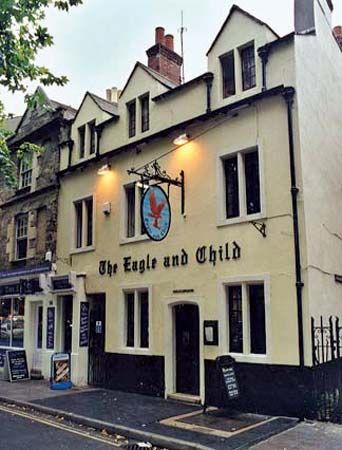
The first main scene of The Lord of the Rings is located in The Ivy Bush, a small inn on the Bywater Road that the Gaffer Gamgee, Sam’s father, likes to frequent. This is no random detail. Hobbit life is built around the enjoyment of food, drink and good company. Tolkien described himself as “a Hobbit (in all but size). I like gardens, trees and unmechanized farmlands; I smoke a pipe and like good plain food.” He might have added his liking for beer, ale and the company of friends. It is no mere accident that some of the finest literary work of the 20th century, work that was wonderfully imaginative, brilliantly critical and profoundly philosophical, arose from The Inklings who used to gather in The Eagle and Child on St Giles’ in Oxford.

The Eagle and Child on St Giles’s in Oxford. It is temporarily closed for a major refurbishment. We are assured that it will be sympathetic. When it reopens I look forward to enjoying its pleasures. Would anyone care to join me there? Perhaps as we enter we could call out, as C.S Lewis used to do, “Any pies today?”

It is no mistake that one of the main things that makes the four hobbits , and especially Merry and Pippin, who set out upon the impossible journey first to Rivendell and then southwards towards Mordor so likeable, is their simple pleasure in food and drink. As Gandalf said of Bilbo and of hobbits in general in The Hobbit, “If more of us valued food and cheer and song above hoarded gold, it would be a merrier world.” It is the possibility of a merrier world that touches so many of the hearts of those who meet Merry and Pippin in their journey, even the glacial hearted Denethor of Gondor. And at this moment of the story as Aragorn, Legolas and Gimli search amidst the debris of battle for signs of their friends it transforms the mere doing of a duty into a passionate and loving self-sacrifice.

“O Rowan Dead, Upon Your Head Your Hair is Dry and Grey.” Quickbeam the Ent Teaches Us the Power of Lamentation.

The Two Towers by J.R.R Tolkien (Harper Collins 1991,2007) pp. 628-631

I have never known any fully mature rowan-trees and so sadly have never encountered in my own experience the description that Bregalad, or Quickbeam as he is called in the Common Tongue, gives of the mighty trees of his youth.

“And these trees grew and grew, till the shadow of each was like a green hall, and their red berries in the autumn were a burden, and a beauty and a wonder.”

A rowan-tree crowned in glory.

I may not have met a fully mature rowan-tree but I do share Bregalad’s love of the rowan and its beauty and I have enjoyed watching birds flock to them later in autumn as other sources of food begin to run scarce. It is a tree that sustains them well into winter and itt is a good tree to plant and grow in a town garden or to see upon a woodland walk in the country.

Merry and Pippin are introduced to Bregalad by Treebeard towards the ending of the first day of Entmoot.

“Are you getting weary, or feeling impatient, hmm, eh?” Treebeard asks. “Well I am afraid that you must not get impatient yet?” This is still only the first day of deliberations that will take three days to conclude. Bregalad has already made up his mind about what to do and needs no more debate and so he is given the task of looking after the young hobbits until all is done.

“I am Bregalad, that is Quickbeam in your language. But it is only a nickname, of course. They have called me that ever since I said yes to an elder Ent before he had finished his question. Also I drink quickly, and go out while some are still wetting their beards.”

The quickness that Merry and Pippin experience in Quickbeam, and which they delight in, is a quickness to sing and to laugh. The very last time we see the friends at the end of The Lord of the Rings as they bid farewell to Sam is as they go off together singing. Bregalad is of the same spirit and so he laughs when the sun comes out from behind a cloud and he laughs whenever he meets a spring or a stream but his singing is subtly different whenever he meets a rowan-tree. He halts a while “with his arms stretched out” and he sings and sways as he sings.

Bregalad is a lover in the sense that he delights in life, and he delights in the life of the forest in particular, and especially in rowan-trees amidst the life of the forest. He takes pleasure in the being-ness of rowan-trees, in the simple fact that they are, and he expresses his delight in his singing. He sings his joy in the beauty of these trees.

O rowan fair, upon your hair how white the blossom lay!
O rowan mine, I saw you shine upon a summer's day,
Your rind so bright, your leaves so light, your voice so cool and soft:
Upon your head how golden-red the crown you bore aloft!

This is a song of praise for the glory of a fellow creature but his song does not end with praise but with lamentation. If, in Derndingle where the Entmoot meets, the mood is of growing anger which will eventually spill forth in songs of war, songs in which Bregalad will join, the mood of the song that he sings to Merry and Pippin is one of the deepest sadness.

O rowan dead, upon your head your hair is dry and grey;
Your crown is spilled, your voice is stilled for ever and a day.

It is not only anger that rouses the Ents against the wanton destruction of Saruman and of the orcs of Isengard but sadness also. And the sadness goes deeper than the anger. With their anger the Ents will “split Isengard into splinters and crack its walls into rubble” but with the sadness that they sing in songs of lament they will labour to heal the land, to renew Fangorn and also to rebuild Isengard making it a place of beauty once again, a place in which earth, air, fire and water can live together in harmony with one another and in which living things that grow and which sustain life can thrive. Bregalad teaches us that we need more than anger if we are to transform the earth. There are other songs to sing than songs of war.

“It is Likely Enough… That We are Going to Our Doom: The Last March of The Ents.” The Ents Go to War at Isengard.

The Two Towers by J.R.R Tolkien (Harper Collins 1991, 2007) pp.623-635

The night that Merry and Pippin spend in Wellinghall is the first since they escaped from the Orcs and the first that they have had in a home, a place of safety, since leaving Lothlórien, and so they sleep long and refreshingly.

Treebeard takes them to Entmoot, the council in which the Ents will deliberate what course of action they must take.

“Deciding what to do does not take Ents as long as going over all the facts and events that they have to make up their minds about”, Treebeard says to the hobbits, and he estimates that this will take a couple of days or so. He sends Merry and Pippin off with a younger Ent called Bregalad or Quickbeam who has already made up his mind about what should be done and the hobbits spend those days in his company as the Moot continues.

It is on the third day, a bleak and windy day, in the afternoon, that all falls silent and then with a great crash and the quivering and bending of the trees that the Ents march towards them.

We come, we come with roll of drum: ta-runda runda runda rom!”

The Ents are marching to Isengard and to war.

It is through Merry that we learn something about Isengard. Merry is the organiser of the four hobbits, the original company of the Ring that left the Shire some months before these events. He organised the purchase of Crickhollow in Buckland, and, as the real reason why Frodo is leaving Hobbiton became clear it is Merry who made secret preparation for leaving the Shire. He is rather proud that while Pippin spent his days in Rivendell idling away the time he tried to find out as much as he could about what might lay ahead.

“Isengard is a sort of ring of rocks or hills, I think, with a flat space inside and an island or pillar of rock in the middle, called Orthanc. Saruman has a tower on it. There is a gate, perhaps more than one, in the encircling wall, and I believe there is a stream running through it; it comes out of the mountains, and flows on across the Gap of Rohan.”

Orthanc is not Saruman’s work but much older having been built by the Númenorians in the days of Elendil. It was a sign of their decline that during the first part of the Third Age it became a lawless place far from the authority of Minas Tirith and a thorn in the side of the new kingdom of the Rohirrim who had settled in the plains of Calenardhon that lay between the southern end of the Misty Mountains to the north and the mountains of Gondor to the south. So it was that when Saruman took possession of Isengard in 2759 of the Third Age both the Steward of Gondor and the King of Rohan welcomed him gladly seeing him as a valuable ally who would watch over the strategically vital Gap of Rohan.

It would seem that Saruman was able to keep his true intentions secret right until the moment he took Gandalf prisoner during the time in which Frodo was making preparations to leave first Hobbiton and then the Shire, although Treebeard seems to have been aware of these intentions for some time and the presence of orcs in Isengard. Even after going to war with Rohan Saruman was able to keep Théoden from making a strong response through the efforts of Grima Wormtongue his chief counsellor who was able to convince Théoden that Saruman’s true wish was for peace.

It is with the arrival of Merry and Pippin in their pure, gentle and artless simplicity that the dam finally bursts and the slowly simmering anger of the Ents finally comes pouring out of Fangorn and down to Isengard. It is as if Nature herself finally rises up against the powers that would destroy her. But even as the Ents march upon Isengard and upon Saruman Treebeard is aware that Nature may fail, that it is “likely enough that we are going to our doom: the last march of the Ents”. But, he adds, “if we stayed at home and did nothing, doom would find us anyway, sooner or later”. The possibility that disenchanted Nature could yet reawaken and rise against a world of “metal and wheels” was something that the Inklings pondered both through the character of Merlin in C.S Lewis’s That Hideous Strength and through Treebeard in The Lord of the Rings. Tolkien allows such a revolt to take place but recognises the heartbreaking fragility of Nature that may yet fall before the walls of Isengard and before technology.

“Come Back to Me! Come Back to Me, and Say My Land is Best!” The Search of the Ents for The Entwives.

The Two Towers by J.R.R Tolkien (Harper Collins 1991, 2007) pp. 618-623

After Treebeard calms down following the outbreak of his rage against Saruman he begins to ponder how large a company of Ents he might be able to gather together to launch an attack upon Isengard. His hope is that he will be able to get together a “fair company of our younger folks” but, he laments, “what a pity there are so few of us”.

Pippin wonders why this should be so when the Ents have lived in Fangorn Forest for so many years. “Have a great many died?” he asks.

“Oh, no!” said Treebeard. “None have died from inside, as you might say. Some have fallen in the evil chances of the long years, of course; and many more have grown tree-ish. But there were never never many of us and we have not increased. There have been no Entings- no children, you would say, not for a terrible long count of years. You see, we lost the Entwives.”

Treebeard’s story is the story of a breakup of a marriage. But not just between the two folk who once pledged their troth to one another but between the males and females of an entire species. And, we might say, between nature and culture themselves.

For with his sub creation of the Ents Tolkien has given us a race of creature in which the masculine and feminine principles seem to reside completely within the males and females of their race. Now we know this is not the case with human beings. In us there are feminine qualities in men and masculine qualities in women and, indeed, there are those who argue that one of our most important tasks in life is to bring these into unity with one another within us after having become clear which gender we are, whether we are male or female.

But in the Ents Tolkien gives us something different and in so doing he speaks of the nature of all growing things. As Treebeard puts it of the Ents, “they gave their love to things that they met in the world”. They loved “the great trees, and the wild woods, and the slopes of the high hills; and they drank of the mountain-streams, and ate only such fruit as the trees let fall in their path.” The Ents gave their love entirely to that which is wild and uncultivated. The Entwives, on the other hand, were in love with gardens. They “desired order, and plenty, and peace” Treebeard says. And then he adds, somewhat acerbically, that “they meant that things should remain where they had set them.”

We have been thinking in this blog of Treebeard’s home, Wellinghall, in the last couple of weeks of postings. We have seen that there is no clear delineation between the world outside his home and that within it. If there are walls then it is the trees of the forest that are those walls. The streams of the Entwash arise from the ground within the house and flow through it and there is no roof that lies between Treebeard and the open sky. He is content to live within weather and not to protect himself from it just as the trees of the forest do. He has no gardens in which he cultivates food. He is a gatherer and, most certainly not a hunter.

As he later remarks, Treebeard thinks that the Entwives would like the Shire because hobbits are gardeners. Indeed, as Frodo remarked to Galadriel, gardeners are held in high honour within that land and it is the name that Sam Gamgee will give to his family as they rise in honour in the Shire. Indeed I wonder if it might have been an Entwife that Sam thought he saw and which he tried to describe to Ted Sandyman in their argument in the pub at the beginning of The Lord of the Rings. Tom Bombadil is a gardener who lives at the edge of the Old Forest and he is contentedly married to Goldberry the daughter of the river although periods of separation from one another seem to keep that marriage fresh.

As we are left wondering whether there can be a reconciliation between the worlds of the forest and of the garden, between the Ents and the Entwives. In the song that the Elves made and which Treebeard sings the hope of a reconciliation is given but it is one that can only be achieved, it would seem, after catastrophe when the Ents and Entwives walk together into something entirely new. And can the forest and the garden do the same?

Together we will take the road that leads into the West,
And far away will find a land where both our hearts may rest.